Artwork
Madonna della tenda
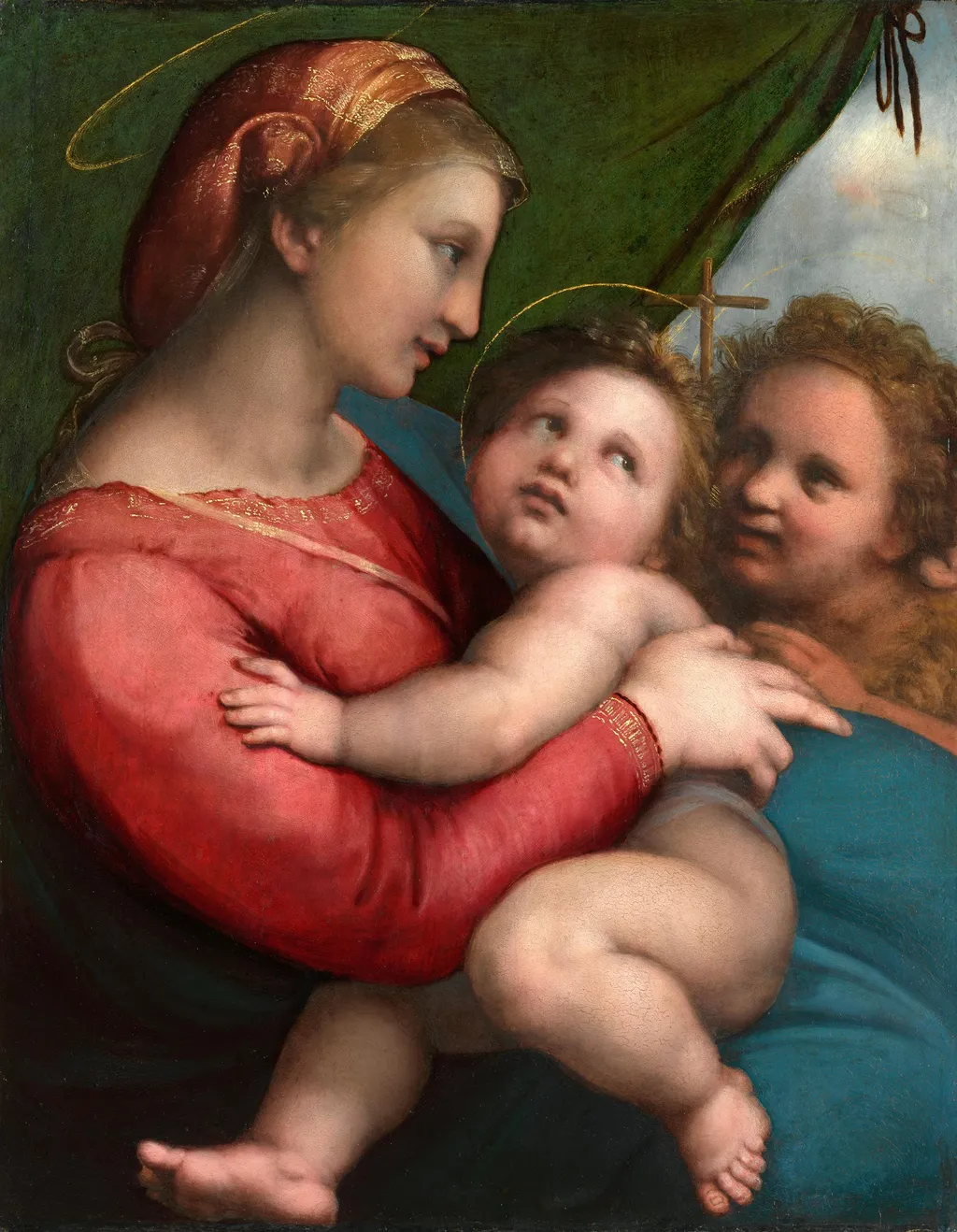
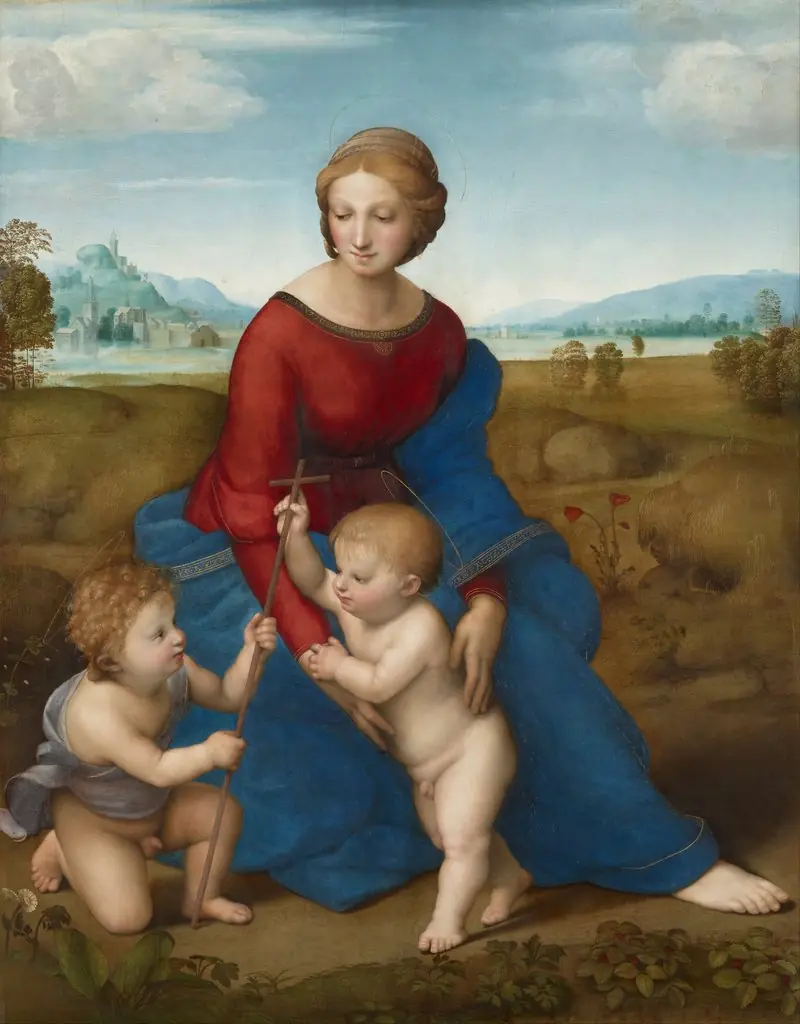
Madonna della tenda is an oil painting by the High Renaissance artist Raphael. It dates from 1513 and is held in the collection of the Alte Pinakothek.
About this work
Subject & Meaning
Mary is shown in profile, draped in a red robe with gold edging, while the Child gazes toward John, whose cross-staff and aureole intersect the figures' halos.
The work portrays the Virgin Mary holding the infant Christ, with the youthful Saint John the Baptist positioned nearby, observing the pair. Mary is shown in profile, draped in a red robe with gold edging, while the Child gazes toward John, whose cross-staff and aureole intersect the figures' halos. A heavy curtain forms the background, giving the painting its name and creating a staged, intimate setting.
The composition reflects a pyramidal arrangement influenced by Leonardo's studies, emphasizing the human connection between mother and child and a quiet devotional intimacy. These elements combine Marian devotion with a tender, familial narrative, underscoring the sacred bond and the presence of the saint.
Technique & Style
The Madonna della tenda is an oil painting executed on a poplar panel support. Created circa 1513–1514, the work measures 65.8 cm in height by 51.2 cm in width. Stylistically, the composition features a pyramidal arrangement of figures that reflects the influence of Leonardo da Vinci.
A dark curtain serves as the background, partially drawn aside to reveal a glimpse of sky and the figure of the young John the Baptist.
The painting depicts the Virgin Mary in a red robe with gold-bordered trim, embracing the Christ Child, who turns to look at the Baptist. The figures are illuminated by golden halos, with the Baptist's cross positioned at the intersection of their halos. While the work shares design similarities with the Madonna della seggiola, it introduces a dynamic interaction between the three figures rather than an isolated intimacy.
Poor conservation conditions have at times led to doubts regarding the work's autography, with some critics previously attributing it to Domenico Alfani after Raphael's design.
History & Provenance
The Madonna della tenda is dated to circa 1513–1514, with one source giving 1514. It is generally linked to the Madonna della Seggiola as a closely related variant, though critics have debated which came first. The panel originally belonged to the Spanish Royal Collection and was housed at the Royal Monastery of San Lorenzo de El Escorial, where it is recorded in a 1793 description by Conca.
It was stolen during the Peninsular War, and in 1813 the painting was taken to England by the dealer William Buchanan, who sold it the following year to King Ludwig I of Bavaria. It subsequently entered the Bavarian court collections and is now held by the Bavarian State Painting Collections at the Alte Pinakothek in Munich. Its attribution to Raphael has occasionally been questioned on conservation grounds, Cavalcaselle attributed it to Domenico Alfani after a Raphael design, while Ortolani considered it autograph.
Two copies of the composition are recorded: one in the Galleria Sabauda in Turin (catalogue 1964, no. 146) and another in the Gallery of the Academy of Fine Arts in Vienna (Inv. no. 240).
Context
Scholars consider the Madonna della tenda a deliberate variation of Raphael's roughly contemporary Madonna della seggiola, though critics debate whether it preceded or followed that related work. The painting's poor condition has repeatedly prompted questions regarding its attribution. While some scholars, such as Ortolani, defended Raphael's direct authorship, others, like Cavalcaselle, argued it was executed by Domenico Alfani based on a Raphael design.
Art historically, the work is recognized for emphasizing the intimate, human relationship between mother and child, a recurring theme in Raphael's oeuvre. Its pyramidal structure reflects the influence of Leonardo da Vinci. Unlike the Madonna della seggiola, this composition incorporates the young John the Baptist, which breaks the earlier work's emotional isolation and reduces direct engagement with the viewer.
Scholars view the painting as a significant document of Raphael's continuous search for renewed forms of harmony and beauty through compositional variation.
Overview
Raphael's Madonna della tenda, an oil on panel painting from approximately 1513–1514, is a notable work of the Italian Renaissance. This composition features the Virgin Mary tenderly holding the Christ Child, while the young John the Baptist observes them. The artwork exemplifies Raphael's characteristic approach to devotional subjects, presenting a scene of intimate familial warmth.
Own this work as a print
Artist & collection
Artist
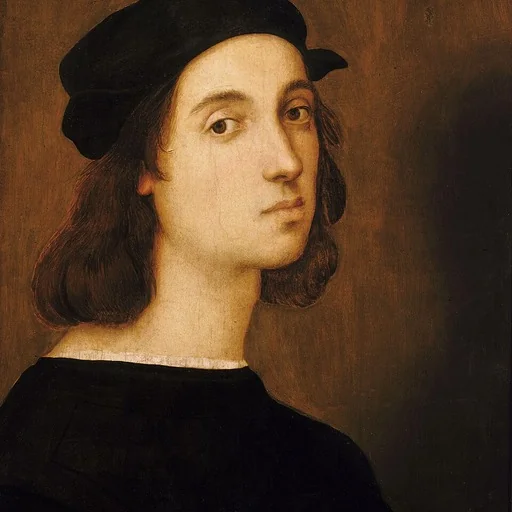
Raphael was born Raffaello Sanzio in Urbino on April 6, 1483, the son of Giovanni Santi, a painter and poet attached to the ducal court.