Artwork
Madonna with the Fish
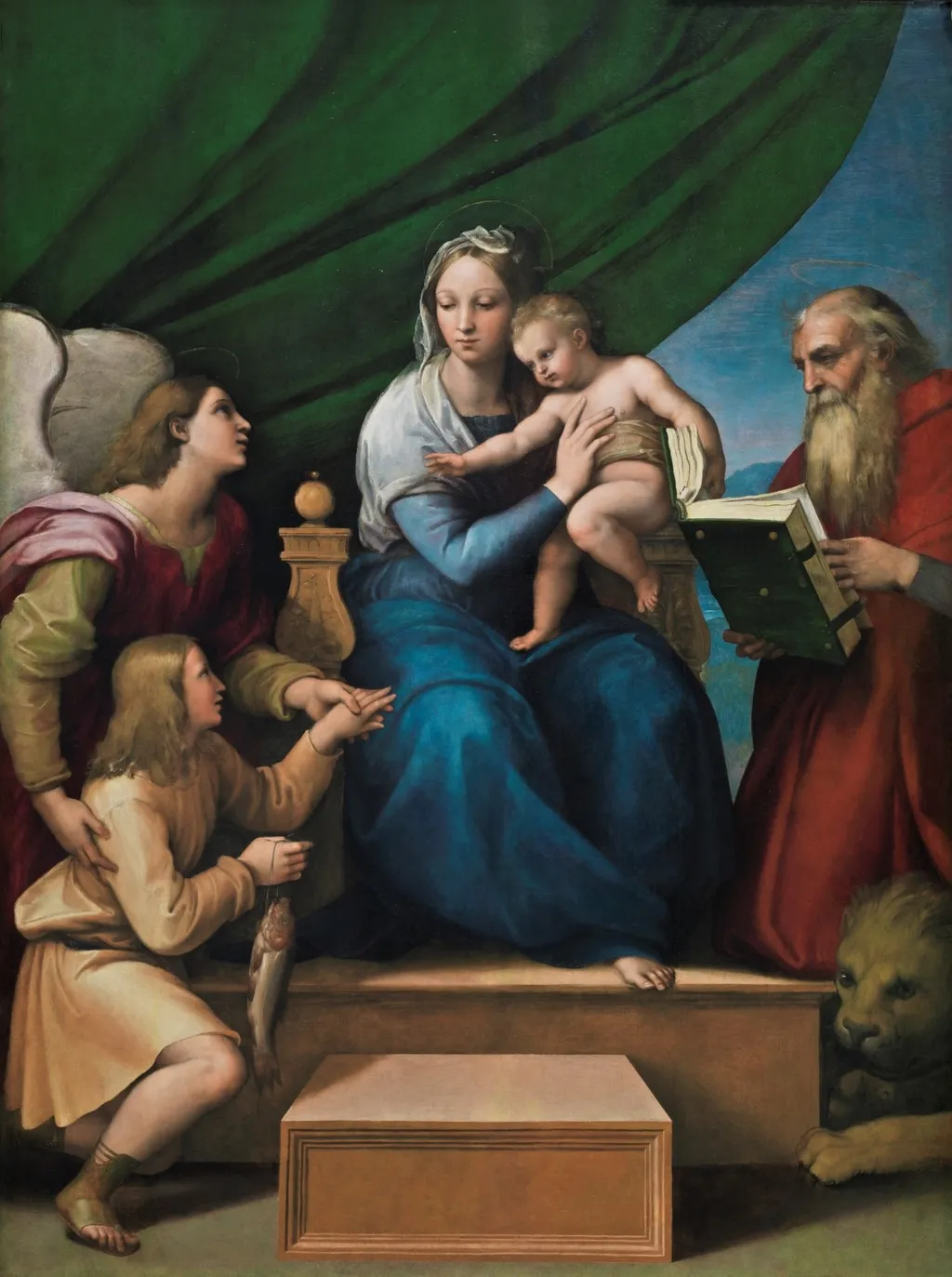
Madonna with the Fish is an oil painting by the High Renaissance artist Raphael. It dates from 1513 and is held in the collection of the Museo del Prado.
About this work
Subject & Meaning
The fish references the Book of Tobit, where its organs cured Tobias's blind father and drove away demons, serving as an early symbol of baptism and Christ.
The painting depicts a sacred conversation centered on the enthroned Virgin Mary holding the Christ Child. Flanking them are Saint Jerome, dressed as a cardinal and kneeling beside his attribute, a lion, while holding his Latin Vulgate Bible; and the Archangel Raphael presenting the young Tobias, who holds a miraculous fish. The fish references the Book of Tobit, where its organs cured Tobias's blind father and drove away demons, serving as an early symbol of baptism and Christ.
Saint Jerome's presence connects to his translation of the Book of Tobit, while the fish and the river in the background reinforce themes of spiritual cleansing. Art historians interpret Tobias as a prefiguration of the Christian neophyte guided by a guardian angel before the Savior. The composition suggests a doctrinal link between the Child's gesture toward the book and the inclusion of the Book of Tobit in the canonical scriptures.
Technique & Style
Executed in oil paint, the work was originally created on a wooden panel before being transferred to canvas during a restoration in Paris between 1813 and 1822. This transfer altered the original textures and colors, complicating precise technical analysis. The painting measures 215 by 158 cm and features a composition built on triangular and rectangular forms, echoing the spatial dynamics of Raphael's Vatican frescoes.
While the design is attributed to Raphael, art historians note that assistants likely executed significant portions, with the figures of the Virgin and Saint Jerome showing the master's hand while elements like the lion are considered of modest quality. The background consists of a dark, draped curtain partially revealing a hilly landscape and water, creating a unified emotional atmosphere through a network of tender gazes.
History & Provenance
The work was commissioned by Giovanni Battista del Doce for a private chapel of Santa Rosa da Lima at San Domenico Maggiore in Naples, where it remained until 1638. That year it was acquired by the Spanish viceroy of Naples, Ramiro Núñez de Guzmán, duke of Medina de las Torres, and entered the Spanish royal collection on behalf of Philip IV. It was moved to the Escorial in 1644–45 and later transferred to the Museo del Prado, where it has been conserved since.
The painting is dated by modern scholarship to about 1513–14 and is associated with Raphael's workshop practice, including contributions by Giulio Romano and Giovan Francesco Penni. In 1813 it was removed to Paris by Napoleonic forces and transferred from its original panel to canvas during this period.
Originally executed on panel, the work was transferred to canvas in 1813 while in Paris under Napoleon's forces, before returning to Spain in 1822. Preparatory drawings related to the composition are preserved in the Uffizi in Florence and the National Gallery of Scotland in Edinburgh.
Context
The Madonna with the Fish is firmly situated within Raphael's High Renaissance output and is generally considered a collaboration with members of his workshop. Scholars including Tom Henry and Paul Joannides, in the context of the 2012 exhibition The Last Raphael, attribute the overall design to Raphael but regard the figure of the lion as modest in quality, suggesting that most of the execution was carried out by assistants, with only the faces of the Virgin and Saint Jerome convincingly in the master's own hand. The French-language tradition similarly credits Giovan Francesco Penni and Giulio Romano with portions of the work.
Stylistically, the painting's chromatic richness and its triangular and quadrangular compositional geometry have been linked to the Stanza di Eliodoro frescoes in the Vatican Apostolic Palace. The composition also exerted influence beyond Raphael's circle: Girolamo da Carpi produced a Virgin and Child with Tobias, the Archangel and Saint Jerome clearly inspired by it, and Étienne-Frédéric Lignon engraved a faithful reproductive print.
Legacy
The composition achieved significant recognition, evidenced by numerous copies created for locations including Naples, Valladolid, and El Escorial. Its visual schema directly influenced Girolamo da Carpi, who produced a work explicitly inspired by the painting's precise arrangement. The image was further disseminated through high-fidelity engravings, such as a print by Étienne-Frédéric Lignon and later steel plates by Pierre Pelée illustrating books on Raphael's Virgins.
Art historical analysis frequently links the work's masterful color and geometric complexity to Raphael's frescoes in the Stanza di Eliodoro. Modern scholarship often attributes the execution to workshop assistants like Giovan Francesco Penni and Giulio Romano under Raphael's design, noting that the transfer from panel to canvas in the early nineteenth century altered its original texture.
Overview
Raphael's oil painting, 'Madonna with the Fish,' created between 1513 and 1514, is a significant work of the High Renaissance, now located in the Museo del Prado, Madrid. It depicts the Virgin Mary enthroned with the Christ Child, flanked by Saint Jerome and the Archangel Raphael, who presents the young Tobias. The artwork is renowned for its balanced composition and rich narrative detail.
Own this work as a print
Artist & collection
Artist
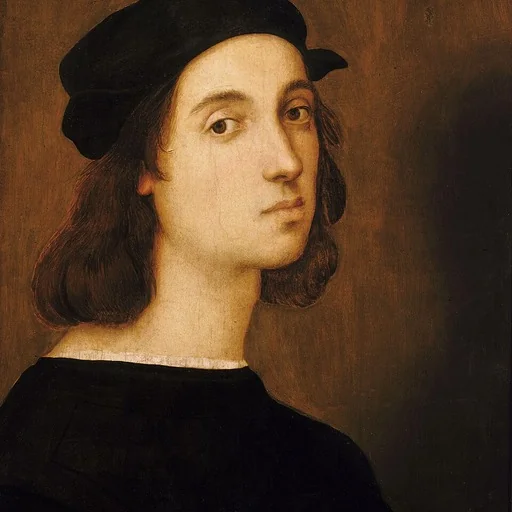
Raphael was born Raffaello Sanzio in Urbino on April 6, 1483, the son of Giovanni Santi, a painter and poet attached to the ducal court.

- Virgin of the Stairs
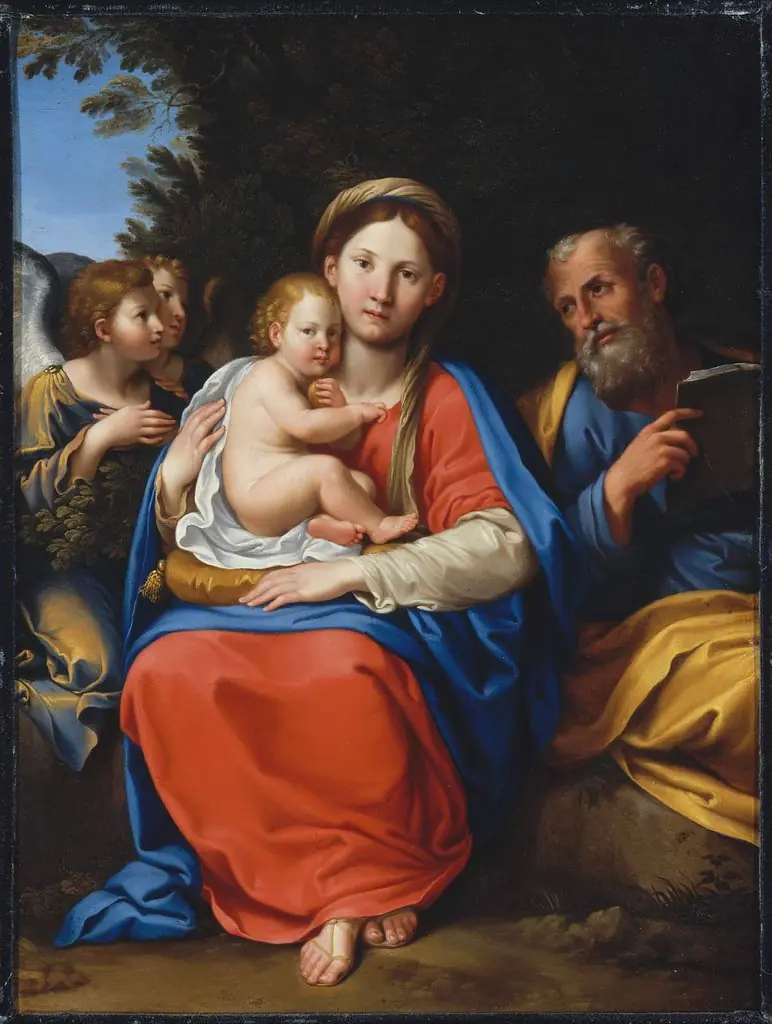 Holy Family with Angels
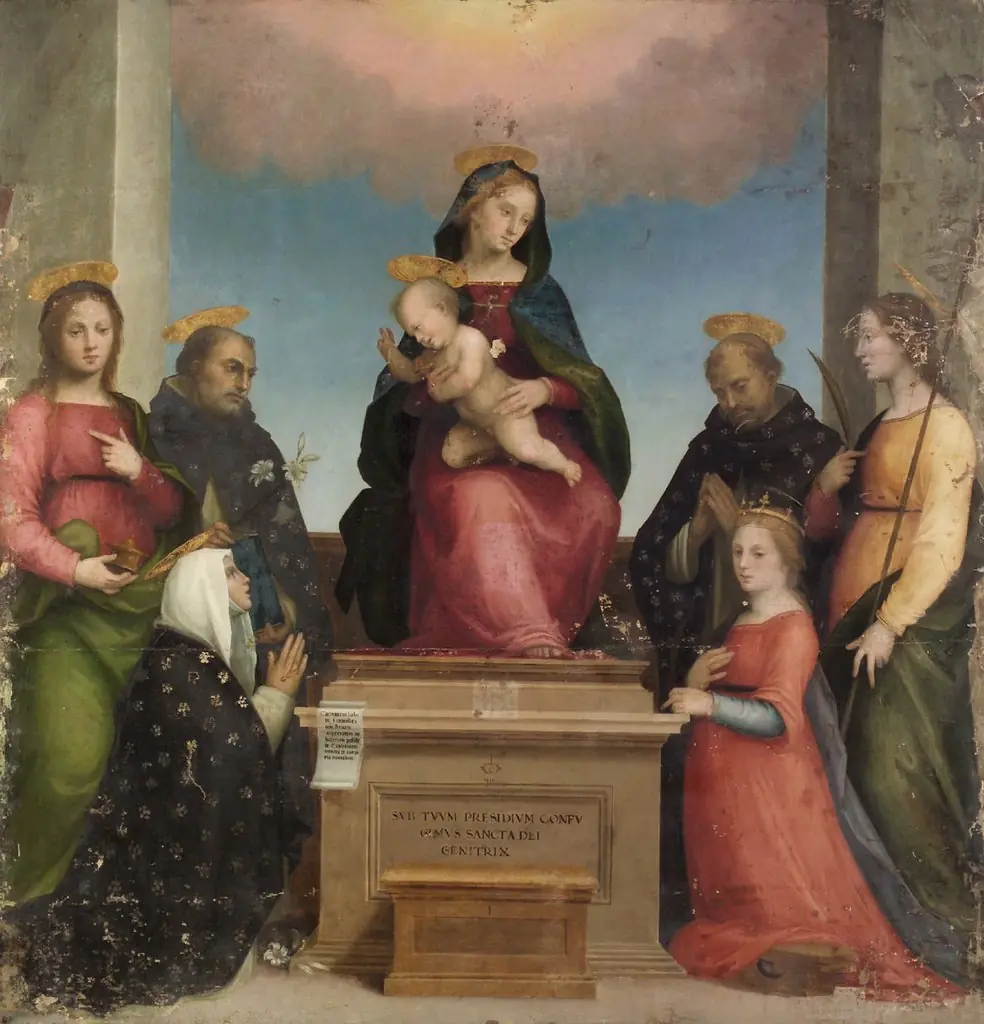 Maria mit Kind und den Hll. Katharina von Siena, Katharina von Alexandrien, Maria Magdalena, Dominikus, Petrus Martyr und einer Märtyrerin
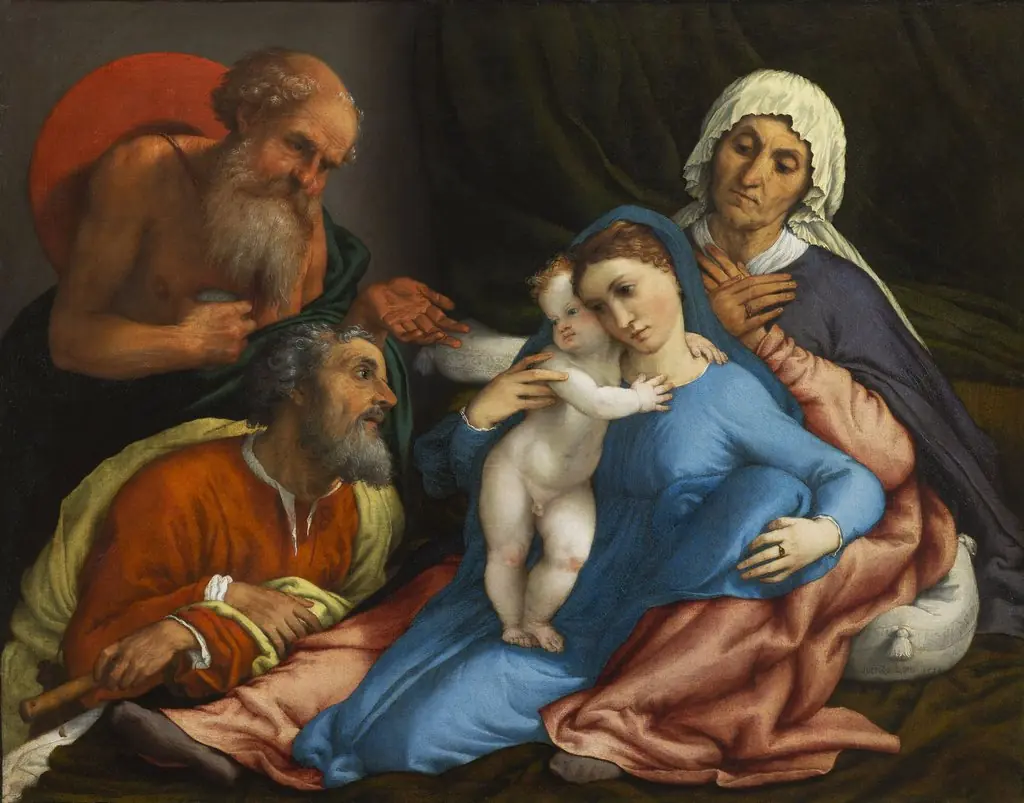 Madonna and Child with Saints
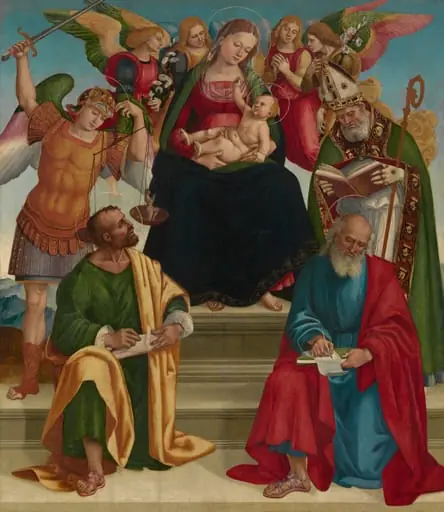 Madonna and Child with Saints and Angels
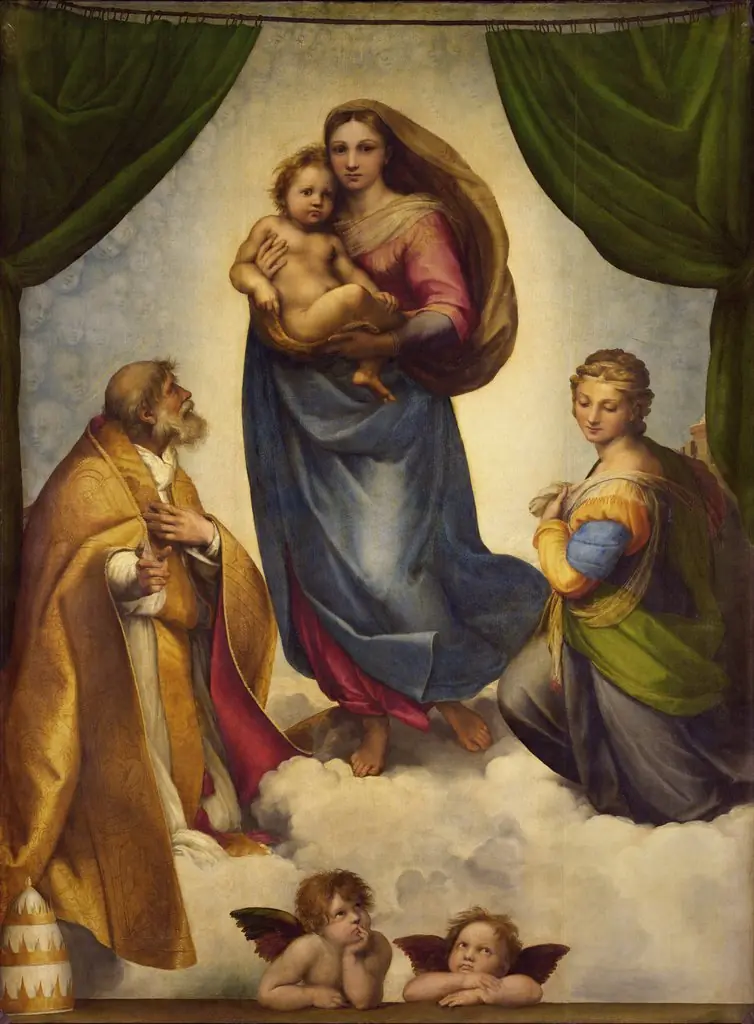 Sistine Madonna
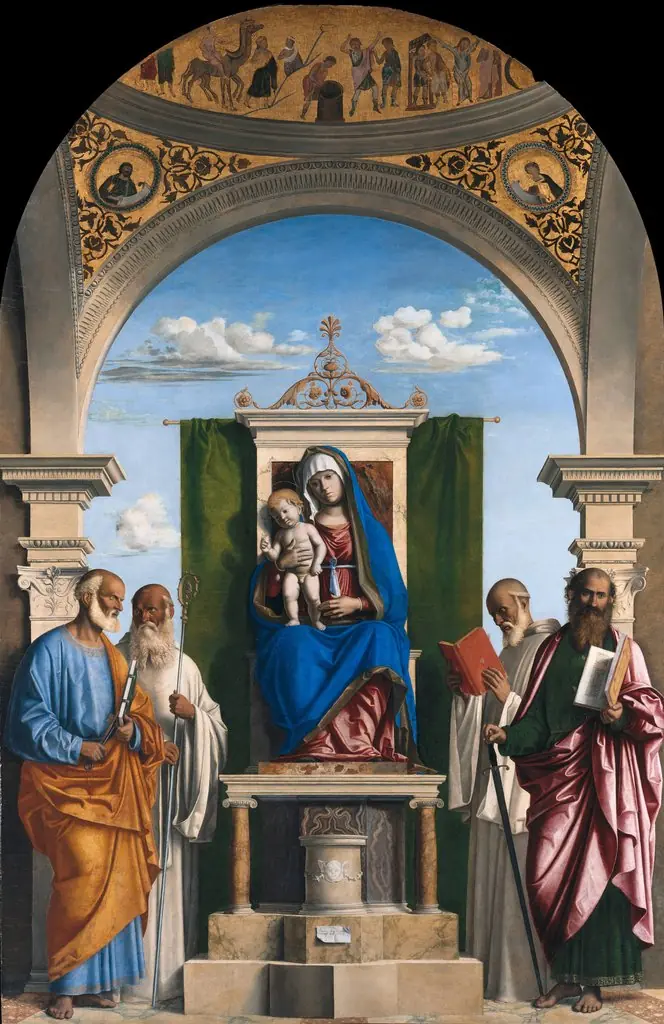 Madonna and Child Enthroned with Saints
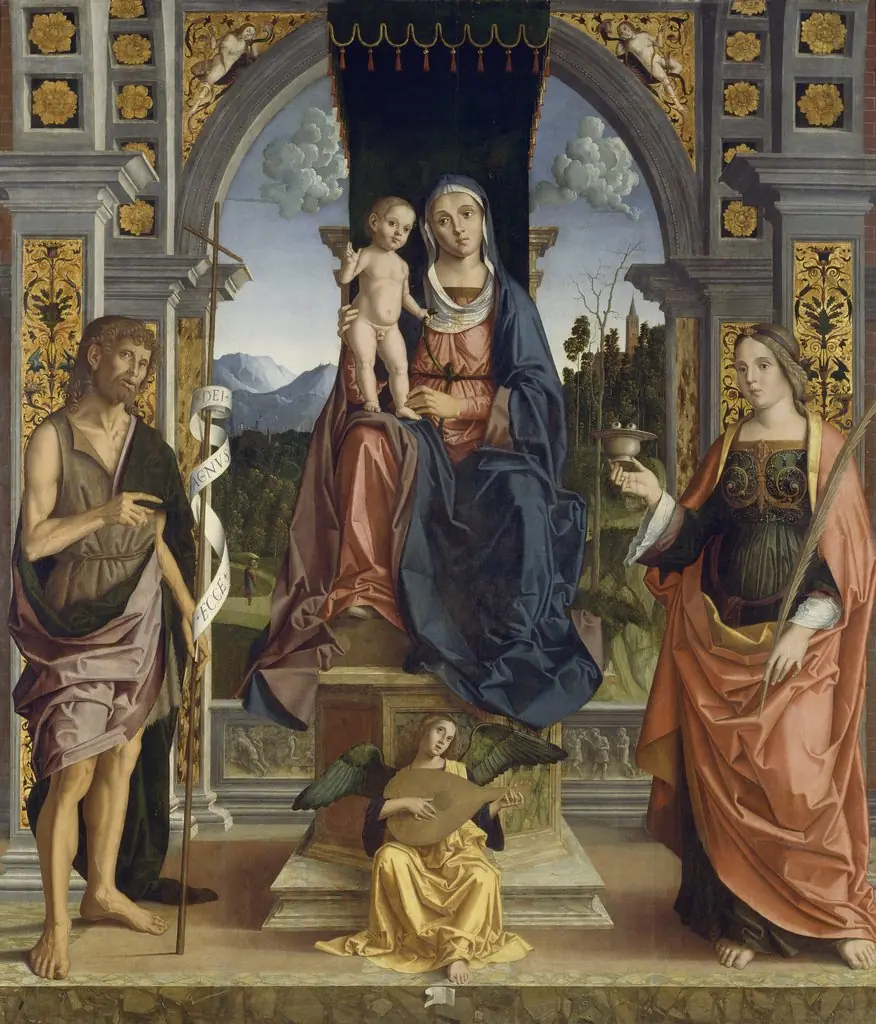 The Virgin and Child Enthroned, with Saints John the Baptist and Lucy
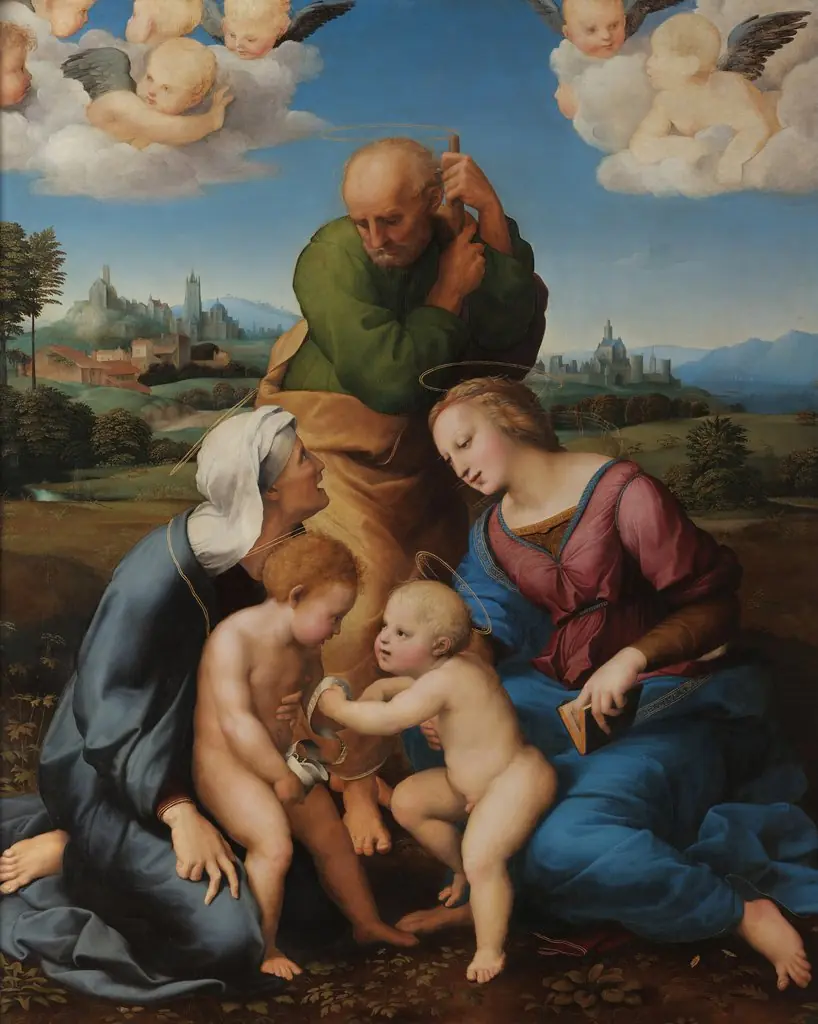 Canigiani Holy Family
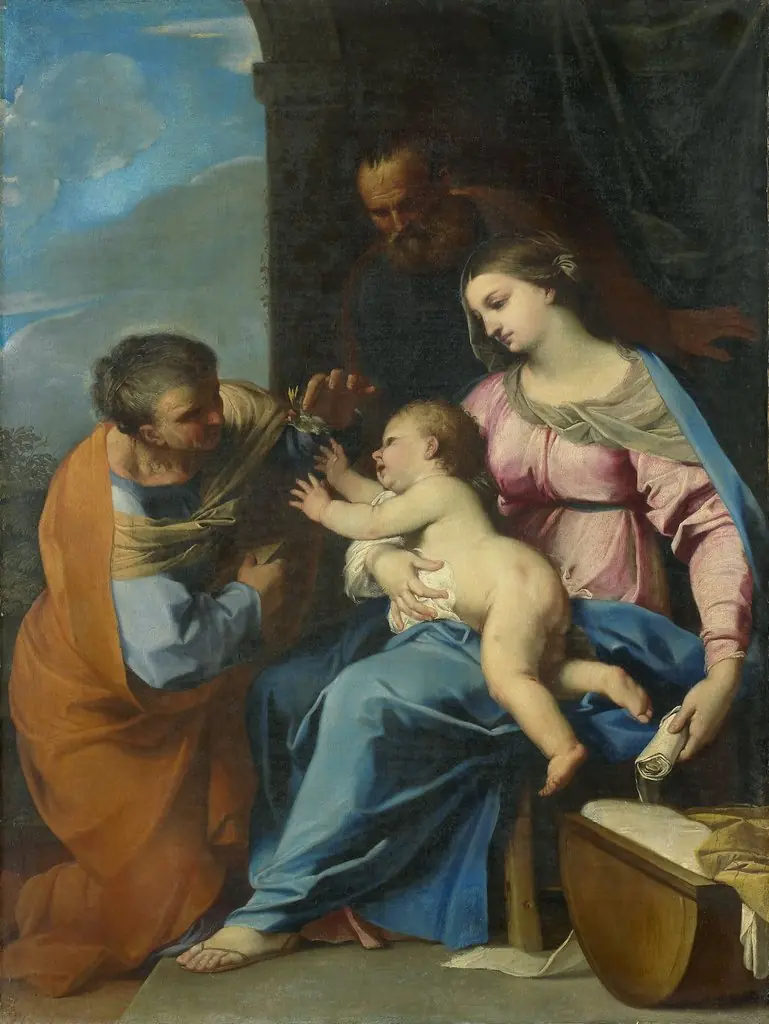 Holy Family
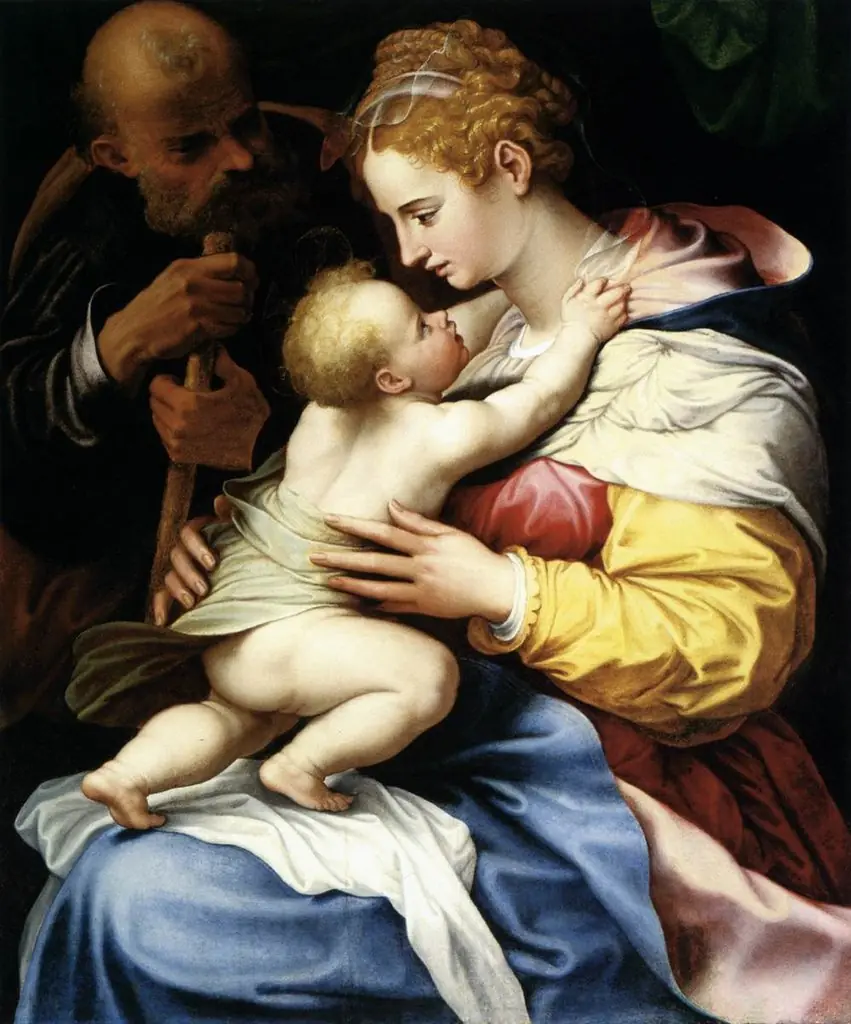 The Holy Family
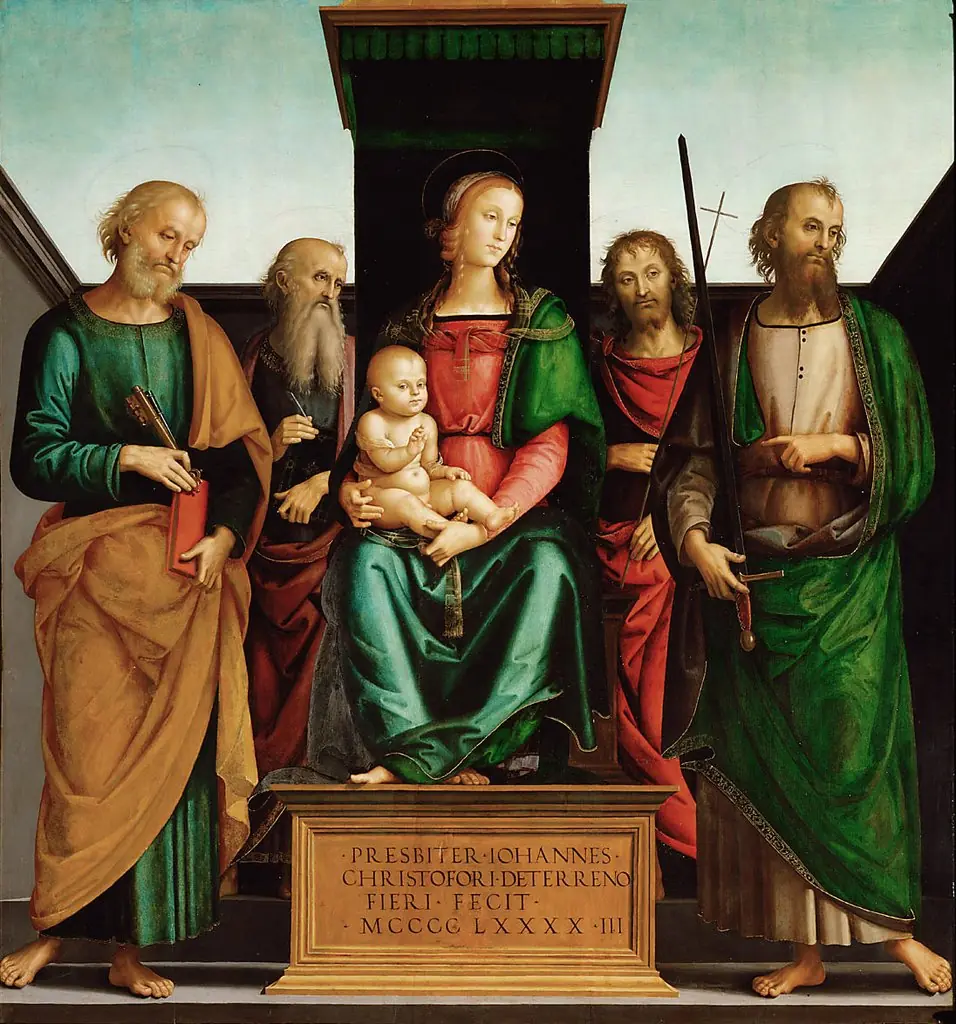 Mary with Child and Four Saints