Artwork
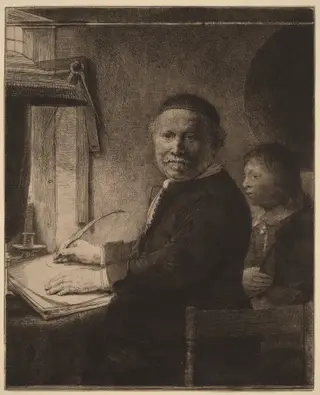
Self-Portrait Drawing at a Window
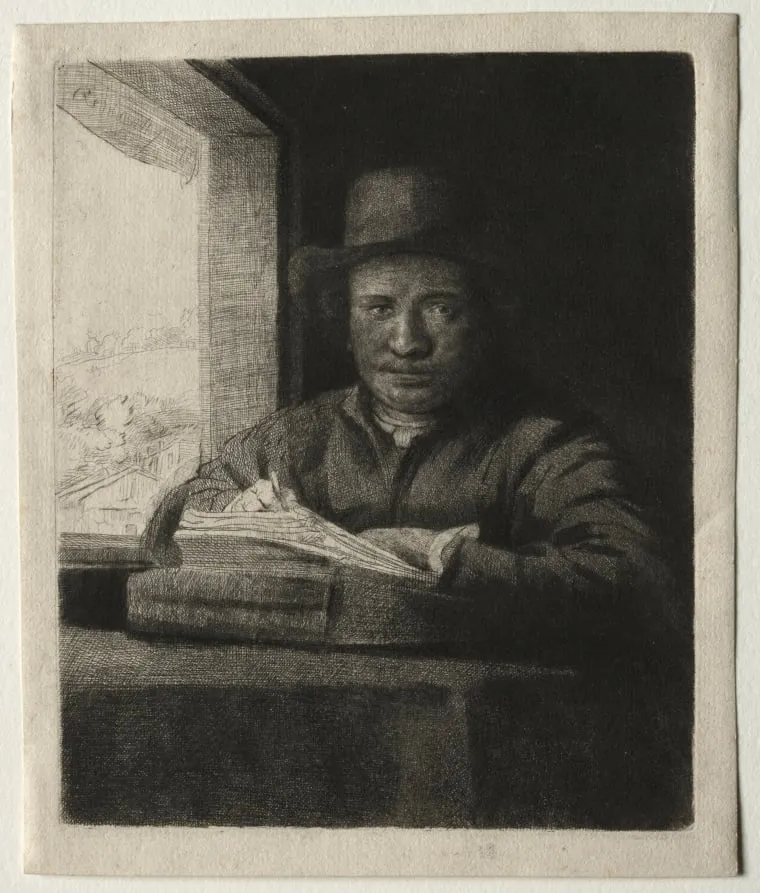
Self-Portrait Drawing at a Window is a print by the Baroque artist Rembrandt van Rijn. It dates from 1648 and is held in the collection of the Cleveland Museum of Art.
- Accession no.
- 1934.350
- Credit line
- Gift of Leonard C. Hanna Jr.
About this work
Overview
This late self-portrait by Rembrandt van Rijn depicts the artist in a casual, absorbed state, engaged in the creative process at a studio window.
Subject & Meaning
Rembrandt captures himself in a moment of interruption, looking directly at the viewer while etching a copper plate. The contrast between the interior workspace and the exterior landscape beyond the window underscores the solitude of artistic creation.
Technique & Style
The work showcases Rembrandt's use of chiaroscuro, with strong light from the window illuminating his subject, himself and his work materials, while casting half his face in shadow, emphasizing the interplay of light and darkness.
History & Provenance
This self-portrait is one of over 80 created by Rembrandt, each distinct from the others. The simplicity of his attire in this piece is notable, lacking the ornate elements often associated with portraits of the time.
Context
Produced in a period where self-portraiture was not uncommon among artists, Rembrandt's approach in this work stands out for its informality and focus on the artistic process, reflecting his innovative approach to the genre.
Legacy
This self-portrait contributes to Rembrandt's legacy as a prolific and expressive artist, with its exploration of light, shadow, and the solitary nature of creativity influencing later artists in their depiction of the artistic life.
Artist & collection

Artist
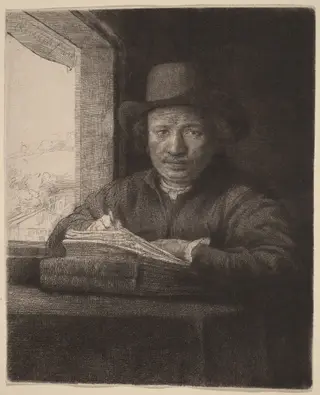
Rembrandt Harmenszoon van Rijn, known mononymously as Rembrandt, was a Dutch Golden Age painter, printmaker, and draughtsman.