Artwork
Man in Oriental Costume
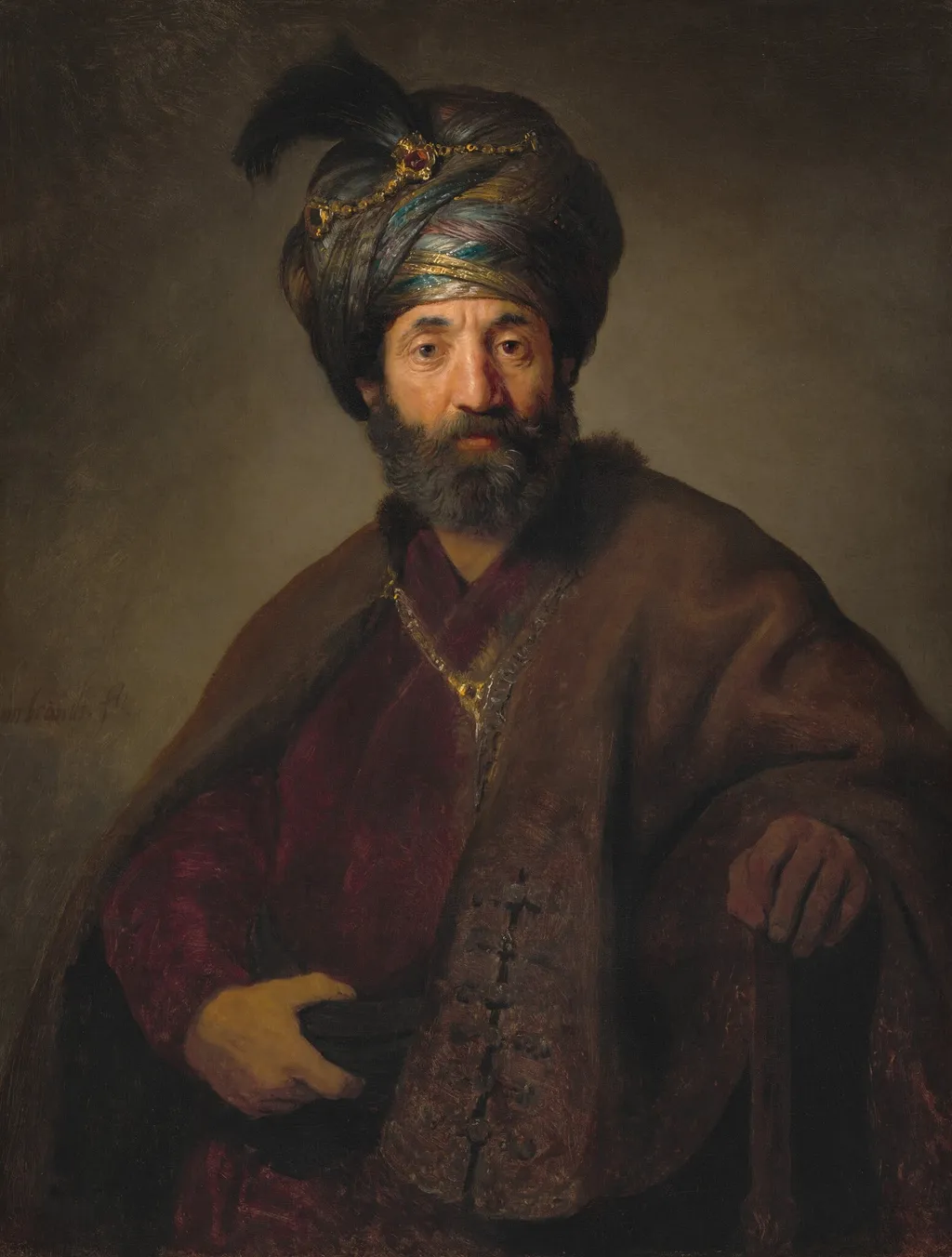
Man in Oriental Costume is an oil painting by the Baroque artist Rembrandt van Rijn. It dates from 1635 and is held in the collection of the Hermitage Museum.
- Inscription
- Inscribed:center left: [R]embrandt ft
About this work
Subject & Meaning
Thus the work operates as a historiated portrait that blends realism with allegorical suggestion of cultural encounter.
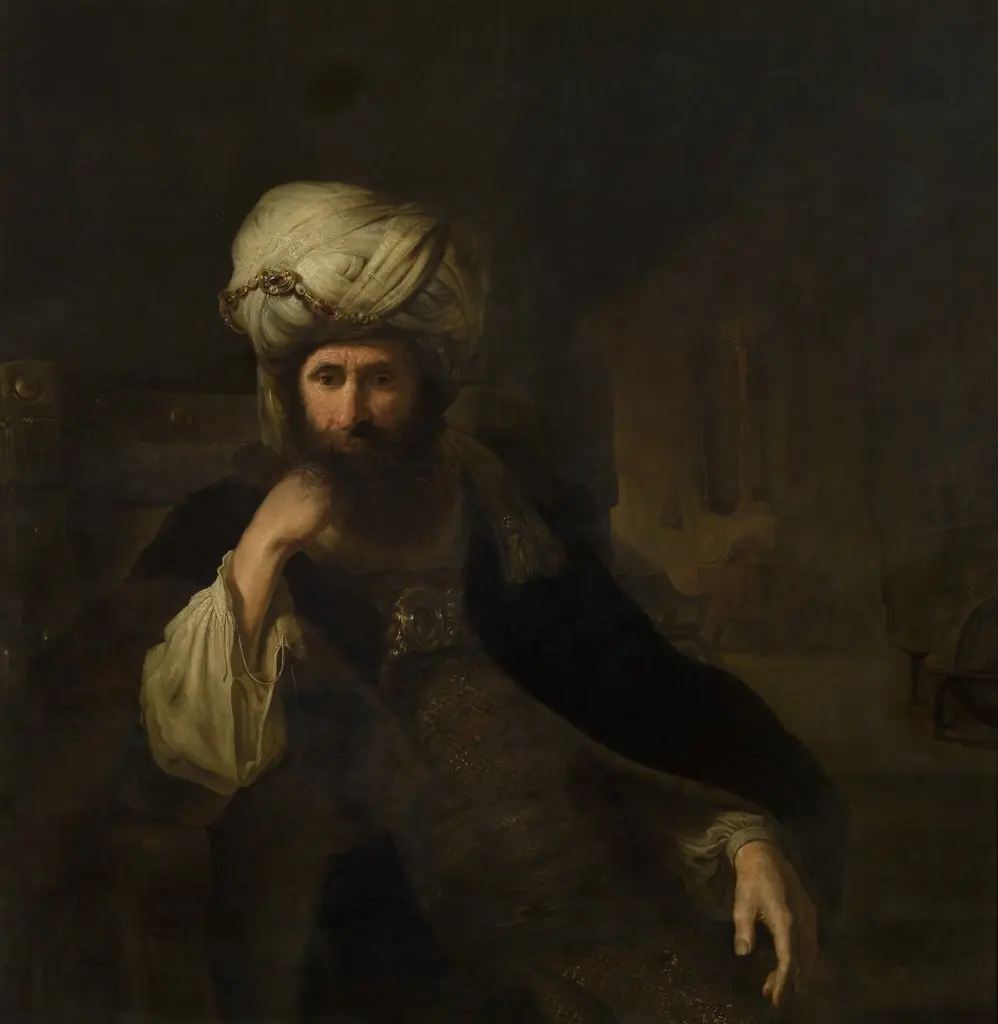
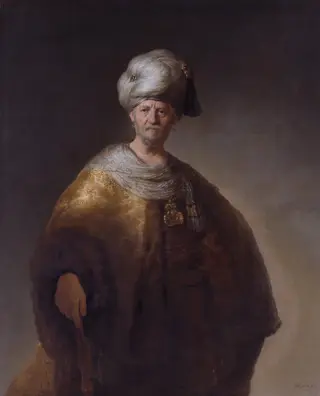
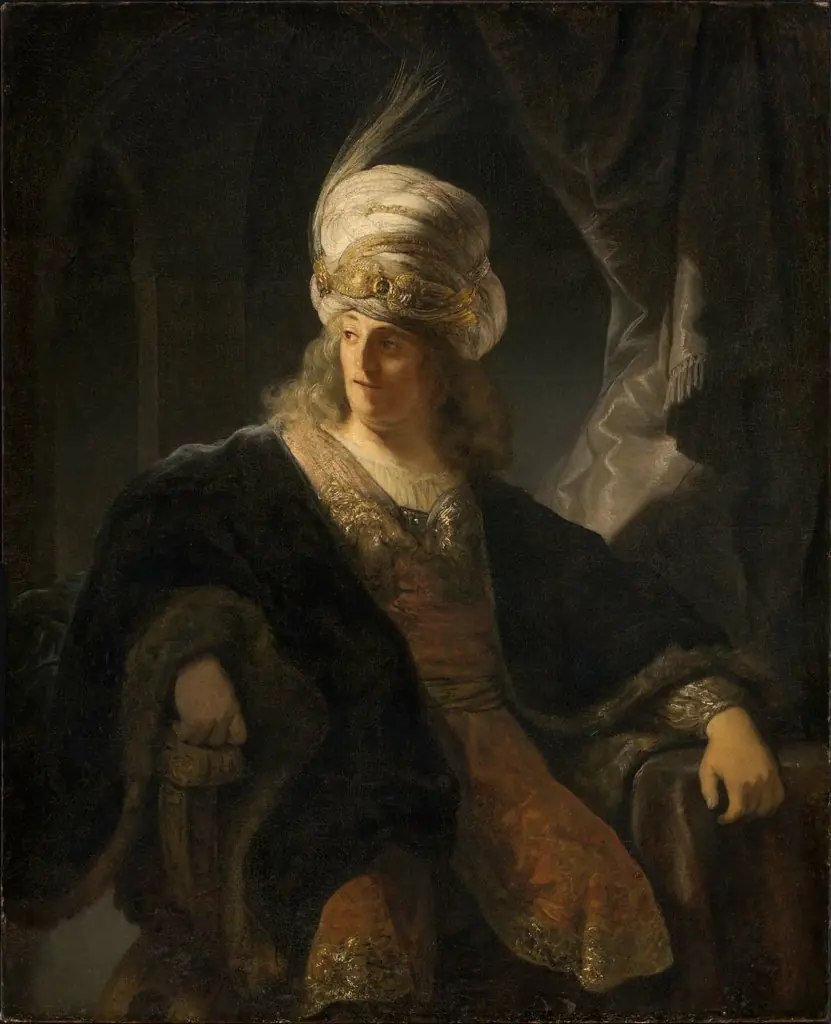
The painting shows a solitary male sitter clothed in an elaborate turban and rich drapery, a visual cue that European audiences of the 1630s associated with imagined Eastern peoples. Rembrandt renders the figure in a half‑length portrait format, emphasizing the sitter’s dignified posture and the texture of the fabric to suggest both individual presence and a generic oriental type. The turban functions symbolically as a marker of exotic otherness, reflecting the period’s fascination with far‑off cultures and the artistic practice of using costume to convey status and narrative. Thus the work operates as a historiated portrait that blends realism with allegorical suggestion of cultural encounter.
Technique & Style
Painted in 1635, Man in Oriental Costume is executed in oil paint on a linen canvas support. The work measures approximately 102.8 cm in height and 78.8 cm in width. Classified as a historiated portrait, the piece depicts a male figure adorned with a turban.
While traditionally attributed to Rembrandt van Rijn, the creation of the work is also associated with Govaert Flinck. The medium consists of oil applied to the woven fabric, a standard technique for Dutch Golden Age portraiture that allows for the rich textural rendering characteristic of the period's handling. The physical dimensions and material composition define the object as a substantial panel-sized canvas painting now held in the Andrew W. Mellon collection.
History & Provenance
Man in Oriental Costume, an oil on linen portrait painted in 1635, was initially acquired by merchant Johan Ernst Gotzkowsky in Berlin around 1756 on behalf of King Friedrich II of Prussia; financial difficulties kept the work in Gotzkowsky’s collection until at least 1766. The painting subsequently entered the collection of Prince Heinrich of Prussia, then passed to Empress Catherine II of Russia by 1773, after which it was displayed in the Imperial Hermitage Gallery in Saint Petersburg. In the early 1930s it was sold through a chain of dealers, Matthiesen Gallery, P. & D. Colnaghi & Co., and M. Knoedler & Co., to Andrew W. Mellon, whose estate transferred it to the A.W. Mellon Educational and Charitable Trust in 1938, and it was gifted to the National Gallery of Art in 1940. The work’s creation date is recorded as 1635.
Man in Oriental Costume is currently held by the National Gallery of Art in Washington, D.C., where it entered the collection as part of the Andrew W. Mellon bequest in 1940. Its provenance traces from Johan Ernst Gotzkowsky (by 1756), to the Prince of Prussia, then to Catherine II of Russia, and finally to the Imperial Hermitage Gallery before its acquisition by Mellon. The work’s accession is recorded within the Mellon collection holdings.
Exhibition history is not detailed in the supplied documentation, and no specific exhibition records are cited in the sources provided.
Overview
Painted in 1635, Man in Oriental Costume is a half-length portrait by Rembrandt van Rijn depicting a figure in elaborate Eastern attire. The subject, likely a self-portrait or a model in costume, faces the viewer directly with a composed expression, wearing a voluminous, patterned turban and a richly textured robe. Rembrandt employs his characteristic chiaroscuro, using deep shadows to accentuate the folds of the fabric and the warm glow of the skin against a dark, indistinct background.
The work exemplifies the artist's exploration of the 'tronie' genre, focusing on the study of facial expression, exotic costume, and the interplay of light on diverse materials rather than documenting a specific historical individual. Created during Rembrandt's early Amsterdam period, the painting reflects the 17th-century Dutch fascination with the Ottoman Empire and the broader East, driven by trade and cultural curiosity. The artist's loose, expressive brushwork in the turban contrasts with the more defined rendering of the face, demonstrating his technical mastery in capturing texture and atmosphere.
This piece remains a significant example of Rembrandt's ability to imbue costume studies with psychological depth and dramatic presence.
Own this work as a print
Artist & collection

Artist
Rembrandt Harmenszoon van Rijn, known mononymously as Rembrandt, was a Dutch Golden Age painter, printmaker, and draughtsman.