Artwork
Adoration of the Magi
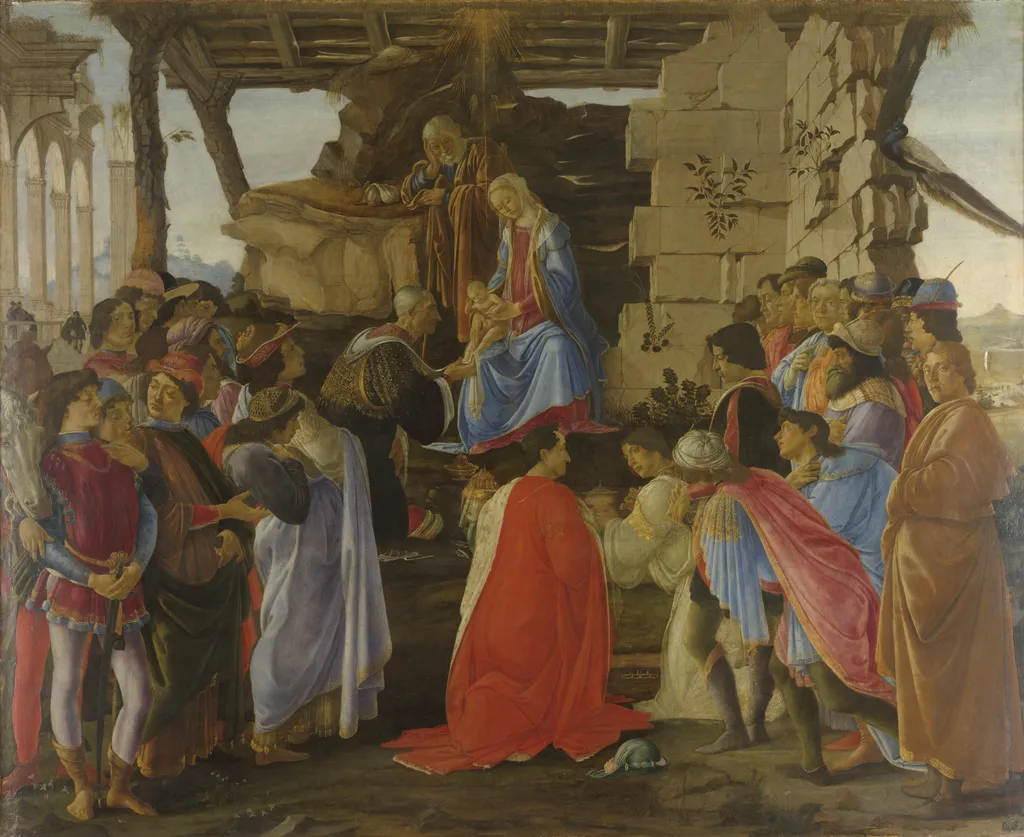
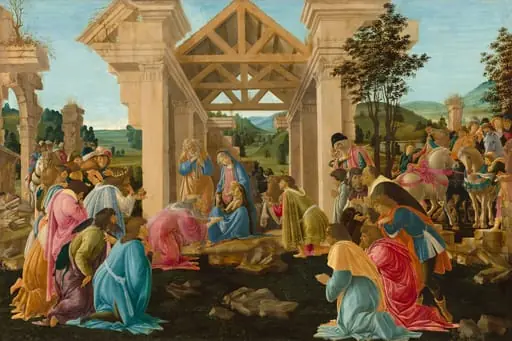
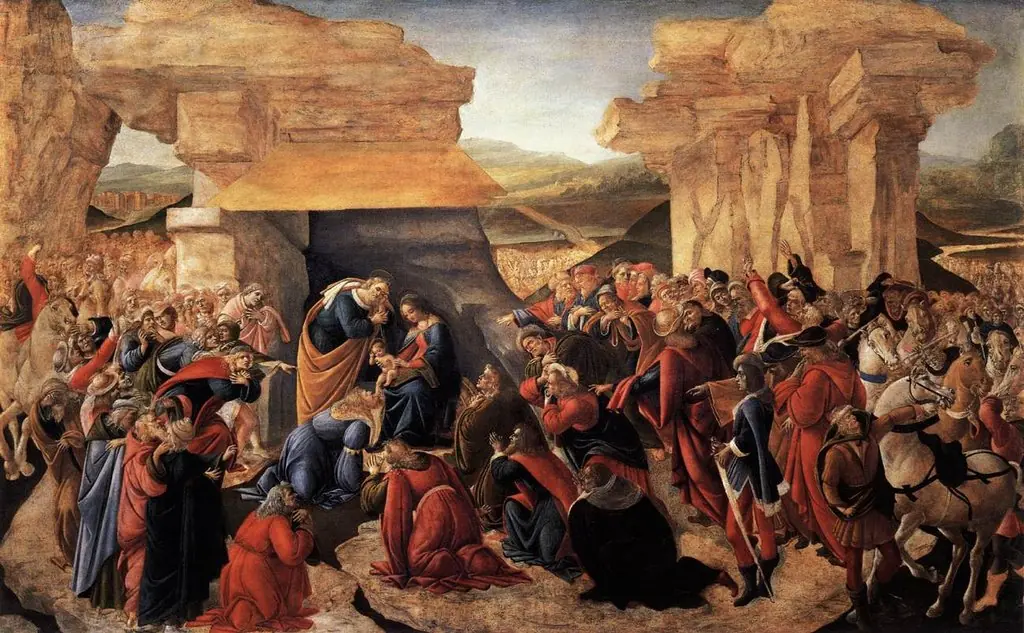
Adoration of the Magi is a tempera painting by the Early Renaissance artist Sandro Botticelli. It dates from 1475 and is held in the collection of the Uffizi Gallery.
About this work
The scene shows Mary holding the Christ Child as three kings bring gifts.
Sandro Botticelli painted Adoration of the Magi in tempera around 1475. It was made for an altar chapel in Florence. The scene shows Mary holding the Christ Child as three kings bring gifts.
One king is believed to be Giuliano de’ Medici. The crowd around them includes older men like John Argyropoulos. This painting mixes Bible scenes with real faces from the artist’s time.
Check out Botticelli next.
Subject & Meaning
The painting depicts the Biblical episode of the Three Magi presenting gifts of gold, frankincense, and myrrh to the Christ Child, who sits with the Virgin Mary and Saint Joseph amidst classical ruins. These ruins symbolize the collapse of the pagan world and the rise of Christianity, while details like the peacock and growing greenery represent immortality and resurrection. Beyond its religious narrative, the work functions as a political allegory and homage to the Medici family.
The three kneeling kings portray deceased Medici patriarchs: Cosimo the Elder, Piero the Gouty, and Giovanni. Surrounding them are living family members, including Lorenzo the Magnificent and Giuliano, alongside prominent humanists and the patron, Gaspare di Zanobi del Lama. By integrating these contemporary portraits into a sacred scene, Botticelli merges theological meaning with the celebration of Florentine power and intellectual culture.
Technique & Style
Executed in egg tempera on a poplar panel measuring 111 × 134 cm, the work shows the characteristic handling of the Quattrocento: layered, cross-hatched brushstrokes build up saturated hues, deep reds, luminous golds, and cool blues, that harmonize under candlelight but appear flattened under modern illumination. The composition arranges the Holy Family on a raised platform of classical ruins, their solid, sculptural forms stabilized by a pyramidal arrangement that anchors the surrounding crowd of Medici and courtiers. Antique arcade fragments and a distant, atmospheric landscape frame the scene, while a peacock perched on the right edge signals resurrection motifs through its traditional symbolism.
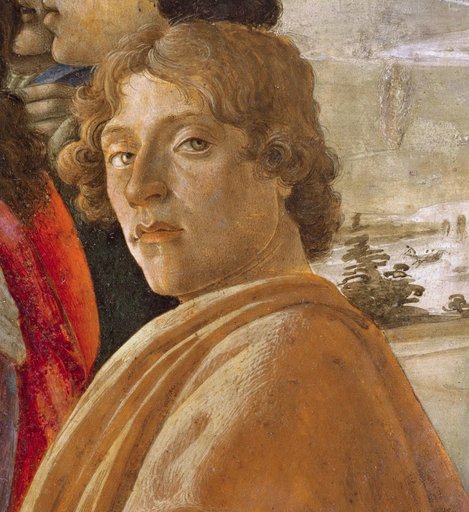
The artist’s probable self-portrait at the far right, turned toward the viewer, punctuates the social fiction of the gathering, merging devotional iconography with contemporary portraiture.
History & Provenance
The Adoration of the Magi was commissioned circa 1475 by the Florentine banker Gaspare di Zanobi del Lama for the altar of his funerary chapel in the Dominican church of Santa Maria Novella. Executed in tempera on panel, the work remained in that chapel for almost a century. Around 1522 the altar’s rights passed to the Fedini family, and circa 1570 it came into the possession of Fabio Arrazola de Mondragone, Marquess of Mondragone, who removed the panel to his palace.
After his betrayal of Francesco I de’ Medici led to confiscation in 1575, the painting entered the grand ducal collections, was moved to the Villa del Poggio Imperiale in 1622, and entered the Uffizi Gallery in Florence in 1796, where it has remained; it was lent to the Minneapolis Institute of Art for an exhibition in 2022‑23.
Context
Vasari singled out the work as a particularly high‑quality achievement (4). Modern scholarship has highlighted its dense Medici portraiture, noting that scholars such as Leuker, Montresor, Schumacher and Zöllner have examined its political and devotional layers (4), while Lemaître describes it as an apotheosis of the Medici entourage (5). The painting is renowned for nearly thirty contemporary portraits that fuse religious iconography with Florentine power dynamics and psychological insight (6), and its innovative pyramidal composition was later cited as a reference point for artists including Leonardo da Vinci (6).
Dated to circa 1475 and executed in tempera on panel (1), the Adoration of the Magi exemplifies Early Renaissance style and remains a key work in the Uffizi’s collection of Italian Renaissance painting (2).
Legacy
Sandro Botticelli's Adoration of the Magi established a significant legacy as a benchmark for Renaissance composition, particularly through its innovative pyramidal structure that later influenced artists such as Leonardo da Vinci. The work is frequently cited for its unique fusion of religious iconography with contemporary political portraiture, effectively serving as a visual homage to the Medici dynasty and the Florentine humanist circle. Art historical reputation for the painting was cemented early by Giorgio Vasari, who highlighted its exceptional quality in his 1550 biographies.
Scholars often describe the piece as a "poetic" and "soulful" masterpiece that transcends standard altarpiece conventions by integrating specific historical figures like Cosimo, Piero, and Lorenzo de' Medici into the biblical narrative. Its status as a document of 15th-century Florentine society, combined with its formal innovations, ensures its continued prominence in major exhibitions, including recent displays at the Minneapolis Institute of Art.
Overview
Sandro Botticelli's "Adoration of the Magi," a tempera painting from approximately 1475, illustrates the biblical account of the Three Kings' homage to the newborn Jesus. Created for an altar chapel in Florence, the work is distinguished by its integration of sacred narrative with contemporary portraiture. It places recognizable figures from Botticelli's time within the traditional religious scene, reflecting a common practice in Renaissance art.
Own this work as a print
Artist & collection
Artist
Alessandro di Mariano di Vanni Filipepi, better known as Sandro Botticelli or simply Botticelli, was an Italian painter of the Early Renaissance.