Artwork
Madonna of the Magnificat
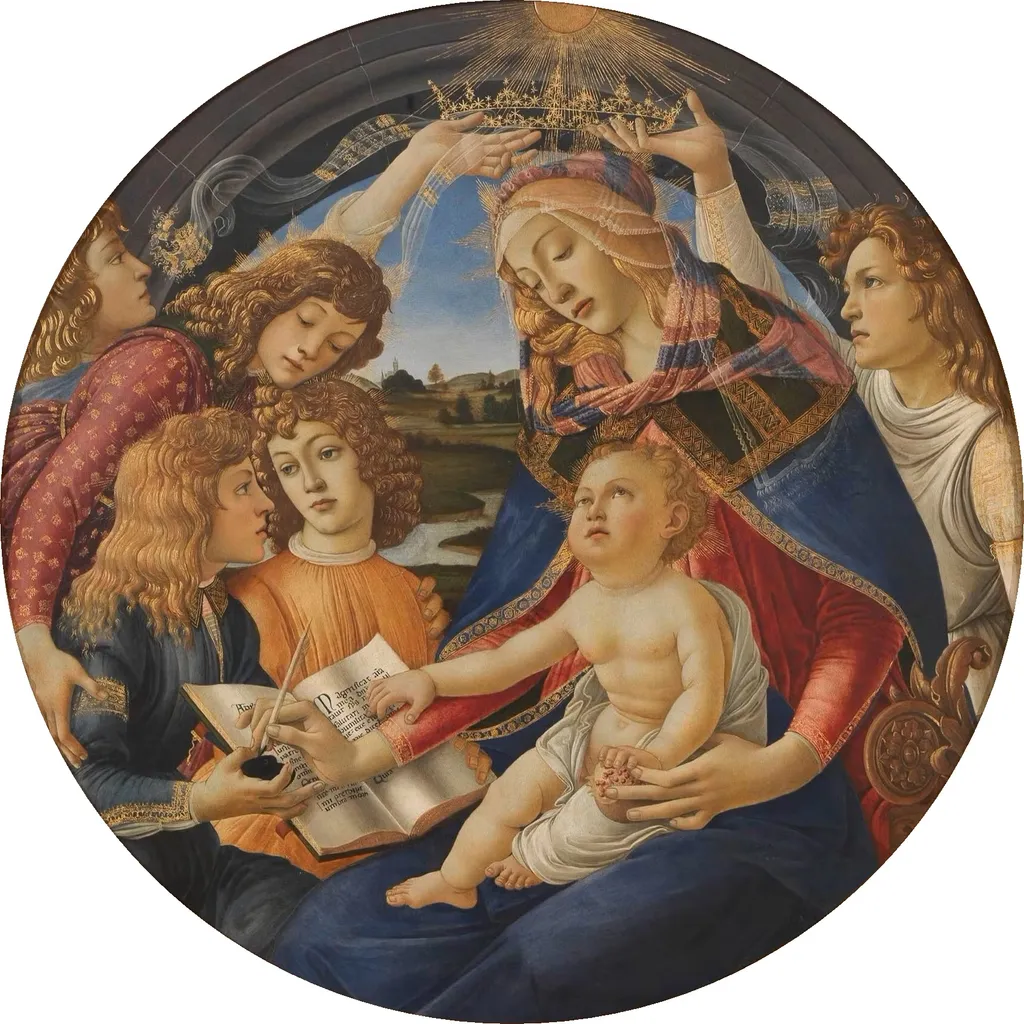
Madonna of the Magnificat is a tempera painting by the Early Renaissance artist Sandro Botticelli. It dates from 1492 and is held in the collection of the Uffizi Gallery.
About this work
Subject & Meaning
The painting depicts the Virgin Mary crowned by two angels while writing the Magnificat, a canticle from the Gospel of Luke, with her right hand.
The painting depicts the Virgin Mary crowned by two angels while writing the Magnificat, a canticle from the Gospel of Luke, with her right hand. The Christ Child sits on her lap, guiding her hand as she writes, while she holds a pomegranate in her left hand. The pomegranate's red seeds symbolize the blood of Jesus's Passion and his future sacrifice for humanity. On the left page of the book, text from the Benedictus, another canticle from Luke, is visible.
Unconventionally, Mary is portrayed as a writer rather than a reader, a choice that has been interpreted through the lens of Humanist rhetoric regarding female literacy. Two additional angels hold a transparent crown of stars above her head, referencing the Queen of Heaven. The scene is framed by a stone window separating the sacred figures from a serene landscape, blending contemporary Florentine fashion with religious iconography.
Technique & Style
The Madonna of the Magnificat is executed in tempera on wooden panel, a common support for Early Renaissance paintings in Florence. The work measures approximately 114 cm in diameter, typical for a tondo of this period, and is painted on a circular wooden support that frames the composition. Botticelli applied tempera pigments mixed with egg yolk binder to achieve fine detail and luminous color, particularly in the blue of the Virgin’s veil and the gold leaf used for decorative elements such as the halo and crown. The painting’s surface shows careful handling, with fine brushwork defining the delicate folds of fabric and the intricate patterns of the angels’ garments. Formal qualities include a balanced, symmetrical arrangement of figures within the circular frame, a clear division between heavenly and earthly space, and a restrained use of linear elegance that reflects Botticelli’s synthesis of Classical grace and contemporary Florentine style. The composition emphasizes the Virgin as both a devotional figure and a scribe, highlighted by her writing hand and the pomegranate she holds, a symbol of the Passion.
History & Provenance
Sandro Botticelli created the Madonna of the Magnificat between 1481 and 1483. The original patron is unknown, though references to John the Baptist, the patron saint of Florence, suggest a Florentine origin; some sources speculate it was painted for the Medici family or for a public building, while its tondo format also suggests private devotion. The Uffizi Gallery acquired the painting in 1784 from a private collection, specifically from Ottavio Magherini. It may have originated from one of the monasteries suppressed by Archduke Pietro Leopoldo. The work is executed in tempera on panel.
The Madonna of the Magnificat is held in the Uffizi Gallery in Florence, where it has been part of the collection since 1784, acquired from a private collection and possibly originating from one of the monasteries suppressed by Archduke Pietro Leopoldo. It is cataloged under the inventory number Uffizi 1890, though this specific identifier is not detailed in the provided sources. The work has been exhibited in the Uffizi's dedicated Botticelli rooms, including displays in the 19th-century reinstallation of the gallery and more recent thematic exhibitions focusing on Renaissance religious art. Additional copies of the painting are held in the Louvre and the Morgan Library & Museum in New York, though the original remains in Florence.
The painting is displayed in Room 11-12 of the Uffizi, within the section devoted to Botticelli's works, where it is presented alongside other tondi and Madonnas from the Medici period. Its exhibition history includes periodic inclusion in retrospectives on Botticelli’s religious works, such as the 1982 exhibition "Botticelli: The Works of the Master of the Magnificat," which highlighted the painting’s significance within his output. The artwork has also been featured in scholarly exhibitions on Early Renaissance art, though specific exhibition catalog entries are not cited in the sources provided.
The provenance indicates acquisition by the Uffizi in 1784, with no earlier documented ownership beyond references to private collections and potential monastic origins. The painting’s display has remained largely continuous since its acquisition, with minimal relocation within the museum’s collection.
The Madonna of the Magnificat is recognized as one of Botticelli’s most important religious works and a key example of Early Renaissance tondo painting, noted for its intricate composition, use of gold leaf, and symbolic elements such as the pomegranate and the written Magnificat.
Context
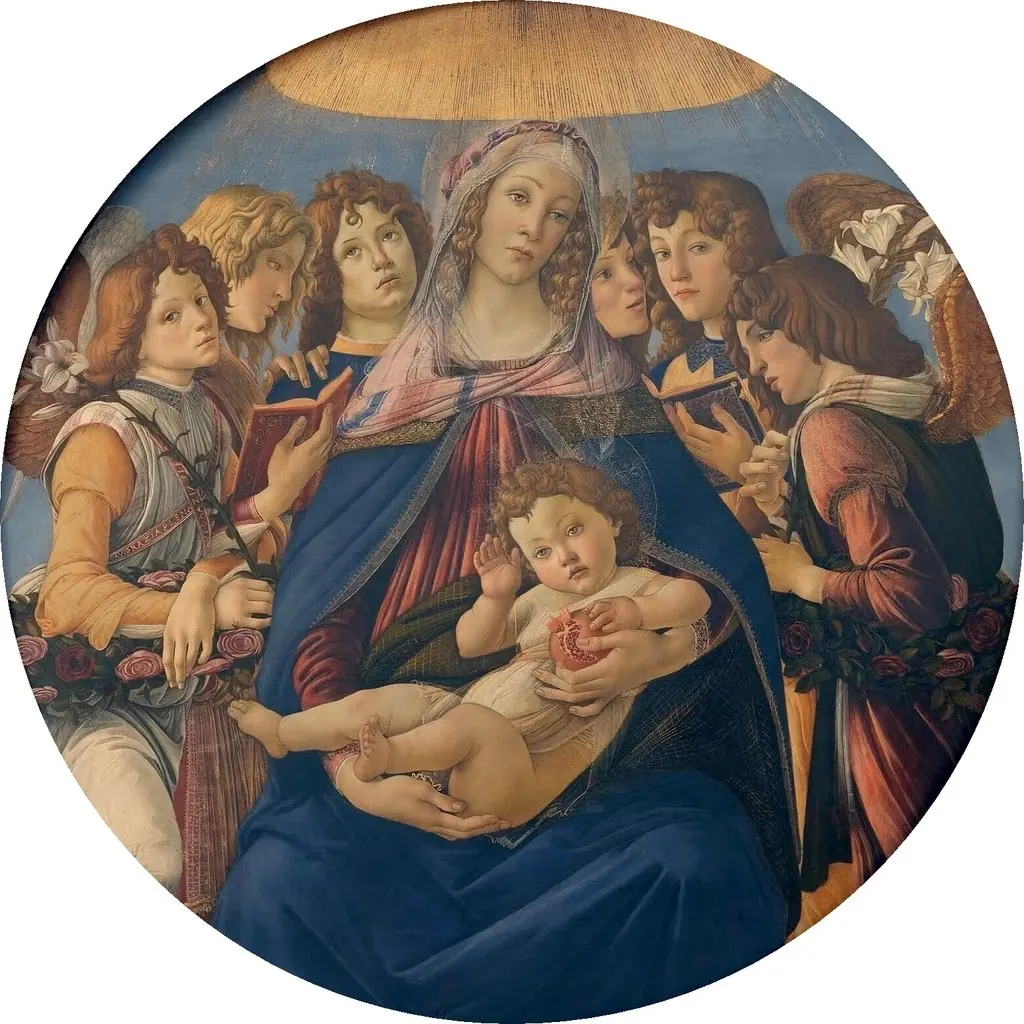
The Madonna of the Magnificat is regarded as one of Botticelli's most precious Madonna paintings and among his earliest tondi, a circular format that was especially popular in 15th- and 16th-century Florence for devotional images placed in private palaces and civic buildings (Source 4). The work is associated with his so-called "Medici phase," during which he produced several highly maternal Madonnas, including the Madonna of the Pomegranate, and developed his characteristic pale, porcelain-like female faces with delicate pink blushing (Source 3). Stylistically, scholars trace the painting's brilliant coloring, sharp contours, linear elegance, and idealized beauty to the influence of Filippo Lippi, Botticelli's first teacher, though Botticelli lends his Virgin a more aristocratic and unattainable air (Source 6). The atmospheric landscape visible through the circular window reflects the impact of Netherlandish painters such as Jan van Eyck, Rogier van der Weyden, and Hugo van der Goes, transmitted through Florentine merchants' commercial ties with the Low Countries (Sources 4, 5). The painting's lavish use of gold, the most expensive pigment, suggests a wealthy Florentine patron, possibly for a civic building rather than a private chapel (Source 4). Although some historians once proposed that the Virgin represents Lucrezia Tornabuoni and the angels her sons Lorenzo and Giuliano de' Medici, this identification has been largely set aside as unsupported (Sources 3, 4, 6).
Legacy
The Madonna of the Magnificat has been repeatedly cited as one of Botticelli’s most prized tondi and a touchstone of Florentine Renaissance devotion. Its later reception is anchored in its inclusion in Paul Veyne’s Musée imaginaire, where it figures among canonical works shaping historical memory of art. Marcel Proust’s À la recherche du temps perdu further embedded the composition in modern literature by evoking its iconography to characterize gesture and elegance, cementing its cultural afterlife beyond art history.
Copies and reception across European collections underscore its enduring model status; versions in the Louvre and the Morgan Library & Museum attest to repeated engagement by later artists and patrons. The generous use of gold, noted by multiple sources, signaled the prestige of its original commission and continued to be read as a marker of artistic excellence, reinforcing the work’s status as a benchmark for tondo composition and Marian iconography in the Quattrocento and beyond.
Own this work as a print
Artist & collection
Artist
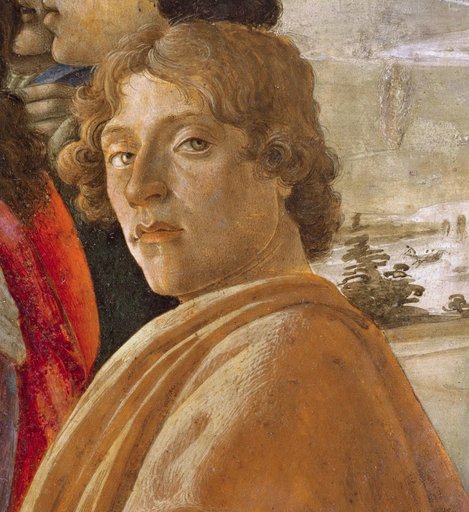
Alessandro di Mariano di Vanni Filipepi, better known as Sandro Botticelli or simply Botticelli, was an Italian painter of the Early Renaissance.

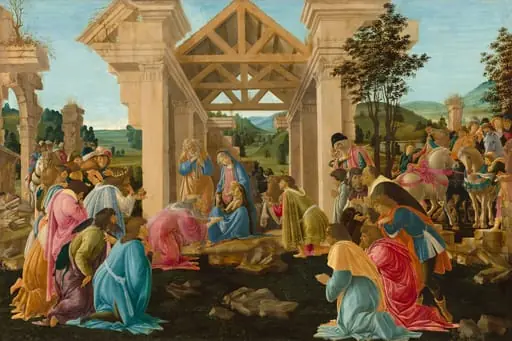
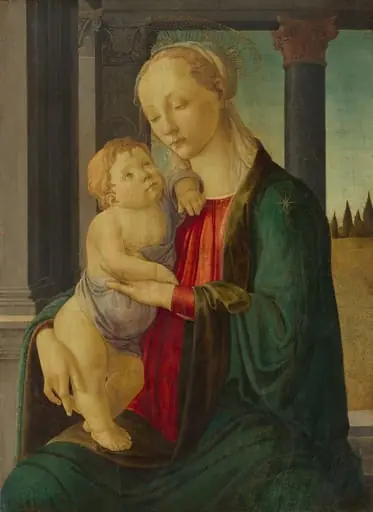
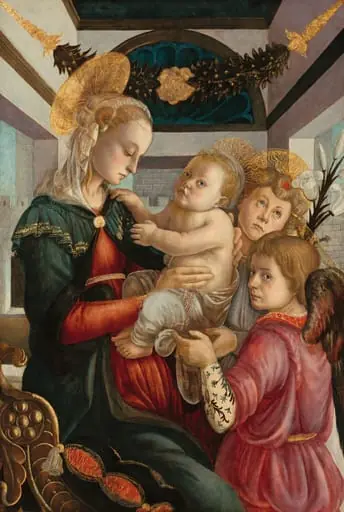
- Madonna of the Pomegranate
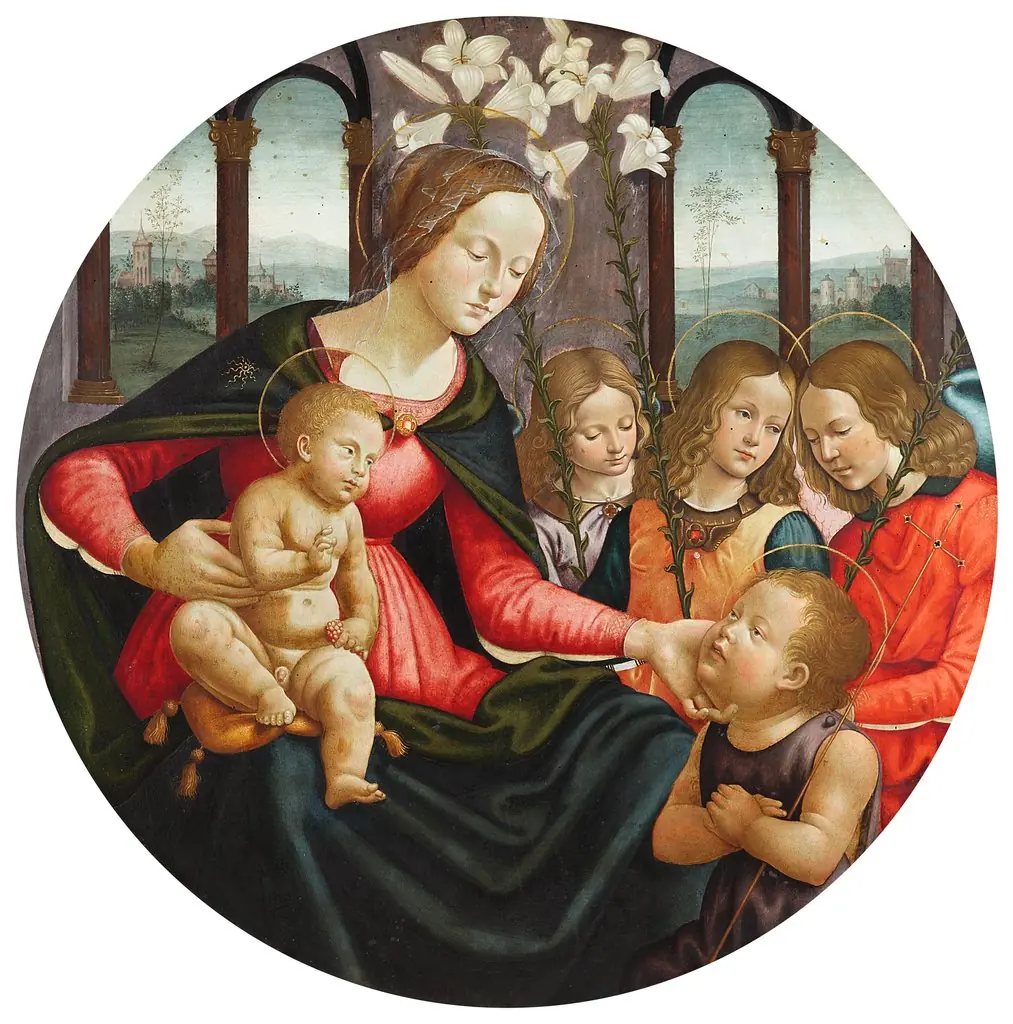 The Virgin and Blessing Child, Young St. John and three Angels
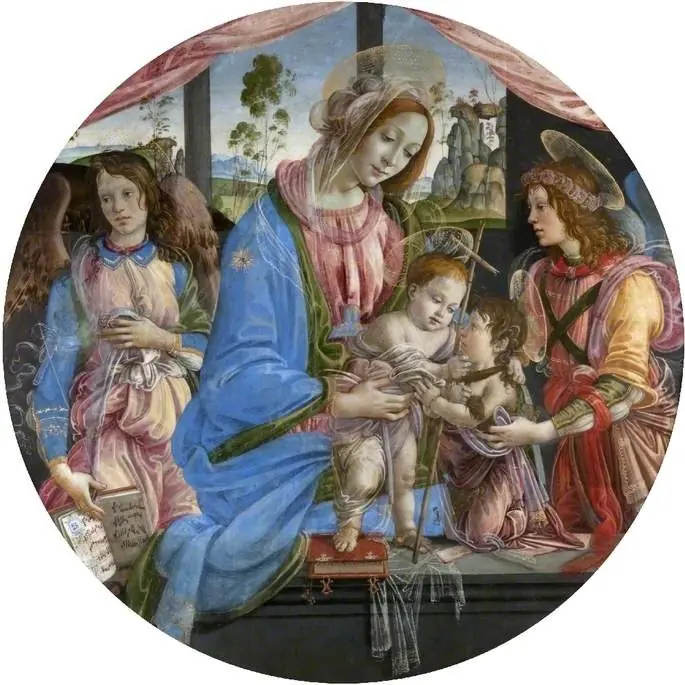 Virgin and Child with the Child Baptist and Two Angels
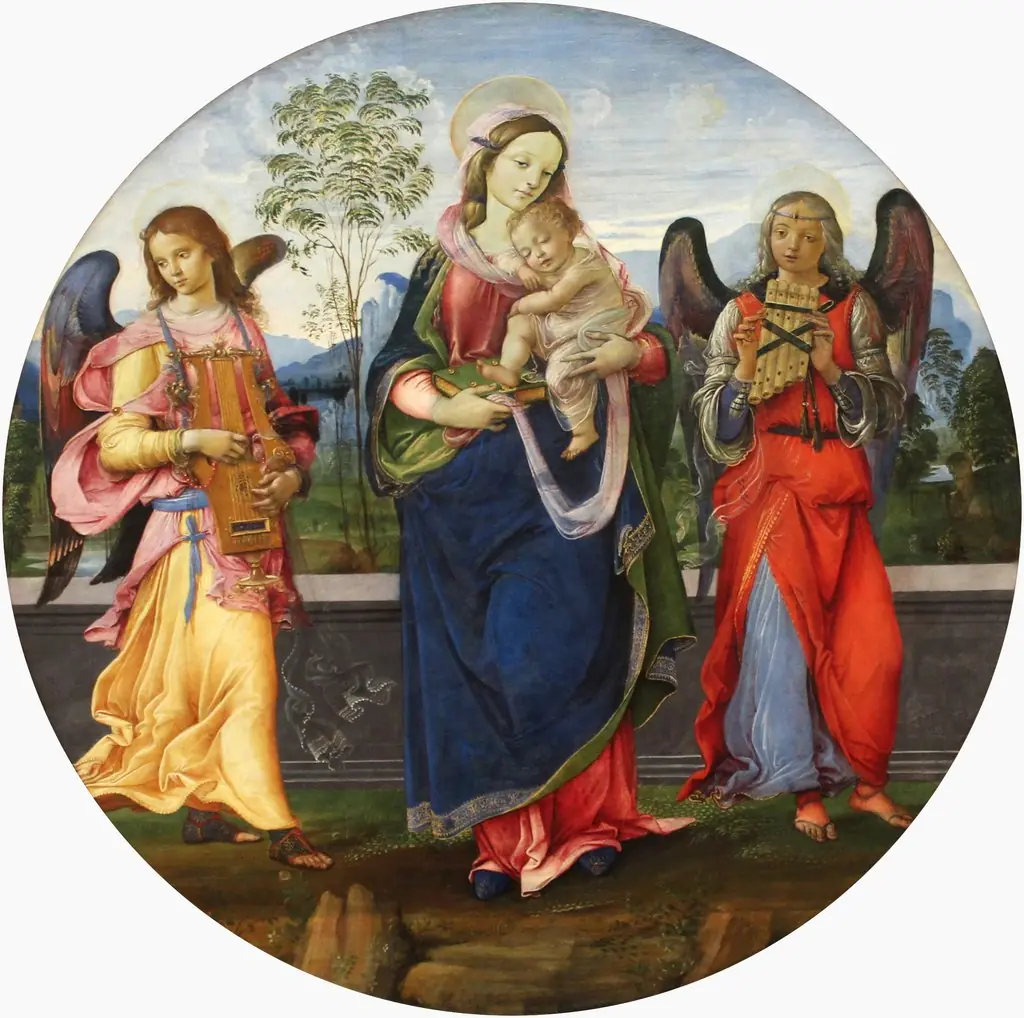 Madonna and Child with two angels playing music
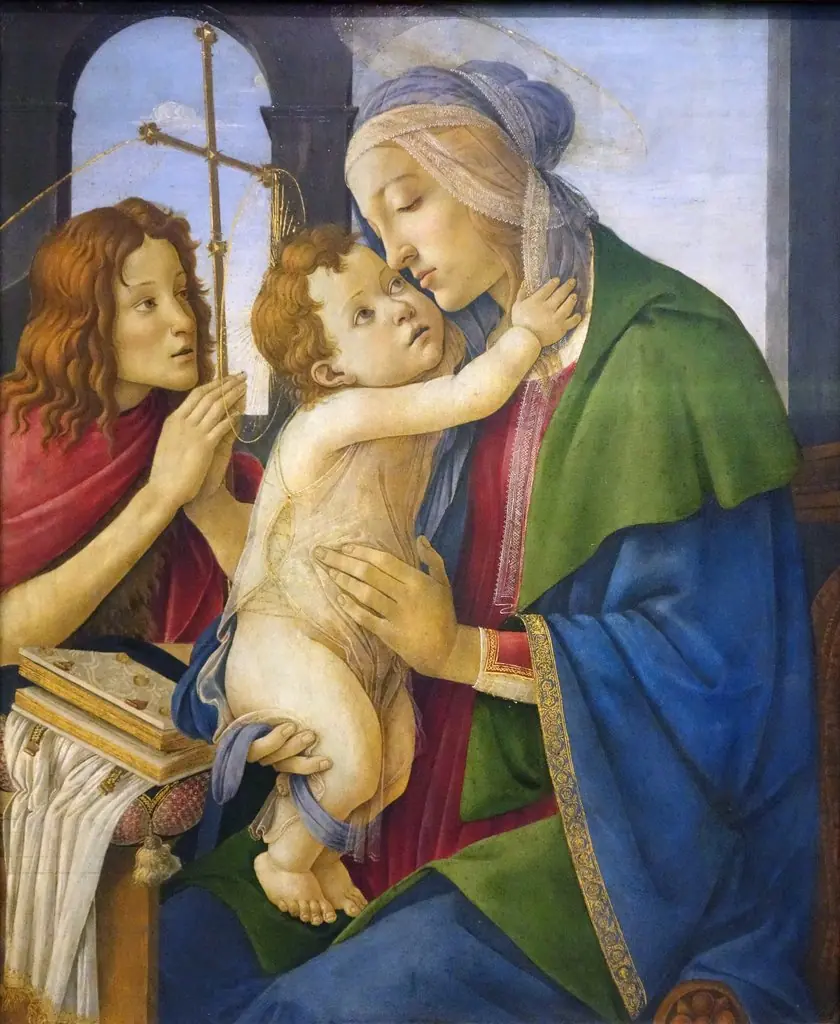 The Virgin and Child with the Young Saint John the Baptist
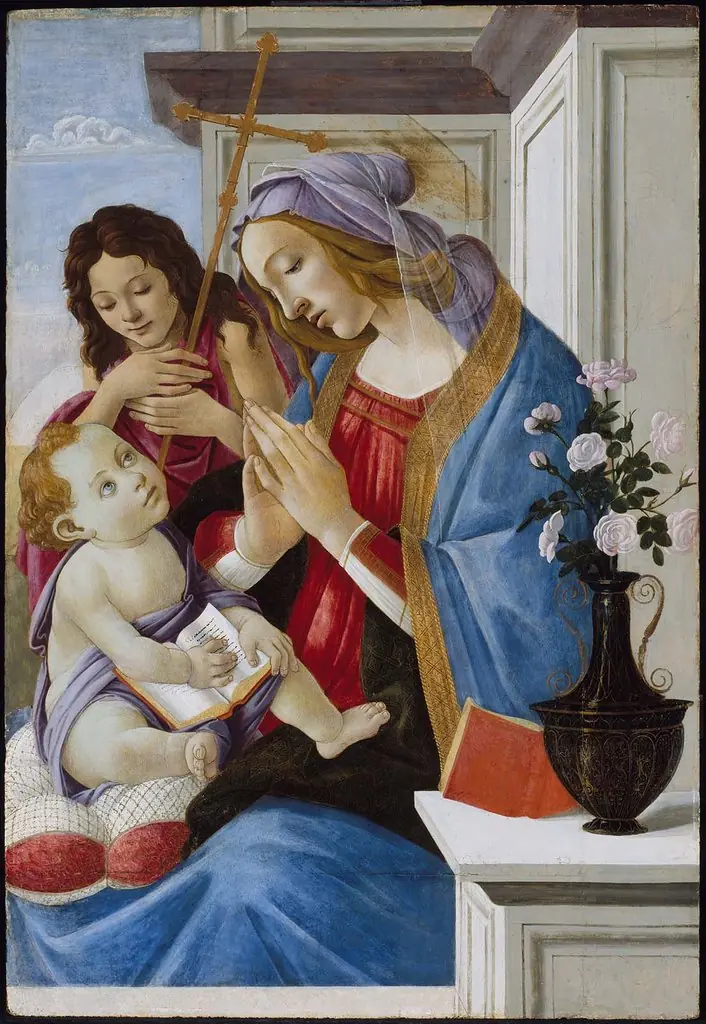 Virgin and Child with Saint John the Baptist
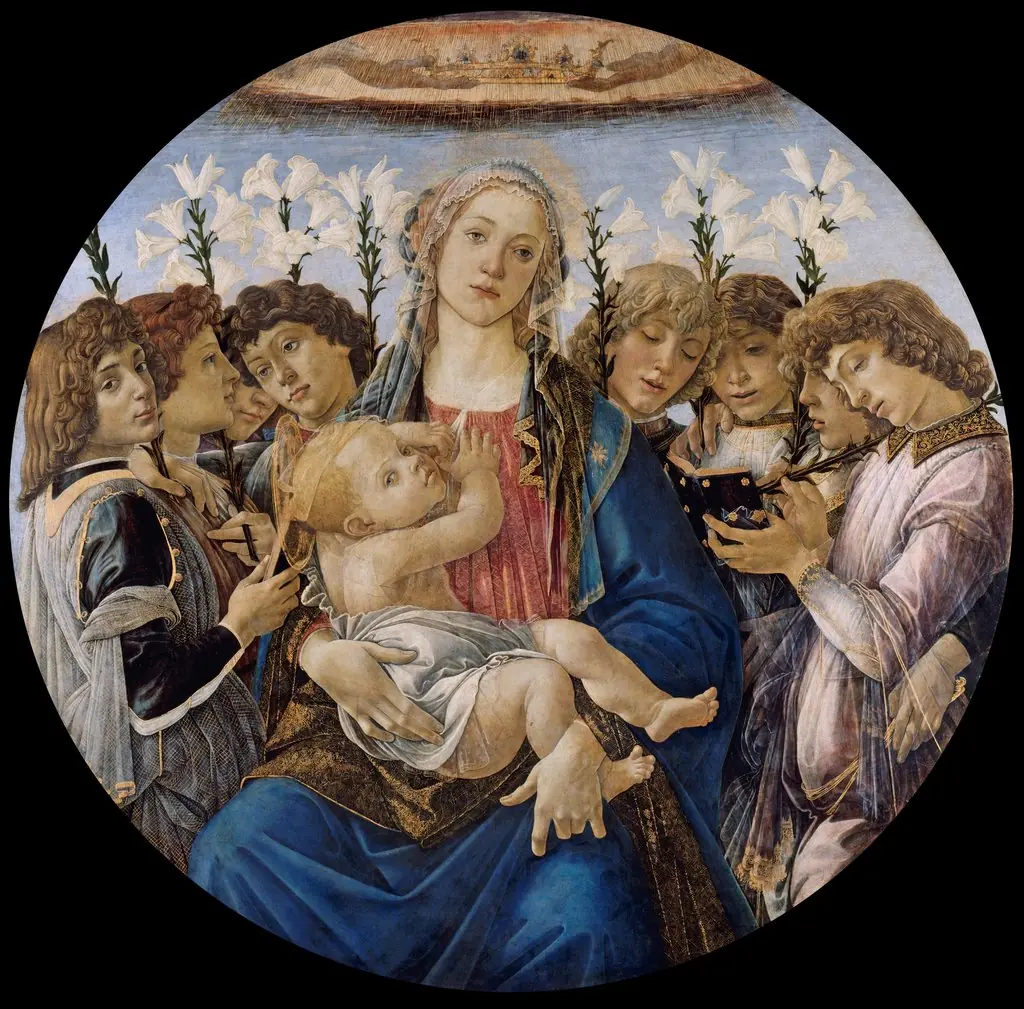 Mary with the Child and Singing Angels
 Terranuova Madonna
 Virgin and Child with the Young Saint John the Baptist
 Virgin and Child with Angels
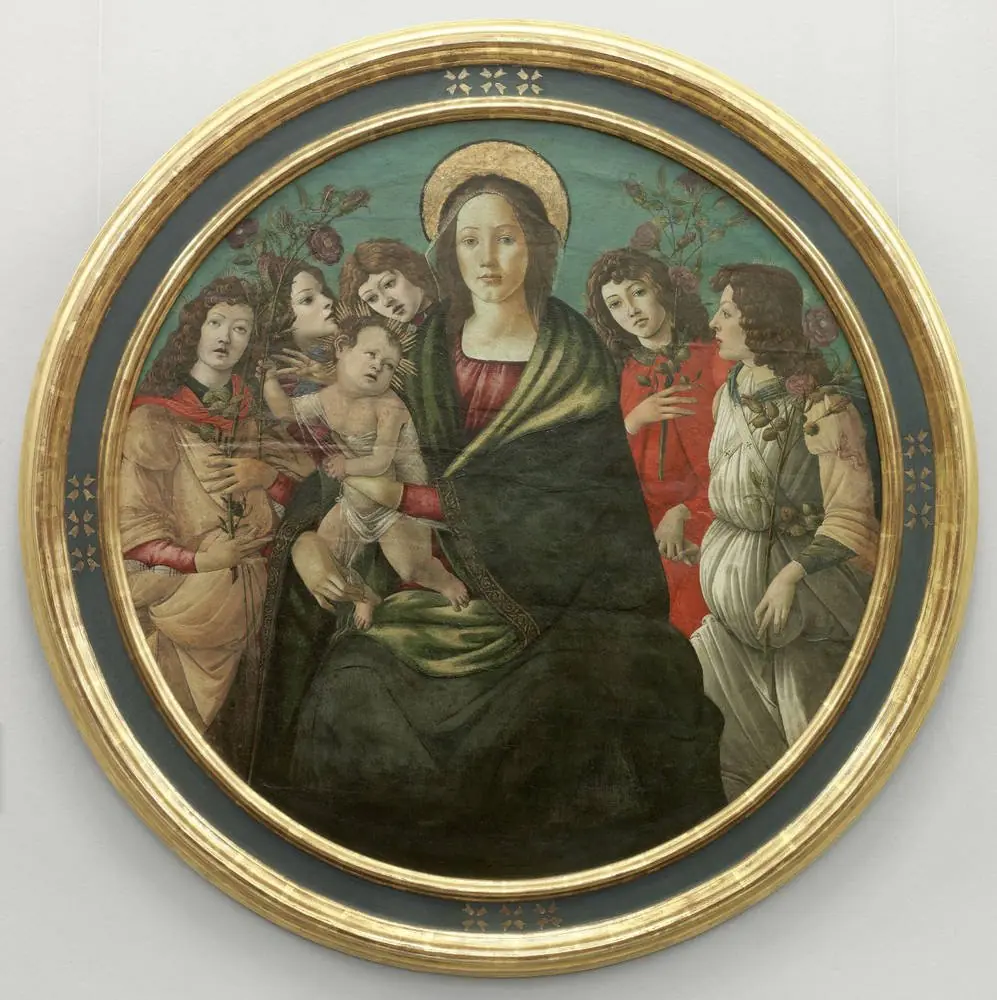 Maria mit dem Kind und Engeln