Artwork
Hans Roth [obverse]
![Hans Roth [obverse], by Bernhard Strigel, oil, 1527](https://artifactworldgallery.com/img/bernhard-strigel--hans-roth-obverse--9904e8cf2692db0d-w1024.webp)
Hans Roth [obverse] is an oil painting by the Northern Renaissance artist Bernhard Strigel. It dates from 1527 and is held in the collection of the National Gallery of Art.
- Inscription
- Inscribed:across bottom on engaged frame: Gleich in gemeldtem iar ach ich, do liess ich Conterfeten mich (decorative element) 1527 (decorative element) / Und ward Octobris sechtzehn tag Alt sechsundzwaintzg iar wie ich sag (decorative element) (In the same year I too had myself portrayed. 1527. And it was the sixteenth day of October. I was twenty-six, as I say.); on ring of sitter's forefinger: (initials RH and the Roth family coat-of-arms: on dexter, a unicorn rampant; on sinister, two bars sable on argent)
About this work
Technique & Style
The oil-on-panel technique allows for smooth blending and fine surface texture, consistent with the Northern Renaissance approach seen in Strigel’s oeuvre.
The work is executed in oil paint on a wooden panel, a medium and support typical of Bernhard Strigel’s small-scale portraits. As a portrait, it likely features the artist’s characteristic precise handling, with careful modeling of facial features and delicate linear detail. The oil-on-panel technique allows for smooth blending and fine surface texture, consistent with the Northern Renaissance approach seen in Strigel’s oeuvre.
History & Provenance
Painted by Bernhard Strigel in 1527, the portrait likely passed first through the family of its sitters, Hans Roth (d. 14 March 1573) and Margarethe Vöhlin (d. 5 July 1582) of Memmingen, Augsburg, and Ulm. Anton H. Konrad proposed in a 1988 letter to NGA curator John Hand that the portraits remained with the Roth family at the Schloss at Reutti (now Neu-Ulm) until 1890, when bankruptcy forced dispersal of the collection; however, the Schloss archive no longer survives, leaving that account unverified.
The documented ownership chain resumes with Manoli Mandelbaum of Berlin, from whom the panel passed through the Munich dealer Julius Böhler in January 1922. Böhler's correspondence with Hand (9 November 1987) and his inventory card no. 22-149 confirm the transaction. The dealer Paul Cassirer in Berlin handled the sale, and in March 1922 collectors Ralph Harman Booth (1873–1931) and Mary Batterman Booth (d. 1951) of Grosse Pointe, Michigan, purchased the painting. In 1947 the Booths gave it to the National Gallery of Art.
The portrait is currently held by the National Gallery of Art in Washington, D.C., where it was accessioned in 1947 as a gift from Ralph Harman and Mary Batterman Booth. Prior to this donation, the work entered the Booth collection in March 1922 after being purchased from the Berlin dealer Paul Cassirer. The painting's provenance traces back to the original sitter, Hans Roth, and his wife Margarethe Vöhlin in the German cities of Memmingen, Augsburg, and Ulm.
Historical records suggest the work remained in the Roth family possession at Schloss Reutti until 1890, when financial difficulties led to the dispersal of their collection.
Overview
Bernhard Strigel, a German painter associated with the Swabian school, completed this oil on panel portrait of Hans Roth in 1527. The work exemplifies characteristics of the Northern Renaissance, notably its emphasis on detailed realism and the depiction of individual character. Strigel, born around 1461 in Memmingen, was active as both a portraitist and a historical painter, eventually earning the patronage of Emperor Maximilian I.
Subject & Meaning
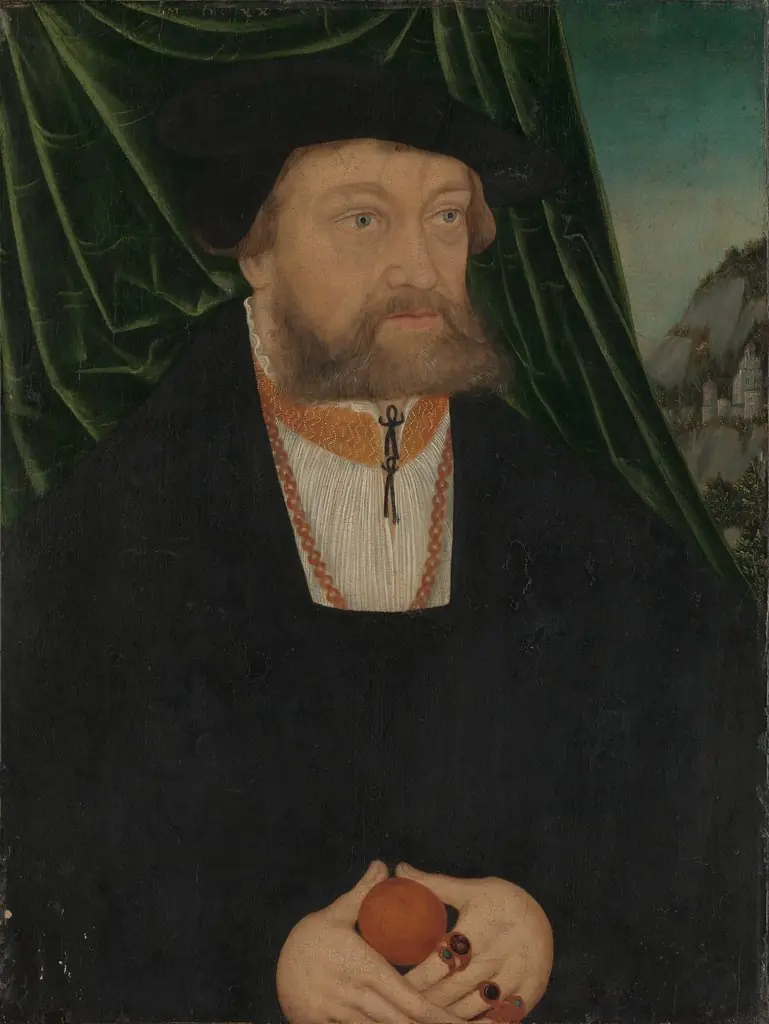
The painting depicts a man, likely Hans Roth, dressed in a black hat, a brown cloak, and a white ruffled collar. He holds an orange in his right hand, which also displays a ring. The background is divided, featuring a landscape on the left side and a decorative green pattern on the right.
This attire and the inclusion of a landscape element are consistent with portraiture conventions of the Renaissance era.
Context
Created in 1527, Hans Roth is a product of the Northern Renaissance, an artistic movement known for its meticulous detail and focus on individual identity. Bernhard Strigel, active in Memmingen, was a prominent figure within this period, particularly favored by Emperor Maximilian I. His work, including this portrait, contributes to the understanding of German Renaissance art, blending regional traditions with broader European artistic developments.
Own this work as a print
Artist & collection
Artist
Bernhard Strigel (c. 1461 – 4 May 1528) was a German portrait and historical painter of the Swabian school, the most important of a family of artists established at Memmingen. He was born at Memmingen and was probably a…

![Margarethe Vöhlin [reverse], by Bernhard Strigel](https://artifactworldgallery.com/img/bernhard-strigel--margarethe-vohlin-reverse--01f4c80425fbb8fe-w320.webp)

![Margarethe Vöhlin [obverse], by Bernhard Strigel](https://artifactworldgallery.com/img/bernhard-strigel--margarethe-vohlin-obverse--435992056faaebf8-w320.webp)
![Hans Roth [reverse], by Bernhard Strigel](https://artifactworldgallery.com/img/bernhard-strigel--hans-roth-reverse--9e98efc46bbdf23c-w320.webp)