Artwork
The young man changes himself to look like Mansur, and thus inveigles himself into the bed of Mansur’s wife, but is put off by her, from a Tuti-nama (Tales of a Parrot): Seventeenth Night
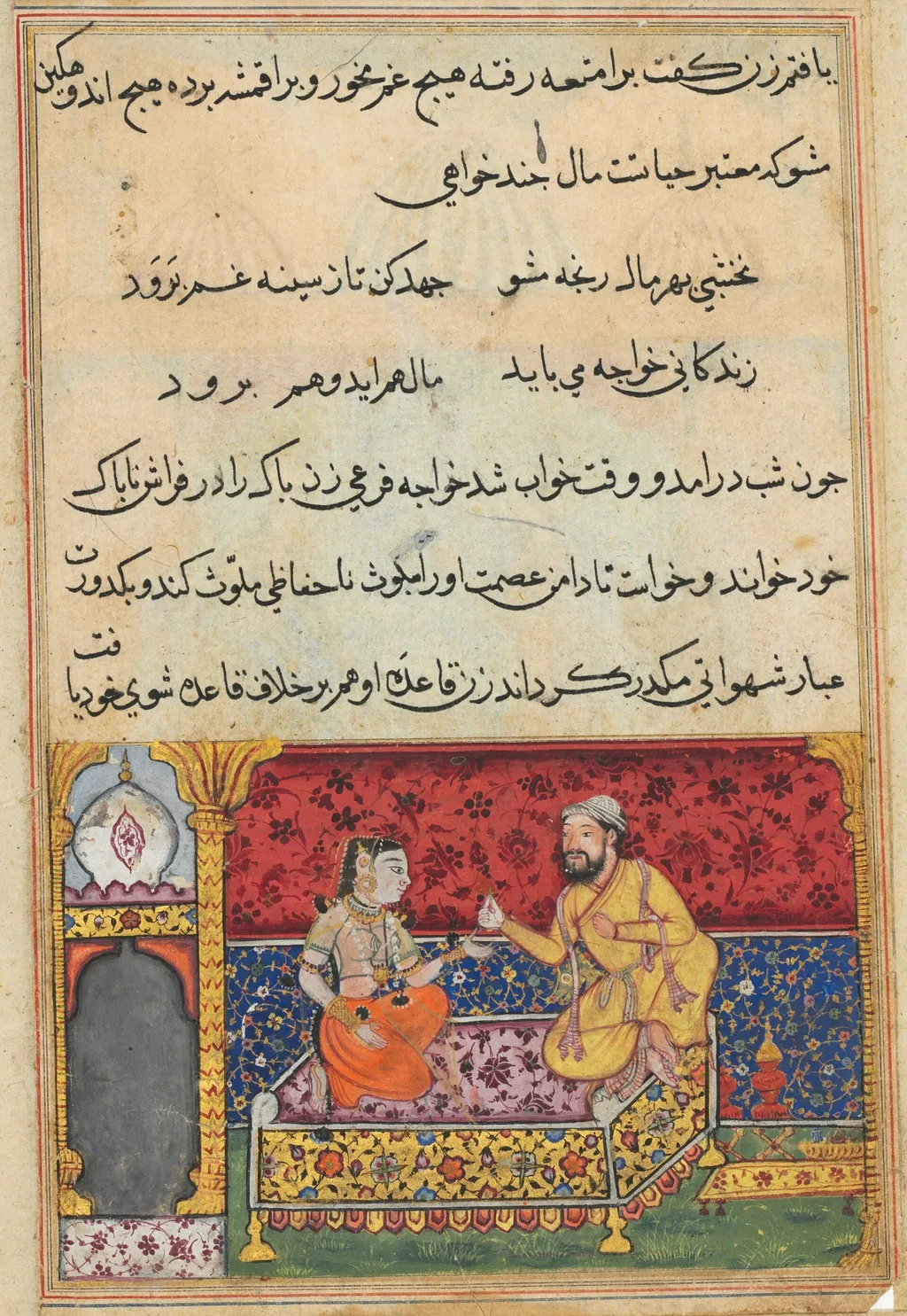
The young man changes himself to look like Mansur, and thus inveigles himself into the bed of Mansur’s wife, but is put off by her, from a Tuti-nama (Tales of a Parrot): Seventeenth Night is an unspecified painting. It dates from 1560 and is held in the collection of the Cleveland Museum of Art. The work illustrates a scene from the seventeenth night of the Persian illustrated manuscript known as the Tuti‑nama, or Tales of a Parrot.
About this work
Subject & Meaning
The painting illustrates the narrative of the seventeenth night from the Tuti-nama (Tales of a Parrot), a Persian manuscript of fables.
The painting illustrates the narrative of the seventeenth night from the Tuti-nama (Tales of a Parrot), a Persian manuscript of fables. The specific scene depicts a young man who magically transforms his appearance to resemble Mansur. Disguised as Mansur, the protagonist attempts to deceive Mansur's wife by gaining access to her bedchamber.
However, the wife rejects his advances, seeing through the deception or refusing the act. Created within the Mughal Empire around 1560, the work serves as a visual retelling of this moral tale concerning deception, disguise, and the consequences of attempted infidelity within the larger framework of the parrot's stories designed to delay a husband's execution of his wife.
History & Provenance
This painting, depicting a scene from the seventeenth night of the Tuti-nama, was created in 1560 within the Mughal Empire. The work is attributed to an unknown artist and is classified as a painting. It is currently held in the collection of the Cleveland Museum of Art, where it is cataloged under the accession number 1962.279.128.b. The specific narrative illustrated involves a young man disguising himself as Mansur to gain access to Mansur's wife.
Overview
The work illustrates a scene from the seventeenth night of the Persian illustrated manuscript known as the Tuti‑nama, or Tales of a Parrot. Executed as a miniature painting, it portrays a young man and a woman seated on a bed, engaged in quiet dialogue. The composition is framed by vivid floral motifs in red and blue, and a modest window appears on the left side of the picture.
Technique & Style
Rendered in the traditional Persian miniature style, the painting employs delicate brushwork and a rich palette of yellows, oranges, whites, reds, and blues. Intricate ornamental borders and stylised floral patterns frame the figures, while the small object held by the man is depicted with fine detail, characteristic of courtly manuscript illustration.
Artist & collection

- The young man changes himself to look like Mansur, and thus inveigles himself into the bed of Mansur’s wife, but is put off by her, from a Tuti-nama (Tales of a Parrot): Seventeenth Night
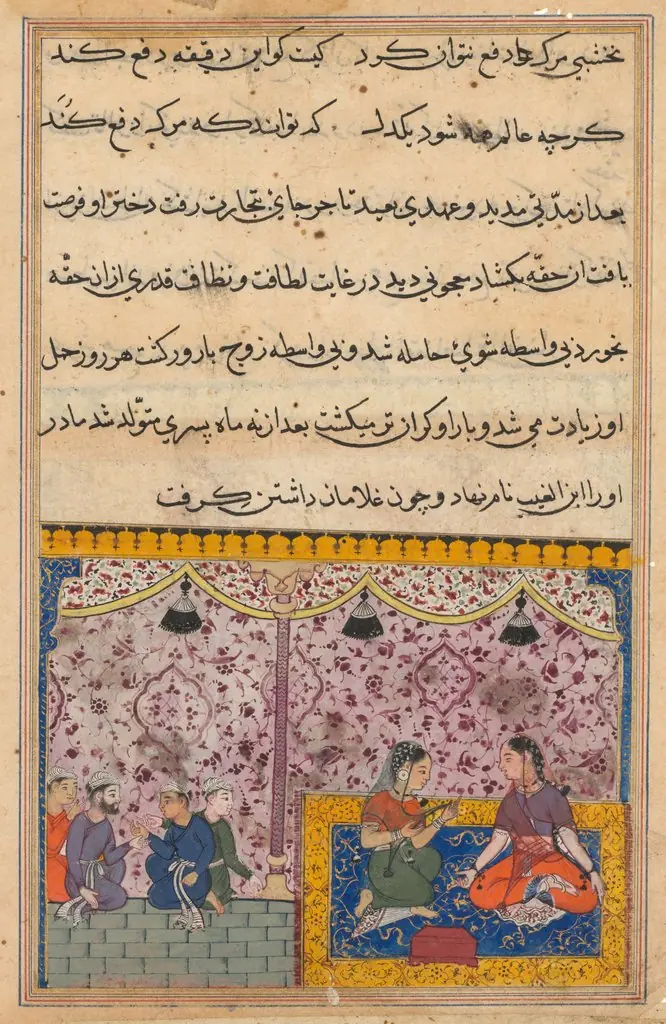 The merchant’s daughter gives birth to a son as a result of eating out of the box. The clever child recognizes the false gems from true, from a Tuti-nama (Tales of a Parrot): Twenty-third Night
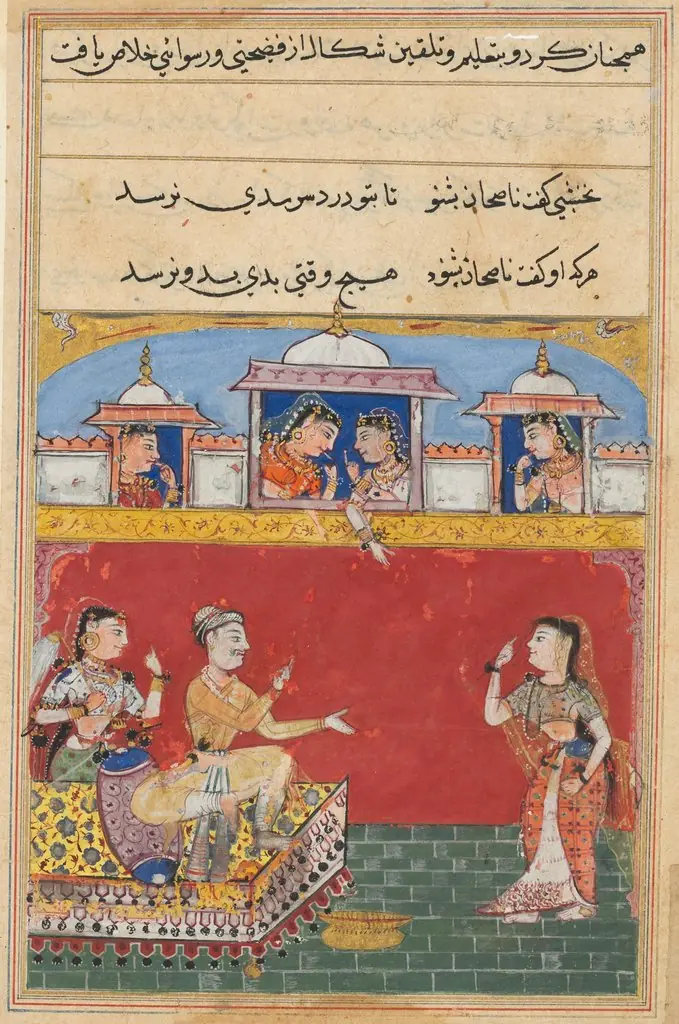 The daughter-in-law returns from her misadventure, feigning insanity, from a Tuti-nama (Tales of a Parrot): Sixteenth Night
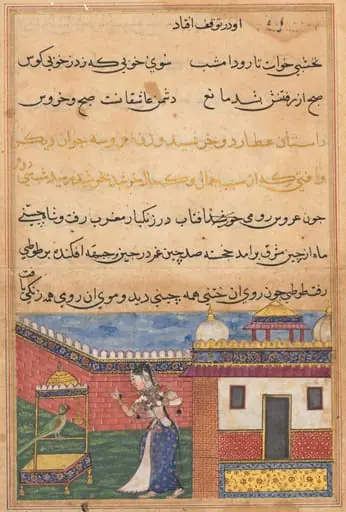 The parrot addresses Khujasta at the beginning of the thirty-second night, from a Tuti-nama (Tales of a Parrot)
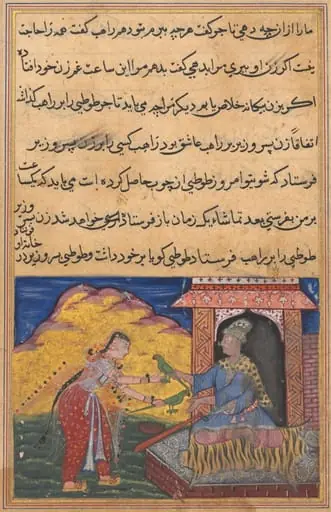 The wife of the son of the vizier brings the magic wooden parrot to her lover, the monk, who exchanges it for the replica, from a Tuti-nama (Tales of a Parrot): Tenth Night
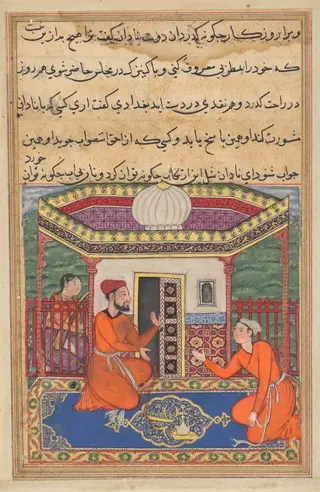 The young man of Baghdad solicits advice from a friend as his slave girl, who is adept at music, awaits, from a Tuti-nama (Tales of a Parrot): Forty-eighth Night
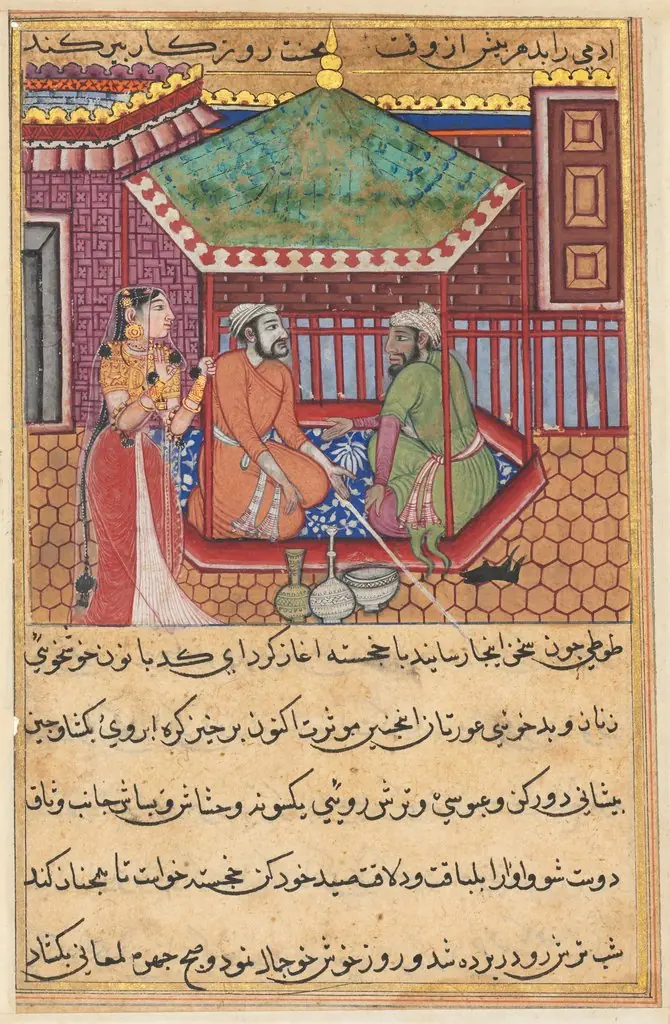 The eldest brother explains the reason for his youthful appearance, from a Tuti-nama (Tales of a Parrot): Forty-ninth Night
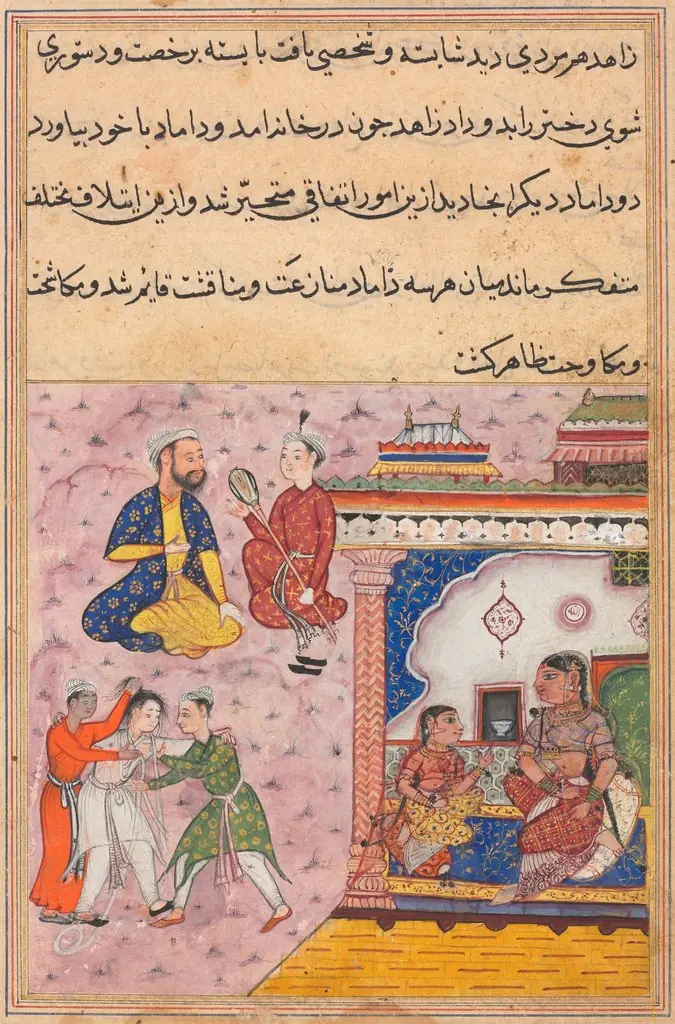 Three suitors fight amongst themselves for the hand of the devotee’s daughter, from a Tuti-nama (Tales of a Parrot): Twentieth Night
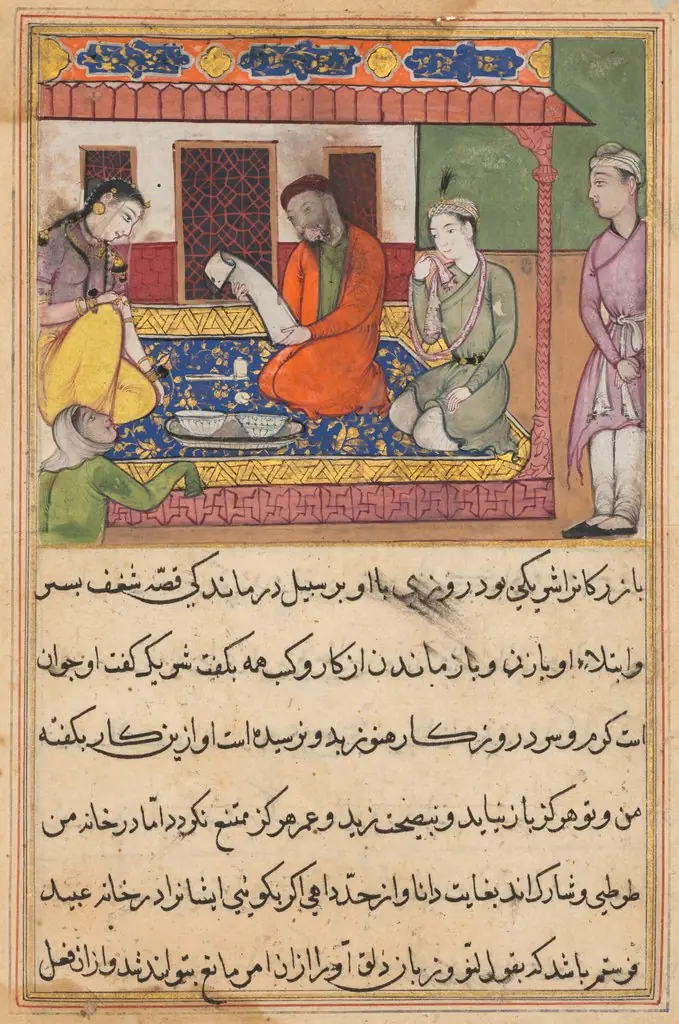 The marriage of ‘Ubaid, son of a merchant of Tirmiz, from a Tuti-nama (Tales of a Parrot): Forty-second Night
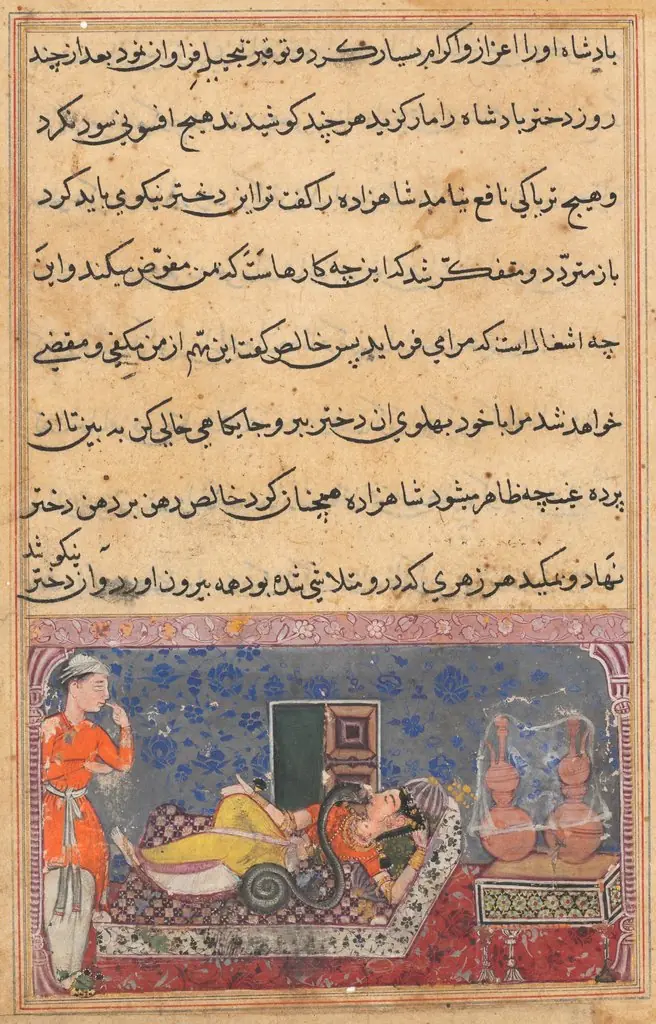 Khalis repays the prince for his kindness by changing into a snake and sucking the poison from the king’s daughter, from a Tuti-nama (Tales of a Parrot): Eighteenth Night
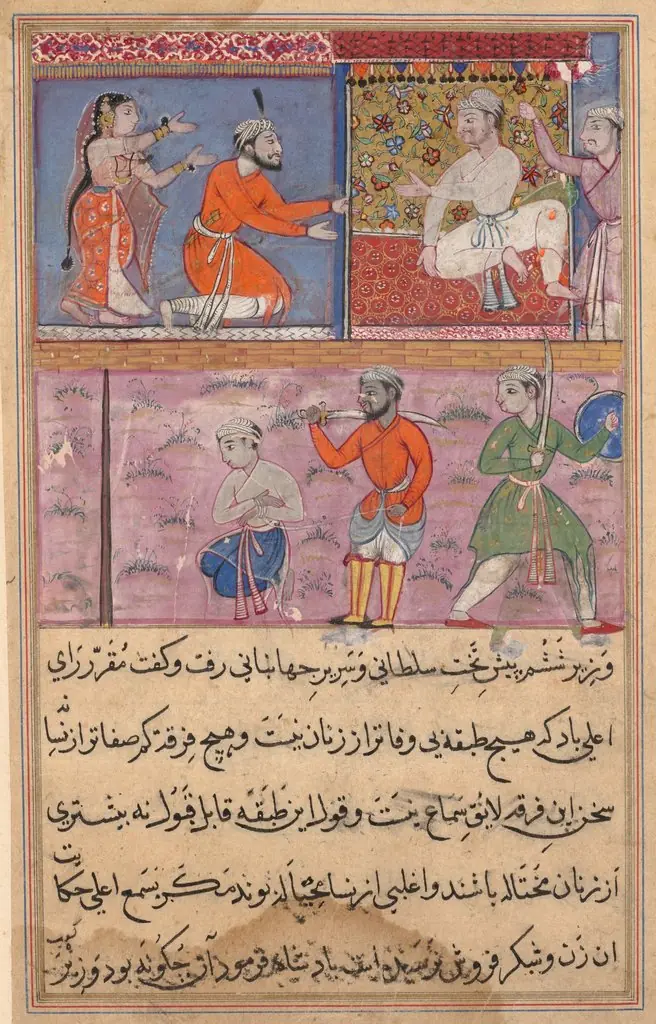 Page from Tales of a Parrot (Tuti-nama): text page
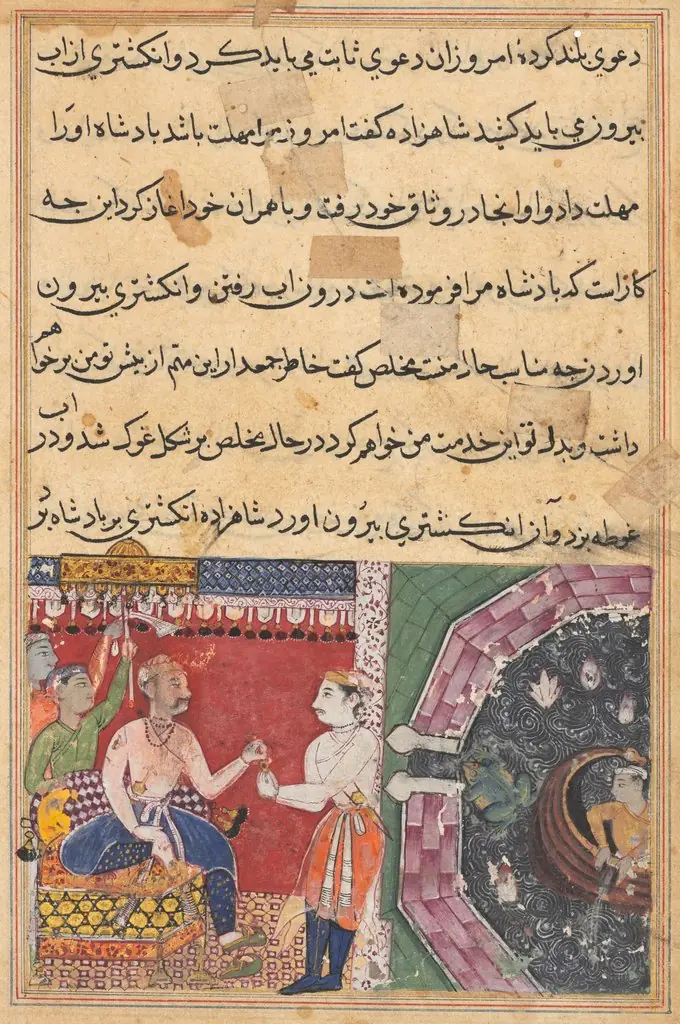 The prince, with the help of Mukhlis who changes into a frog, recovers the ring lost in the sea, and returns it to the king, from a Tuti-nama (Tales of a Parrot): Eighteenth Night