Artwork
Danaë
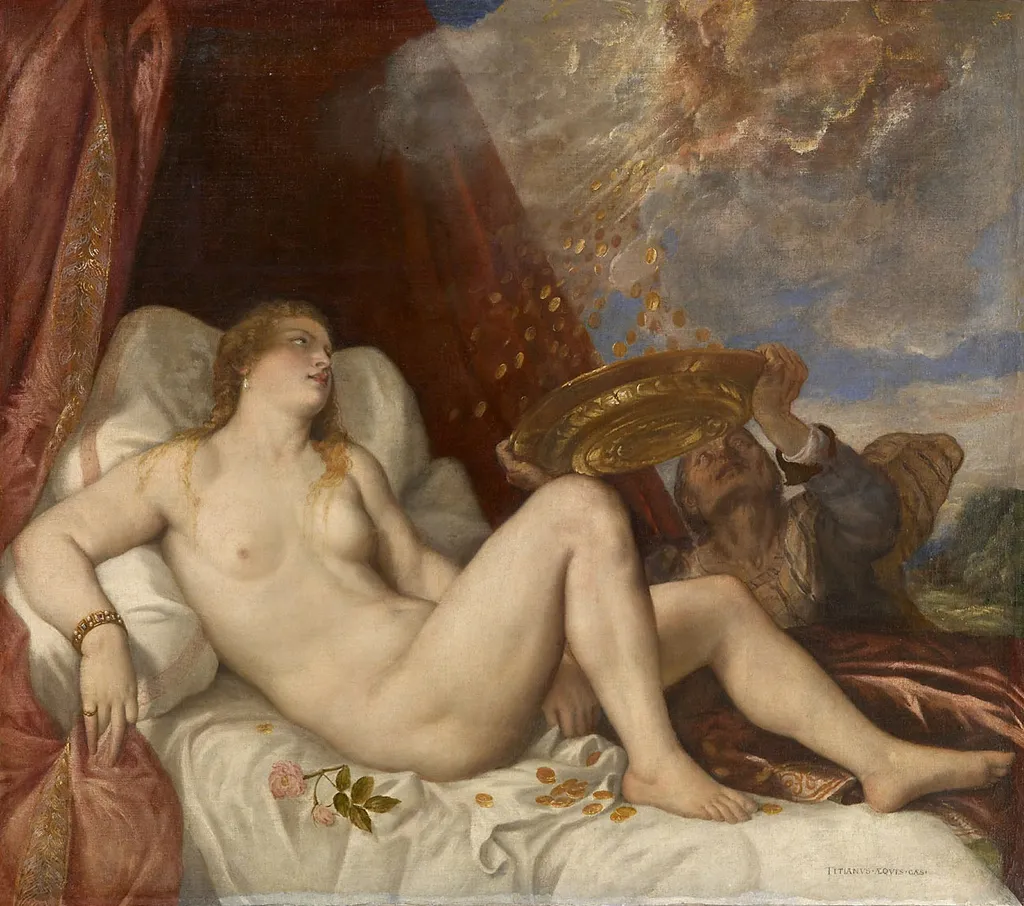
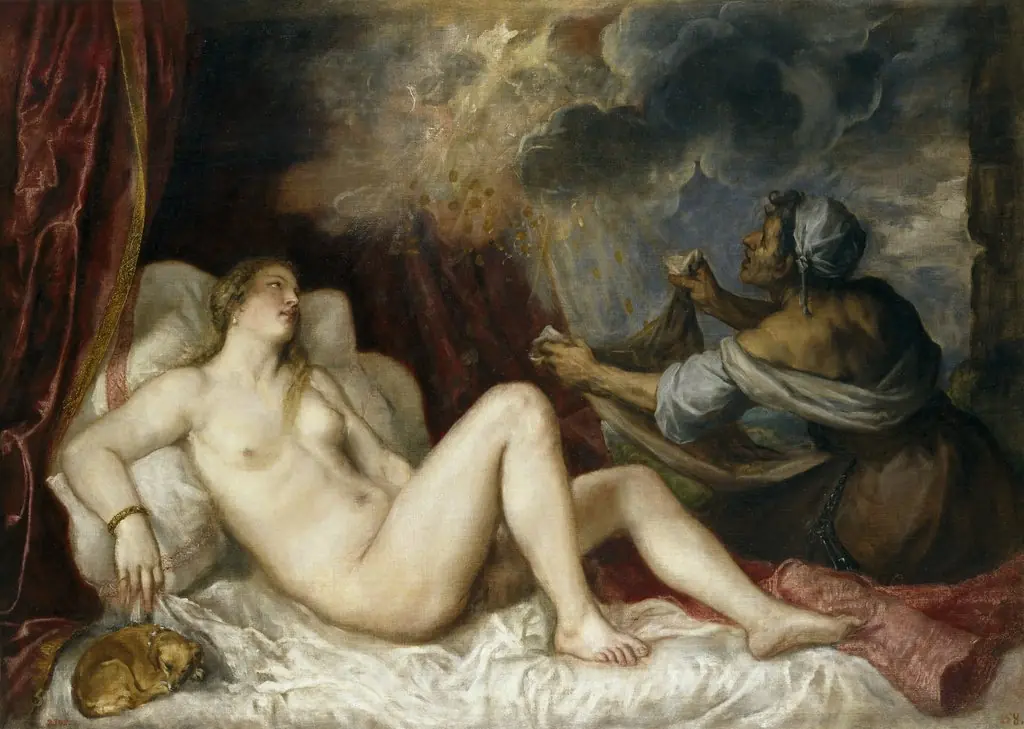
Danaë is an oil painting by the High Baroque Italian artist Titian. It dates from 1550 and is held in the collection of the Kunsthistorisches Museum.
About this work
Subject & Meaning
The painting illustrates the mythological figure Danaë, specifically capturing the moment of her impregnation by Jupiter, who appears as a shower of gold.
The painting illustrates the mythological figure Danaë, specifically capturing the moment of her impregnation by Jupiter, who appears as a shower of gold. In this Viennese iteration, the iconography diverges from earlier versions by depicting the divine presence as a distinct head within a cloud rather than an abstract luminous force. Furthermore, the miraculous rain is rendered as tangible gold coins falling onto the bed and into a platter held by a domestic attendant, who actively collects the wealth.
This specific visualization transforms the celestial event into a scene of material accumulation, emphasizing the monetary value of the divine visitation alongside the erotic nude form of the heroine.
Technique & Style
The painting is executed in oil on canvas, measuring approximately 135 × 152 cm and dated to the mid‑1550s; the dimensions and material are recorded in the museum catalogue. Titian’s handling features a thick, impasto underpainting applied in broad patches, followed by successive reworking that leaves pentimenti visible in X‑ray examinations. The composition displays a cloud‑filled sky, a shower of gold coins, and a servant collecting them, a motif that replaces the traditional rain of gold and reflects the Venetian school’s emphasis on luminous colour and dynamic brushstroke.
Recent conservation at the Kunsthistorisches Museum confirmed the work’s authorship and revealed hidden architectural elements, underscoring its delicate condition and the layered technique characteristic of Titian’s late period.
History & Provenance
The Vienna Danaë is an oil on canvas (135 × 152 cm) painted by Titian, with sources dating it to 1550 or 1554. It is the only signed version of the composition, bearing the inscription "Titianus. Aeques.
Caes." Nothing is known about its original commission. The painting was long considered a workshop production, but following restoration by the Kunsthistorisches Museum in Vienna, scholars now attribute it to Titian with assistance.
According to Robert Wald's X-ray studies, the Vienna canvas derives compositionally from the earlier Naples Danaë (first version, 1545) and the subsequent Madrid version, which served as its cartonic basis. By 1600 the work was recorded among the canvases that Cardinal Montalto sent to Emperor Rudolf II in Prague. It subsequently passed to Archduke Leopold Wilhelm of Austria before entering the imperial collection that is today housed at the Kunsthistorisches Museum in Vienna.
The painting is held in the collection of the Kunsthistorisches Museum in Vienna. Historically, the work was owned by Emperor Rudolf II, having been sent to him in Prague around 1600 by Cardinal Montalto. It subsequently entered the possession of Archduke Leopold Wilhelm of Austria before becoming part of the imperial collections.
Although long considered a workshop production, recent restoration and analysis by scholars such as Robert Wald have led critics to attribute the canvas to Titian with assistance. The work is distinguished as the only version of the subject signed by the artist. While specific modern exhibition records are not detailed in the available texts, its provenance traces a clear path from papal circles in Rome to the imperial courts of Prague and Vienna.
Context
Titian's Vienna Danaë occupies a pivotal position in the artist's late career, reflecting the stylistic shift described by Vasari in 1566 toward a looser, more painterly technique executed with broad strokes and visible patches. Scholarship, including X-ray analysis by Robert Wald, reveals the work's complex genesis, tracing its composition back to the earlier Naples version and showing links to Michelangelo's figures and Giorgione's influence. While once attributed to the workshop, restoration and critical re-evaluation now affirm it as a collaboration between Titian and assistants.
The painting is the only signed version of the myth by the artist and served as a foundational model for later treatments by Rembrandt, Van Dyck, and Klimt. Its unique iconography, featuring a nurse collecting gold coins rather than a shower of light, distinguishes it within the series of mythological nudes created for the Farnese and Habsburg patrons.
Legacy
The Vienna Danaë, housed in the Kunsthistorisches Museum, has undergone a shifting reputation: long regarded as a workshop product, a recent restoration led scholars to accept it as a work by Titian with assistance, and it remains the only signed version of the composition. Its provenance includes inclusion in the 1600 shipment of Cardinal Montalto’s paintings to Emperor Rudolf II in Prague. After Titian, the motif of Danaë inspired later artists such as Rembrandt, van Dyck and Klimt, demonstrating its enduring influence on European art.
Overview
Titian's Danaë, an oil painting from approximately 1550, presents the mythological princess Danaë in a reclining pose. The artwork captures a pivotal moment from her story, depicting her encounter with a divine shower of gold. This significant piece is housed within the collection of the Kunsthistorisches Museum, showcasing the artist's enduring skill in narrative and figure painting.
Artist & collection
Artist
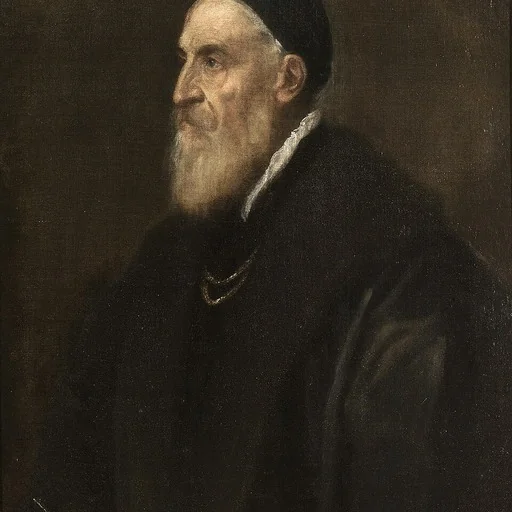
Tiziano Vecellio (Italian:; c. 1488/1490 – 27 August 1576), Latinized as Titianus, hence known in English as Titian ( TISH-ən), was an Italian Renaissance painter. The most important artist of Renaissance Venetian…