Artwork
Ecce Homo
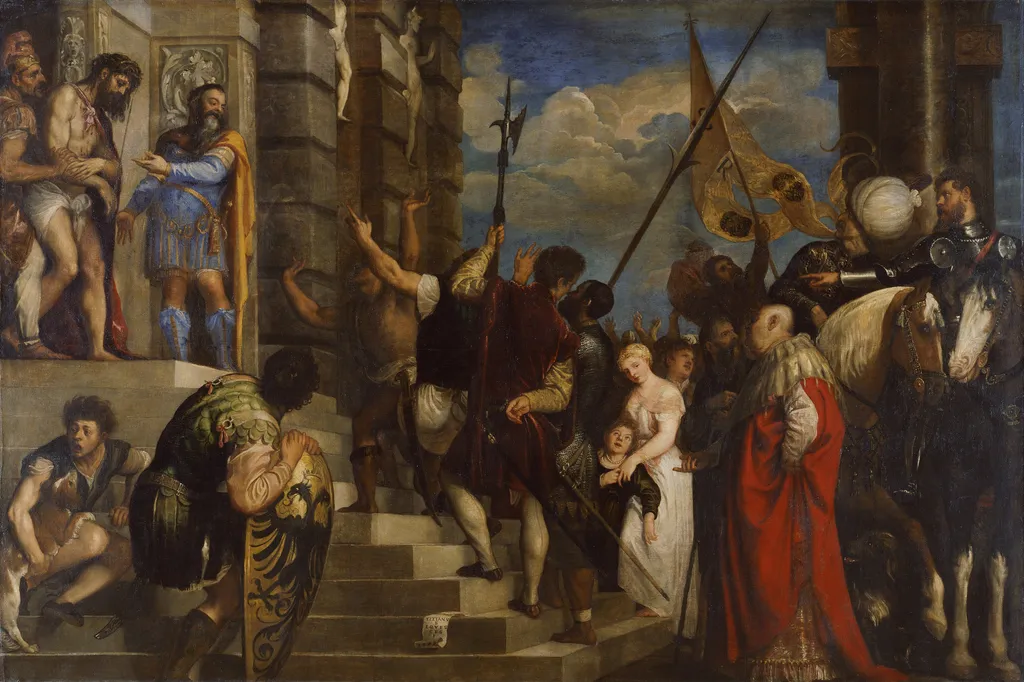
Ecce Homo is an oil painting by the Mannerist artist Titian. It dates from 1543 and is held in the collection of the Kunsthistorisches Museum.
About this work
The painting is called Ecce Homo, made by Titian in 1543. It's an oil on canvas work, which is a common way to make paintings. The Kunsthistorisches Museum in Vienna has this painting, and it's notable because it's signed and dated by Titian, which helps us know it's really his work. You can learn more about this style by looking at the work of artist Titian.
Subject & Meaning
Scholars interpret the composition as a visual critique of judgment and mockery, emphasizing the contrast between Christ's suffering and the indifferent crowd.
Ecce Homo depicts Christ standing, bare-chested, presented by Pontius Pilate to a diverse assembly that includes a young woman in white, a patrician in ermine, soldiers, horsemen and a figure bearing a shield. Pilate's face, modeled on Pietro Aretino, conveys haughty cynicism; the white-clad girl is identified as Titian's daughter Lavinia. The painting's iconography mixes contemporary Venetian elite symbols, horses, a shield bearing the double eagle, and a figure possibly representing a Turkish sultan, reflecting the patronage context.
Scholars interpret the composition as a visual critique of judgment and mockery, emphasizing the contrast between Christ's suffering and the indifferent crowd.
Technique & Style
The Ecce Homo is executed in oil on canvas, measuring approximately 242 cm high by 361 cm wide and signed and dated 1543. Titian's handling of the medium creates a broad, dynamic rhythm; the composition is built on sweeping diagonals and a lively interplay of poses and gestures. Figures are rendered with strongly marked individual types, Pilate in a blue Roman costume, the young girl in a soft white satin dress, and a crowd of warriors, horsemen and oriental types, while light falls intensely on the background, highlighting halberds, lances and fluttering banners. These qualities exemplify the Venetian school's emphasis on color and movement.
History & Provenance
Titian completed the oil-on-canvas Ecce Homo in 1543 in Venice for Giovanni d'Anna, a wealthy Flemish merchant residing on the Grand Canal. The work remained in the d'Anna family until at least 1580, during which time King Henry III of France reportedly offered 800 ducats to Paolo d'Anna in 1574 without success. By the early seventeenth century, Sir Henry Wotton acquired the painting, passing it to the Duke of Buckingham in 1621, who famously declined a £7,000 offer from the Earl of Arundel.
Following the English Commonwealth, the piece was auctioned in Antwerp in 1648 and subsequently purchased by Archduke Leopold Wilhelm for Emperor Ferdinand III. The painting was recorded in Prague before being transferred to Vienna in 1723, where it currently resides in the Kunsthistorisches Museum.
Titian's 1543 oil on canvas Ecce Homo is currently housed in the Kunsthistorisches Museum in Vienna, Austria. The work was originally commissioned by the Flemish merchant Giovanni d'Anna and remained in his family until the early seventeenth century. It was subsequently acquired by Sir Henry Wotton and later sold to the Duke of Buckingham in 1621.
After leaving England during the Commonwealth, the painting was auctioned in Antwerp in 1648 and purchased by Archduke Leopold Wilhelm for Emperor Ferdinand III. The artwork resided in Prague until it was transferred to Vienna in 1723, where it has remained part of the imperial collection ever since. No specific accession number is provided in the available records.
Overview
Titian's large oil on canvas painting, titled "Ecce Homo" (Latin for 'Behold the Man'), was completed in 1543. The artist's signature and the date are clearly visible on the work, confirming its authorship and period of creation. This significant piece is a prominent feature of the collection at the Kunsthistorisches Museum in Vienna.
Context
This particular "Ecce Homo" stands as a distinct work within Titian's oeuvre, which includes several compositions depicting Christ. It is important not to confuse it with other, often smaller, pieces by the artist on similar themes. For instance, another work, "Christ Carrying the Cross," is a separate painting whose attribution has sometimes been debated between Titian and Giorgione.
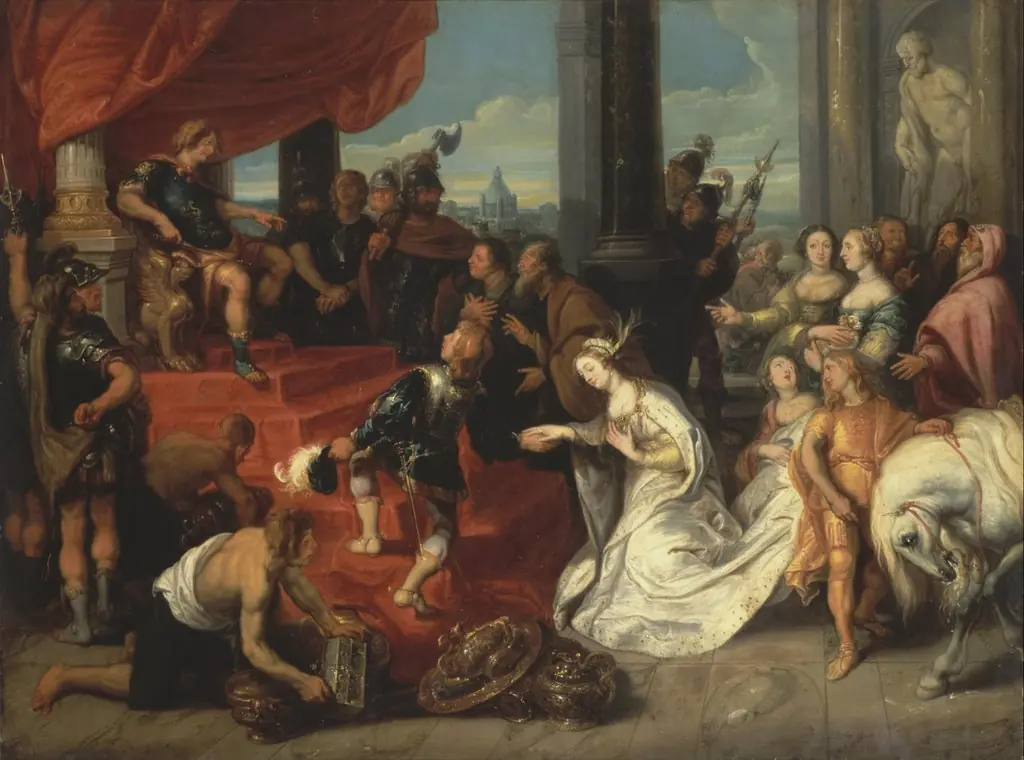
Own this work as a print
Artist & collection
Artist
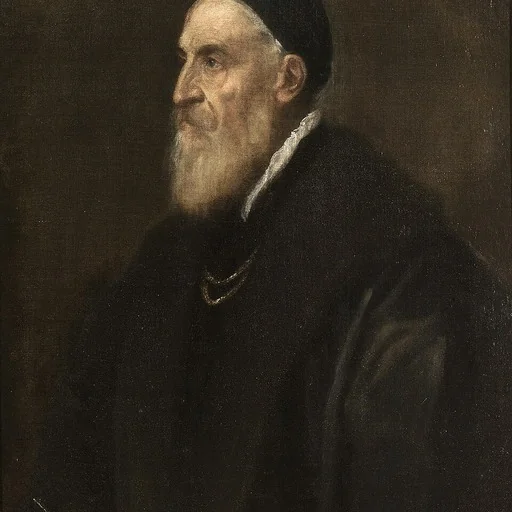
Tiziano Vecellio (Italian:; c. 1488/1490 – 27 August 1576), Latinized as Titianus, hence known in English as Titian ( TISH-ən), was an Italian Renaissance painter. The most important artist of Renaissance Venetian…

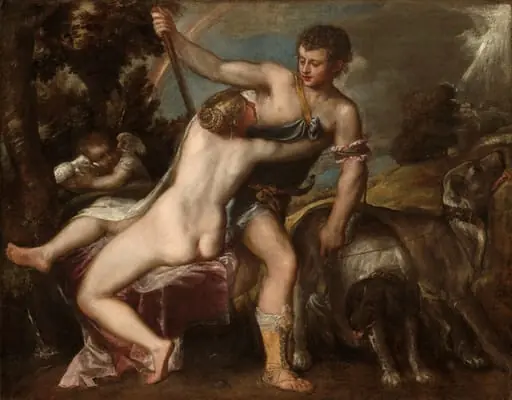
- The Magnanimity of Scipio Africanus
 Imperial Coronation
 Scene of Sacrifice
 The Meeting of David and Abigail
 Allegory of the wedding of Archduke Ferdinand Karl and Anna de' Medici
 David with Goliath's Head
 Feat of Marcus Curtius
 Queen Zenobia before the Emperor Aurelian
 Magnanimity of Scipio
 Alexander en Diogenes
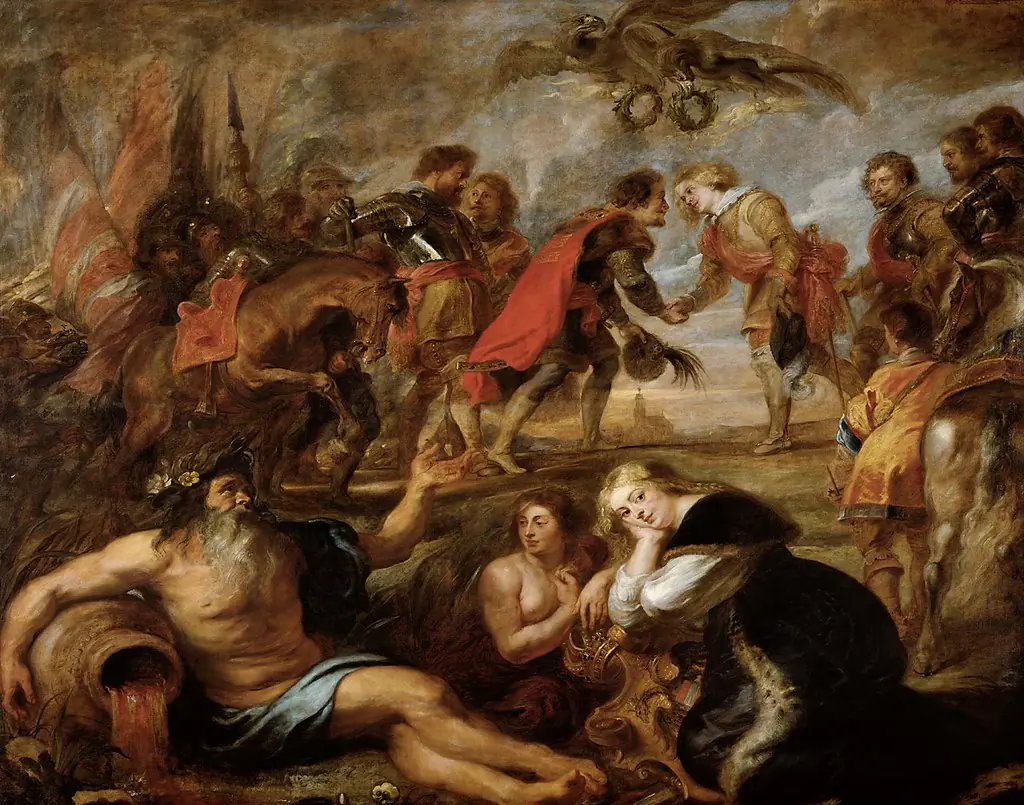 Meeting of King Ferdinand and Cardinal-infante Ferdinand at Nördlingen
 Absalom propitiating friends (2 Samuel 15:2-5)