Artwork
The Gypsy Madonna
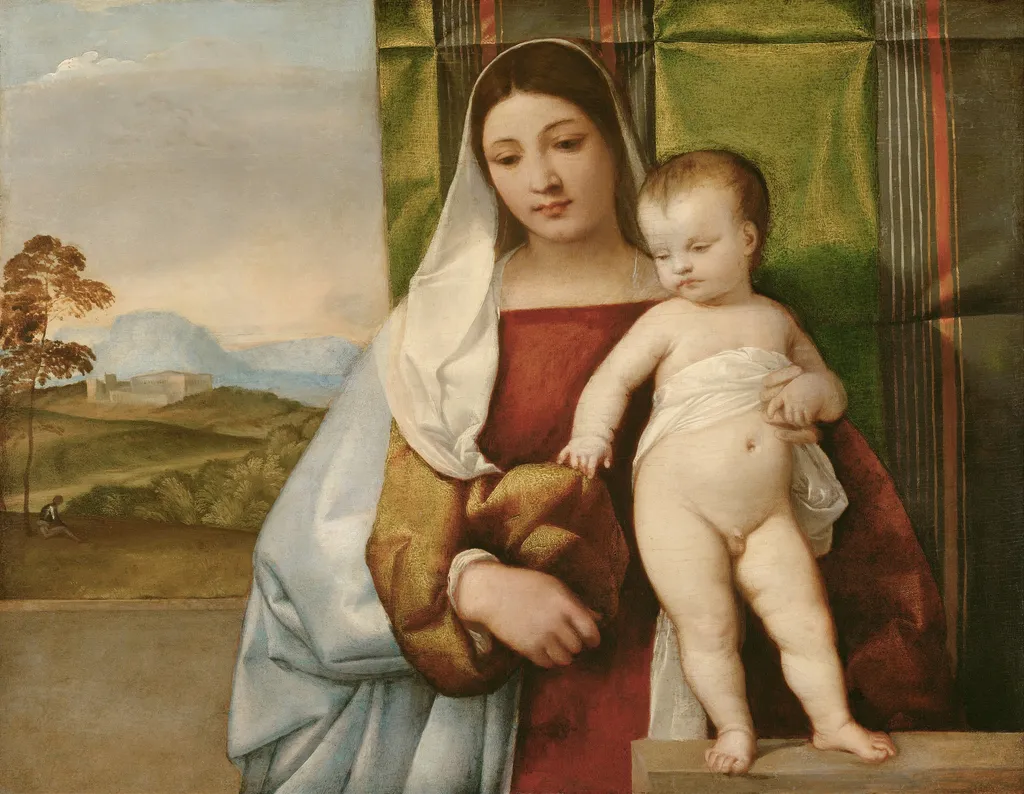
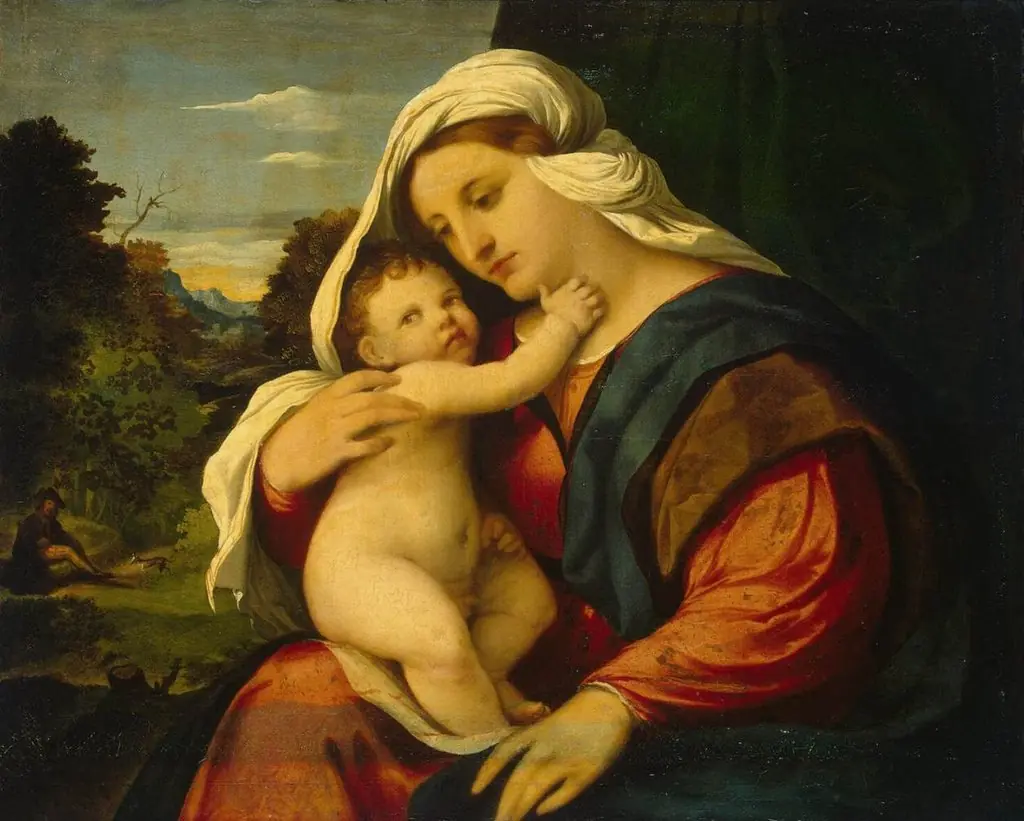
The Gypsy Madonna is an oil painting by the High Renaissance artist Titian. It dates from 1510 and is held in the collection of the Kunsthistorisches Museum.
About this work
Subject & Meaning
Titian's handling of light and texture endows the figures with a palpable presence, marking his early development of a distinctive, sensuous style.
The painting shows the Virgin Mary holding the infant Christ, identified as a Madonna and Child. She is portrayed with dark hair and eyes, a feature that inspired the 19th-century nickname "Gypsy Madonna." The composition includes a richly folded cloth of honour behind an implied throne, a landscape backdrop that mirrors the left portion of Giorgione's Dresden Venus, and a distant mountain and curtain that reference earlier Bellini formulas.
These elements link the work to the Venetian tradition while signalling a shift toward a more intimate, informal portrayal of the holy pair. Titian's handling of light and texture endows the figures with a palpable presence, marking his early development of a distinctive, sensuous style.
Technique & Style
Executed in oil on panel around 1510–1511, this work measures approximately 65.5 by 83.5 cm. Technical analysis reveals that Titian abandoned the careful underdrawing typical of Giovanni Bellini, instead employing summary brushstrokes with thin wash shading as guidelines. Significant compositional changes occurred during execution; radiographic evidence indicates the Christ Child originally looked directly at the viewer, and the background landscape differed from the final version.
Stylistically, the painting synthesizes Bellini's compositional formulas with Giorgione's atmospheric tonalism and harmonious figural fullness. The Virgin is depicted with a dusky complexion and dark features, while the landscape unifies the scene through color repetition. A carefully rendered cloth of honour occupies the right background, implying an unseen throne and marking a transition between formal enthroned Madonnas and informal landscape settings.
History & Provenance
The Gypsy Madonna was painted by Titian around 1510–11 as an oil on panel intended for domestic display rather than a church setting. Technical examination has shown that Titian reworked the composition significantly during execution, deviating from his usual underdrawing method by using only loose brush guidelines, and that the Christ Child's head was originally turned outward toward the viewer.
The work very likely entered the Venetian collection of Bartolomeo della Nave before being sold in Venice in 1636 to the Duke of Hamilton, who brought it to London. Following Hamilton's execution, it was acquired in 1659 by Archduke Leopold Wilhelm of Austria in Brussels, whose collection subsequently passed into the imperial holdings in Vienna, where it remains in the Kunsthistorisches Museum (inventory number GG 185).
Context
Scholars view The Gypsy Madonna as a pivotal early work in Titian's career, marking his transition from the influence of Giovanni Bellini and Giorgione toward an independent Venetian style. Freedberg emphasizes its technical virtuosity, noting the painting's unprecedented sense of palpable presence within a luminous atmosphere, achieved through refined optical handling of color and texture. The composition blends older formal traditions, such as the implied throne and cloth of honor, with newer informal motifs, positioning it between enthroned Madonnas and landscape-centered devotional images.
Early attributions to Giorgione persisted into the 20th century due to the Virgin's "harmonious fullness" and Giorgionesque melancholy gazes, yet technical studies confirm Titian's authorship and reveal significant pentimenti, including the Child's original frontal gaze.
The work's popular title, coined in the 19th century, reflects its reception as an image of earthly humanity, emphasizing the Virgin's dark features and the tender, tactile bond between mother and Child, a hallmark of Titian's humanist approach to sacred subjects.
Legacy
The Gypsy Madonna became a touchstone for Titian's early reputation by crystallizing his break from Bellini and Giorgione. In the nineteenth century its "dusky complexion" and dark hair prompted the popular name, and the painting's intimate humanity and optical intensity were seized upon by critics such as Sydney J. Freedberg as proof of Titian's precocious originality.
Its compositional synthesis, halfway between the formal enthroned Madonnas and informal Venetian pastoral modes, shaped later High Renaissance practice, influencing how Venetian painters balanced landscape with devotional intimacy. Technical findings that Titian repeatedly revised the design further burnished his image as an instinctive innovator who worked directly on the panel rather than relying on meticulous underdrawing.
Overview
Titian's The Gypsy Madonna, painted around 1510–11, depicts the Virgin Mary tenderly holding the Christ Child. Executed in oil on panel, this work is housed in the Kunsthistorisches Museum in Vienna. Unlike many religious commissions of its era, this painting was likely intended for private devotion within a domestic setting rather than a public church. Its intimate scale and composition reflect this personal purpose.
Own this work as a print
Artist & collection

Artist
Tiziano Vecellio (Italian:; c. 1488/1490 – 27 August 1576), Latinized as Titianus, hence known in English as Titian ( TISH-ən), was an Italian Renaissance painter. The most important artist of Renaissance Venetian…