Artwork
Sciarra Madonna
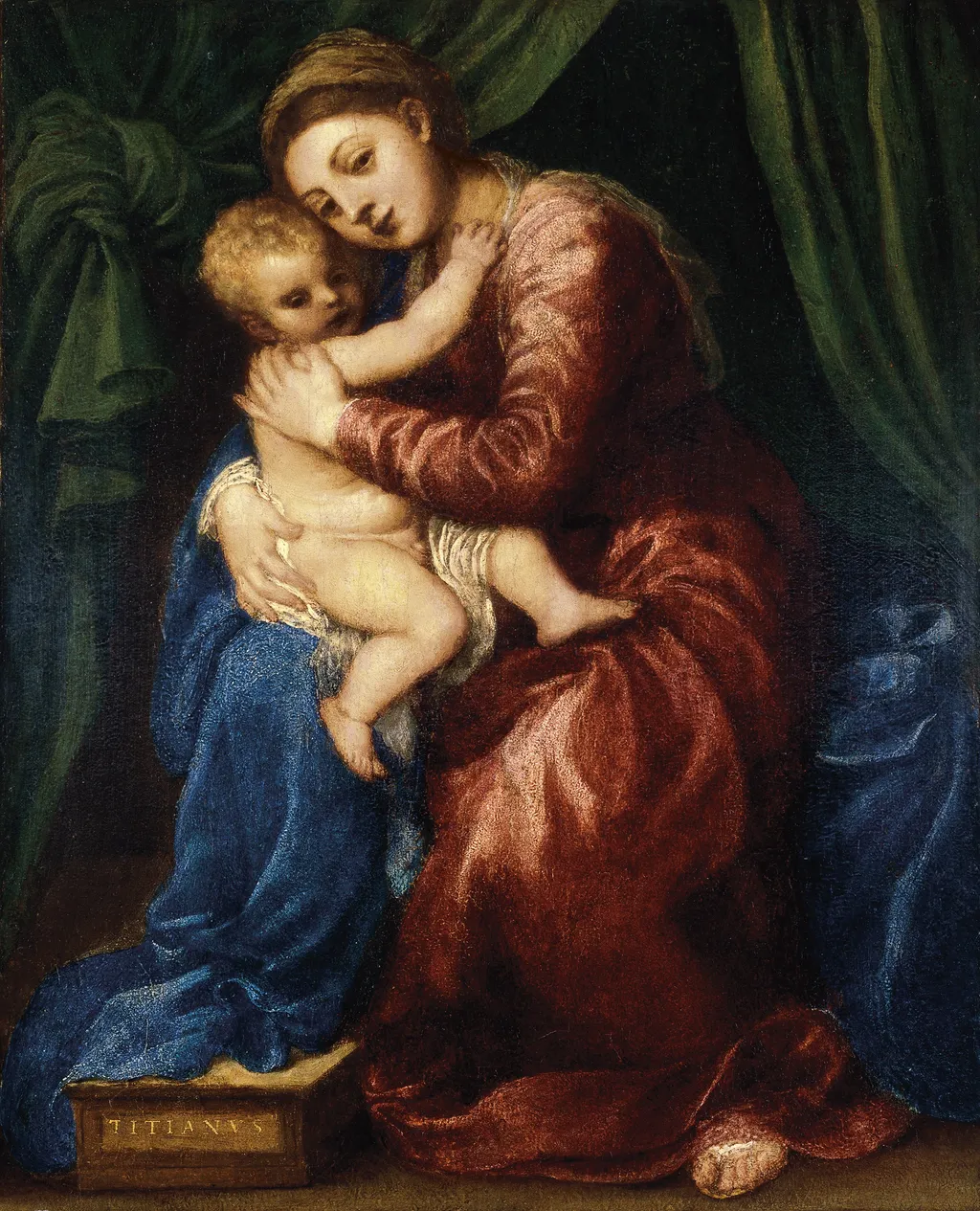
Sciarra Madonna is an oil painting by the Mannerist artist Titian. It dates from 1540 and is held in the collection of the Museu Nacional d'Art de Catalunya.
About this work
The Sciarra Madonna is a painting by Titian. It's an oil on panel work signed by the artist. The painting is held at the Museu Nacional d'Art de Catalunya, which is where you can find it on display, and it was created around 1540, a notable time for art. You can learn more about the artist who created this work, Titian.
Subject & Meaning
The red garment evokes divine love, the blue blanket heavenly purity, and the curtain acts as a veil that reveals the holy moment.
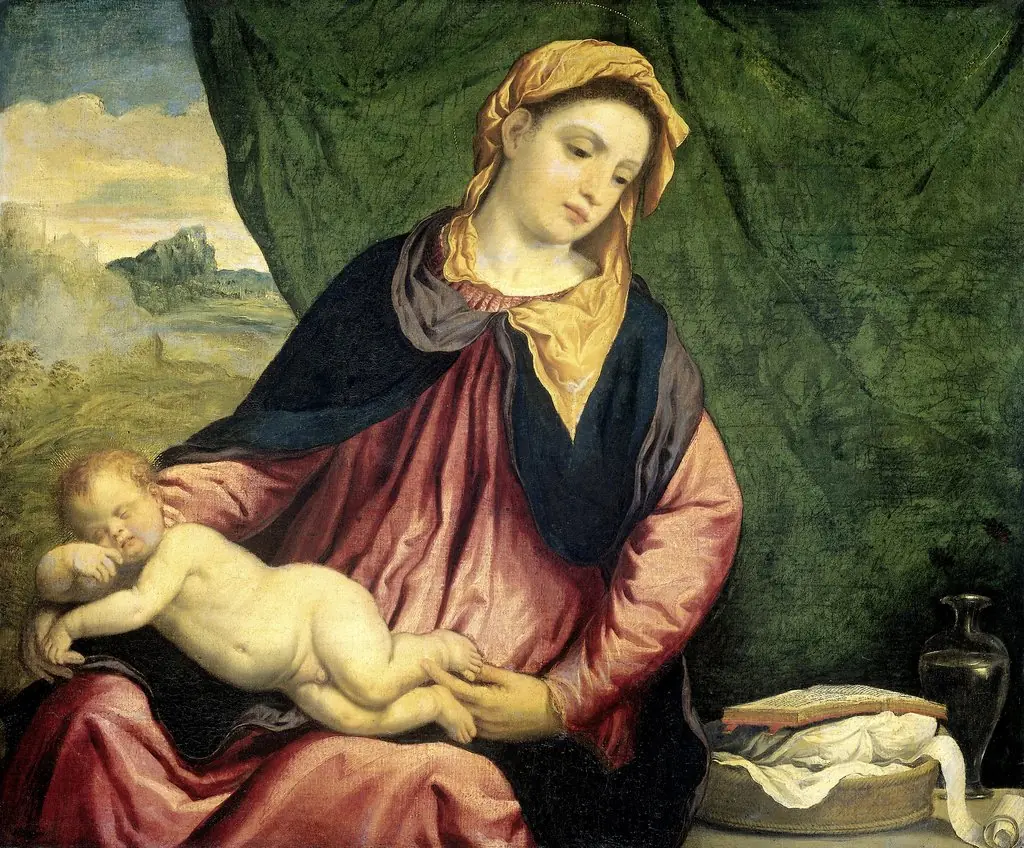
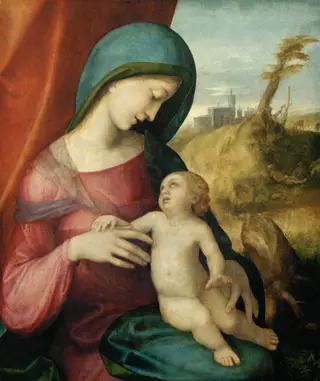
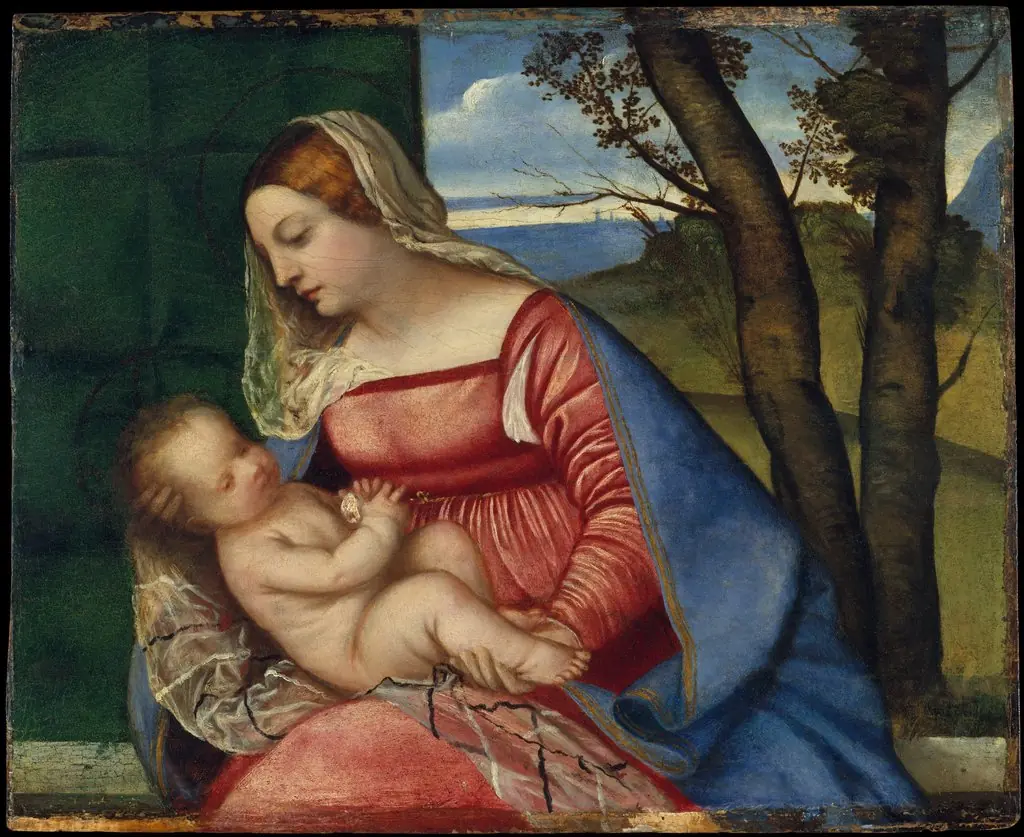
The Sciarra Madonna shows the Virgin Mary tenderly embracing the Christ Child while seated on a bed with a deep‑blue blanket, dressed in a vivid red robe, before a partially drawn green curtain; she smiles outward to the viewer. This intimate, half‑length pose recalls Titian’s Rest on the Flight into Egypt, a connection noted by Suida, and underscores the work’s devotional character as a small‑scale commission for private prayer. The red garment evokes divine love, the blue blanket heavenly purity, and the curtain acts as a veil that reveals the holy moment.
Technique & Style
The work is an oil painting executed on wooden panel, measuring 281 cm in height and 195 cm in width, and is dated to around 1540. It depicts the Madonna and Child in an intimate composition, with the Virgin holding the infant Christ against a curtained backdrop. The painting's style reflects the Venetian school and Mannerist tendencies, characterized by rich coloration, a pasty brushwork, and softened contours. The Madonna is shown seated on a bed with a deep blue cover, wearing a vivid red garment, while the Child rests on her lap and gazes thoughtfully toward the viewer. The attribution to Titian's circle has been subject to scholarly debate, with early recognition by Cavalcaselle, later dismissal, and renewed support from Suida, who highlighted compositional parallels with works such as Rest on the Flight into Egypt. Current consensus, as reflected in museum records and scholarly literature, attributes the piece to Titian's workshop rather than as an entirely autograph masterpiece.
History & Provenance
The Sciarra Madonna is an oil painting dated to circa 1540, signed "TITIANVS" and attributed to Titian, though some scholars like Tietze and Berenson classify it as a work by his school. The work was originally housed in the Palazzo Sciarra in Ferrara before being purchased in Rome in 1834 by Francis Cowper. It subsequently passed through Cowper's descendants into the Thyssen collection. Currently, the painting belongs to the Thyssen-Bornemisza Museum and is held on deposit at the Museu Nacional d'Art de Catalunya in Barcelona.
The Sciarra Madonna is housed in the Museu Nacional d'Art de Catalunya in Barcelona, where it is recorded under the inventory of the Thyssen-Bornemisza collection and is on long-term deposit. Its provenance traces back to the Palazzo Sciarra in Ferrara, from which it was acquired in Rome in 1834 by Francis Cowper; subsequent ownership passed through his descendants to the Thyssen family before entering the museum's custody. The work was first publicly exhibited at the Royal Academy Winter Exhibition and has since appeared in various institutional displays, including those highlighting Venetian school and Mannerist religious art.
Context
The critical reception of the Sciarra Madonna has shifted over time. Early attributions to Titian by Cavalcaselle were later questioned and set aside before being revived by Suida, who highlighted the echo of the Madonna’s pose in Rest on the Flight into Egypt (Longleat House). Tietze and Berenson ultimately regarded it as a work of Titian’s school rather than an autograph painting. Scholars such as Tietze and Berenson have debated its authorship, with some attributing it to the workshop and others to the master himself. The painting is housed in the Museu Nacional d'Art de Catalunya and has been part of the Thyssen-Bornemisza collection since its acquisition in Rome in 1834 from the descendants of Francis Cowper, who first recorded it in the Palazzo Sciarra in Ferrara.
Legacy
The attribution of the Sciarra Madonna has been a focal point of its scholarly legacy. Cavalcaselle first accepted it as an autograph work by Titian, but later critics including Tietze and Berenson rejected that view, classifying it instead as a product of Titian's workshop. The attribution was subsequently revived by Suida, who observed that the Virgin's pose recalled that in Titian's Rest on the Flight into Egypt. The painting's provenance, traced from the Palazzo Sciarra in Ferrara to its acquisition in Rome by Francis Cowper in 1834 and eventual entry into the Thyssen collection, has also shaped its documented history. It was included in the Royal Academy Winter Exhibition, and its current placement on deposit at the Museu Nacional d'Art de Catalunya has extended its visibility within the Catalan capital.
Discussion of the panel has also touched on its execution: the rich coloring, impasto handling, and softened contours align with Titian's manner, while certain details have been judged below his usual standard, leading some scholars to suggest that the modest scale and private devotional commission may have prompted workshop assistance.
Own this work as a print
Artist & collection

Artist
Tiziano Vecellio (Italian:; c. 1488/1490 – 27 August 1576), Latinized as Titianus, hence known in English as Titian ( TISH-ən), was an Italian Renaissance painter. The most important artist of Renaissance Venetian…