Artwork
Altarpiece from Thuison-les-Abbeville: Saint Hugh of Lincoln
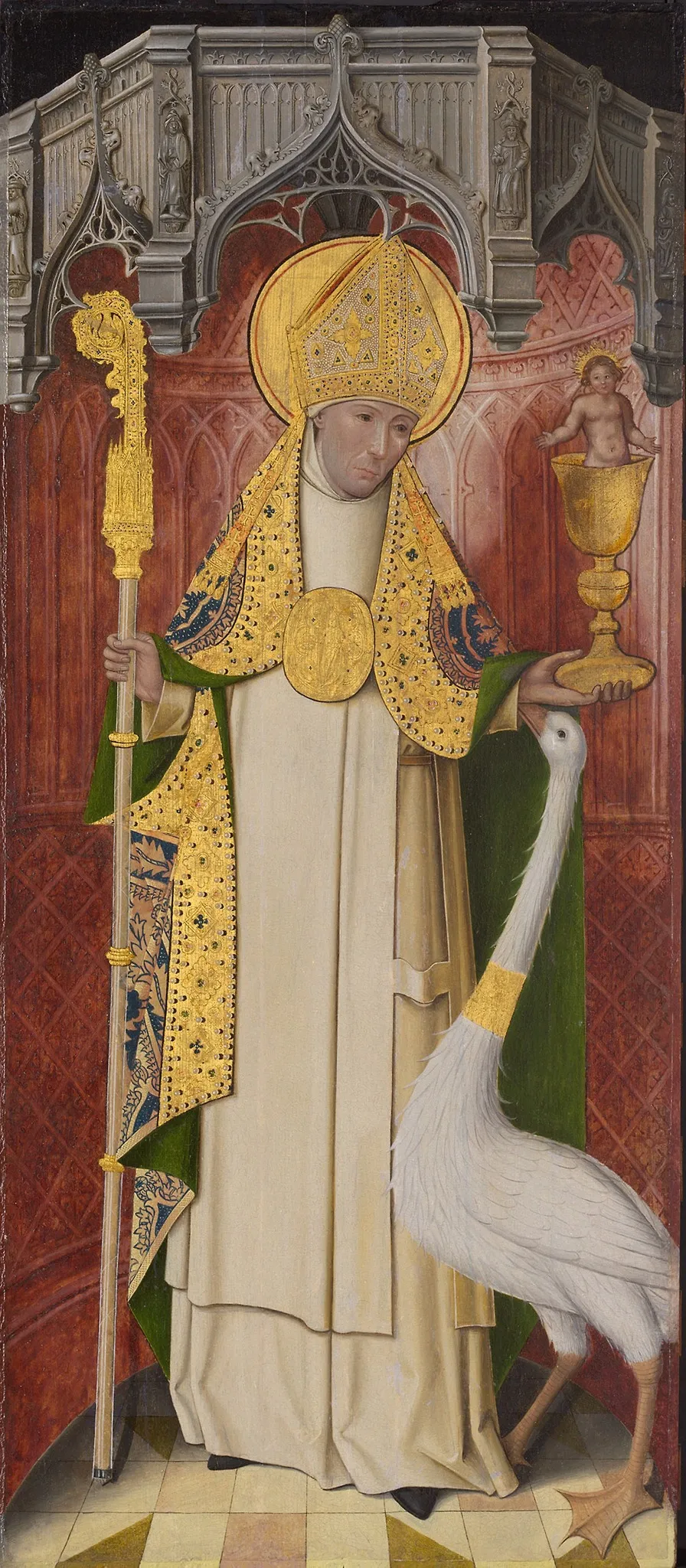
Altarpiece from Thuison-les-Abbeville: Saint Hugh of Lincoln is an oil painting by the Northern Renaissance artist Unknown. It dates from 1496 and is held in the collection of the Art Institute of Chicago. The work is an oil painting forming part of an altarpiece from Thuison‑les‑Abbeville, portraying a bishop in full ceremonial dress.
About this work
Overview
7 centimeters, the panel depicts Saint Hugh of Lincoln in full episcopal regalia and is now held in the Art Institute of Chicago as part of the Mr.
The Altarpiece from Thuison-les-Abbeville: Saint Hugh of Lincoln is an oil-on-panel painting by an unknown French artist working in Picardy, dated to approximately 1490-1500. Measuring 117 by 50.7 centimeters, the panel depicts Saint Hugh of Lincoln in full episcopal regalia and is now held in the Art Institute of Chicago as part of the Mr. and Mrs. Martin A. Ryerson Collection. The work matters as a significant surviving fragment from a dismantled Carthusian altarpiece, offering rare evidence of late fifteenth-century panel painting in northern France and its complex artistic exchanges with the Burgundian Netherlands.
Subject & Meaning
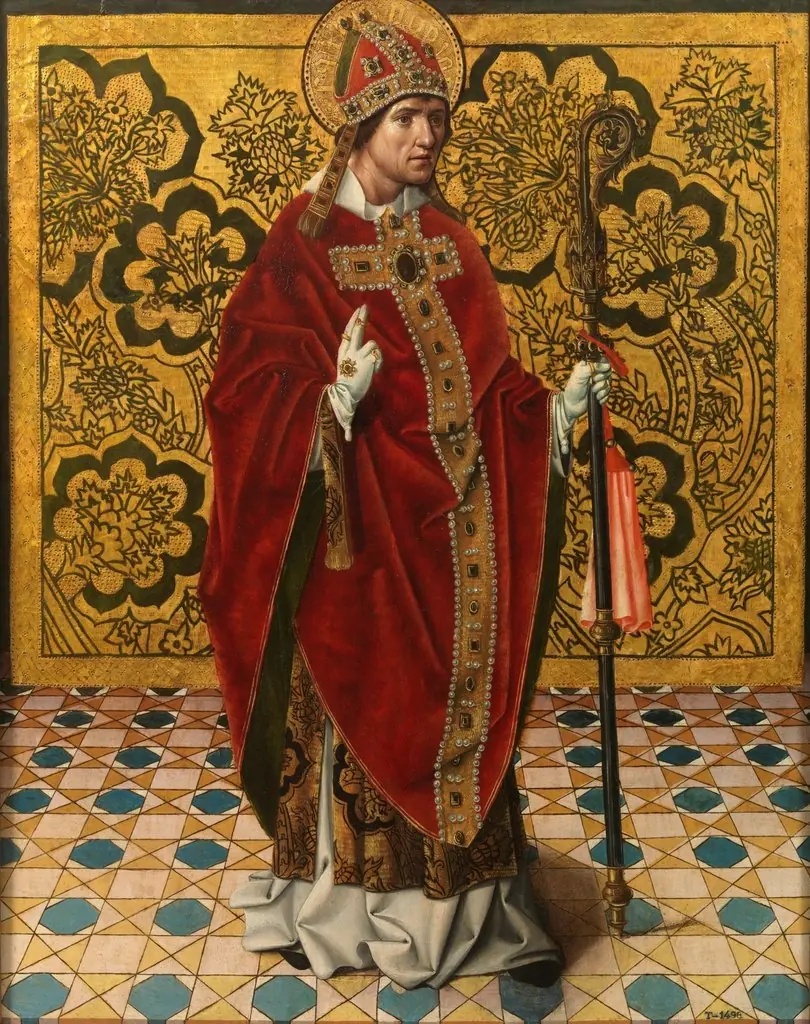
The painting portrays Saint Hugh of Lincoln, also known as Hugh of Avalon or Hugh of Châteauneuf, the twelfth-century bishop of Lincoln renowned for his piety and reforming zeal. He stands frontally beneath an ornate Gothic canopy with carved pinnacles and small sculpted figures, wearing a tall jeweled mitre, golden halo, elaborate gold cope with embroidered patterns over a white alb and green vestments. In his right hand he holds a crozier; in his left, a golden chalice containing a small nude child, an image that likely alludes to the Eucharist or a miracle associated with the saint. At the lower right, a large white bird with a long neck and golden collar, its beak touching the saint's green sleeve, serves as his primary attribute. This bird, variously described as a crane or swan, symbolizes purity and devotion in Hugh's iconography. The red patterned drapery and Gothic architectural details behind him, together with the checkered floor tiles, create a formal sacred space that isolates and elevates the saint's presence.
Technique & Style
The work is executed in oil on panel, a medium that allowed for the smooth surface and fine detail visible in the textiles and metalwork. The painted surface measures 115.5 by 49.6 centimeters. The artist employs flat, even lighting throughout, with illumination falling primarily on the front of the figure to emphasize his face and vestments. The palette is dominated by gold, red, green, and white, with warm cream and golden tones highlighting the saint's spiritual authority. The handling shows particular attention to the rendering of elaborate ecclesiastical fabrics and jeweled ornament, while the rigid frontal posture and formal arrangement contribute to an atmosphere of restrained solemnity. The architectural canopy with its sculpted pinnacles and small figures demonstrates familiarity with Gothic decorative conventions, and the overall style reflects the strong influence of Netherlandish painters such as Rogier van der Weyden and Simon Marmion on Picard artists of this period.
History & Provenance
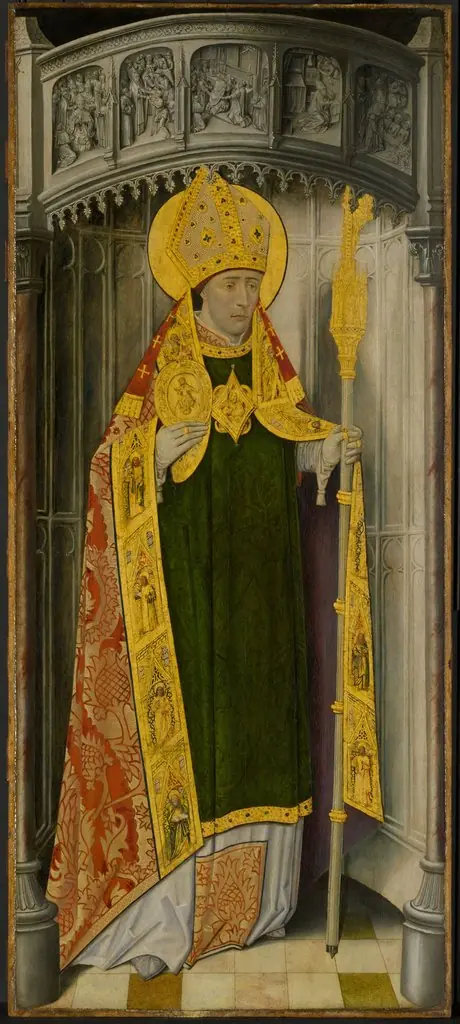
This panel was originally part of the altarpiece decorating the high altar of the Carthusian monastery of Saint-Honoré at Thuison, outside Abbeville in northern France. The altarpiece was structurally complex: four saints stood in niches painted on the exterior of the wings, while the interior, revealed when the wings were opened, presented the story of Christ's Passion and Resurrection through painted narratives and painted and gilded carvings in a central shrine focused on the Crucifixion. These carvings have not survived. In the mid-nineteenth century, the fronts and backs of the wings were sawn apart, dispersing the panels. Of the wing panels, all except one narrative, The Entry into Jerusalem now in the Hermitage, Saint Petersburg, entered the collection of the Art Institute of Chicago. The museum acquired this panel as part of the Mr. and Mrs. Martin A. Ryerson Collection, with the reference number 1933.1060. The work has been exhibited in significant shows including the Exposition des primitifs flamands à Bruges and the Exposition des primitifs français, as well as a Loan Exhibition of French Primitives and Objects of Art. It is currently off view.
Context
Picardy, the region where this altarpiece was created, occupied a crucial position in late medieval European art. A rich border region north of Paris, it was a possession of the Burgundian Netherlands in the mid-fifteenth century before becoming part of France in 1477. This political history shaped its artistic culture: Picard painters were strongly influenced by artists from the neighboring provinces of the Low Countries, absorbing and adapting the refined oil technique and detailed naturalism associated with Netherlandish masters. The altarpiece's attribution to an unknown French artist reflects the limited documentary record for panel painting in this region, even as the surviving works demonstrate sophisticated accomplishment. The Carthusian monastery context is significant, as the order's emphasis on contemplation and austerity would have shaped the devotional function of the imagery. Scholarship on this work has focused on its place within the dispersed Thuison altarpiece and on tracing the stylistic currents, Netherlandish, French, and Burgundian, that converge in its execution.
Legacy
The Altarpiece from Thuison-les-Abbeville: Saint Hugh of Lincoln survives as a fragment of a once-magnificent monastic ensemble, its dismemberment in the nineteenth century emblematic of the broader dispersal of French religious art during that era of secularization and collecting. Its afterlife in the Art Institute of Chicago, alongside the other surviving panels from the same altarpiece, allows modern viewers to reconstruct something of the original devotional program even as the central shrine's carvings and the physical experience of the altarpiece's opening and closing are irretrievably lost. The work's reproduction and circulation through print vendors and digital platforms has extended its reach beyond the museum, while its presence in major exhibitions of early French and Flemish painting has contributed to scholarly understanding of regional artistic exchange in late medieval Europe. As a testament to the international character of late fifteenth-century art production, it continues to prompt study of how Netherlandish innovations in oil painting were transmitted, adapted, and transformed across political and linguistic boundaries.
Artist & collection