Artwork
King Siddhartha and Queen Trishala Sit Alone to Discuss Her Dreams, Folio 24 (recto), from a Kalpa-sutra
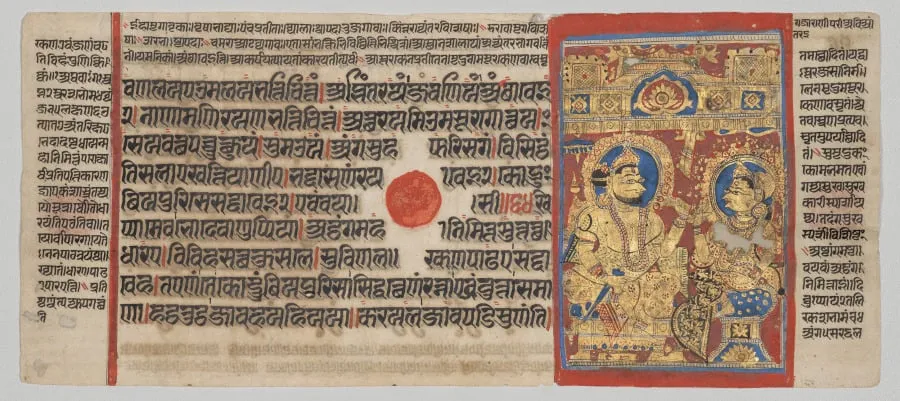
King Siddhartha and Queen Trishala Sit Alone to Discuss Her Dreams, Folio 24 (recto), from a Kalpa-sutra is an unspecified painting by the Mughal Painting artist Unknown. It dates from 1488 and is held in the collection of the Cleveland Museum of Art. This folio originates from a lavishly illustrated manuscript of the Kalpa-sutra, a sacred Jain text.
- Accession no.
- 1932.119.24.a
- Credit line
- Edward L. Whittemore Fund
About this work
You see a king and queen sitting on a golden throne under a red canopy, surrounded by tiny figures and patterns in gold and blue.
You see a king and queen sitting on a golden throne under a red canopy, surrounded by tiny figures and patterns in gold and blue.
This painting comes from a Jain holy book. The queen had dreams that predicted her son would become a great spiritual leader. The artist used real gold and crushed lapis lazuli, a bright blue stone, to make the colors glow.
Over time, the green paint on the queen’s dress ate through the paper, you can still see the holes.
Look up more paintings from western india, gujarat, last quarter of the 15th century to see how they tell stories like this.
Overview
This folio originates from a lavishly illustrated manuscript of the Kalpa-sutra, a sacred Jain text. Created in western India during the late 15th century, it depicts a pivotal moment in the life of Mahavira, the 24th Tirthankara. The scene captures King Siddhartha and Queen Trishala in quiet contemplation, their royal status conveyed through opulent adornments and a richly decorated setting. The painting’s materials and craftsmanship reflect its religious significance and the patronage of a wealthy community.
Subject & Meaning
Queen Trishala recounts a series of dreams foretelling the spiritual destiny of her unborn child, Mahavira. These visions, central to Jain cosmology, signal the arrival of a Tirthankara, a liberated soul who teaches the path to enlightenment. The king’s attentive posture underscores the gravity of the moment.
The composition isolates the couple, emphasizing the intimacy of divine revelation within the royal household, a narrative device common in Jain illustrated manuscripts.
Technique & Style
The artists employed mineral pigments, including crushed lapis lazuli for deep blue and real gold leaf for luminous detail. The queen’s green garment, made from copper acetate, was chemically unstable and has corroded the paper over time, leaving visible perforations. Figures are rendered with fine brushwork, set against ornate backgrounds of intricate gold patterning.
The use of a red canopy and elevated throne reinforces hierarchy, while miniature attendants frame the scene with rhythmic, decorative precision.
History & Provenance
The folio was part of a larger manuscript produced in Gujarat during the final quarter of the 15th century, likely for a Jain lay patron or monastic community. Such manuscripts were used in ritual recitations and kept in temple libraries. The degradation of the green pigment suggests the work was handled and displayed over centuries, though its survival attests to its enduring reverence. Similar folios are held in collections across India and Europe, indicating wide circulation among Jain communities.
Context
Jain manuscript painting in this period emphasized narrative clarity and symbolic richness over naturalism. Artists drew from established iconographic conventions, using gold and lapis to signify sacredness and divine favor. The depiction of dreams as visual prophecy aligns with broader South Asian traditions, but here it serves a distinctly Jain theological framework. These works were not merely decorative but integral to religious practice, reinforcing doctrinal teachings through visual storytelling.
Legacy
The physical deterioration of the queen’s garment has become part of the artwork’s historical record, revealing the material realities of pre-modern pigment use. Despite this, the folio remains a key example of late medieval Jain artistry, influencing later regional styles. Its survival offers insight into the devotional practices of Jain communities and the technical ingenuity of artists who worked with fragile, luminous materials to convey spiritual truths.
Artist & collection









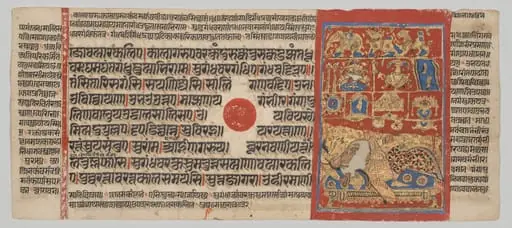 The Fourteen Dreams of Queen Trishala, folio 14 (recto), from a Kalpa-sutra
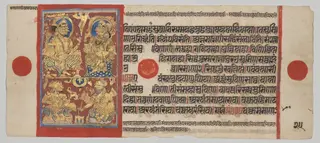 King Siddhartha and Queen Trishala with the Dream Interpreters, Folio 25 (verso), from a Kalpa-sutra
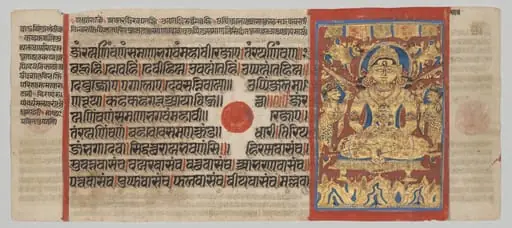 Ritual Bath of Mahavira, Folio 31 (recto), from a Kalpa-sutra
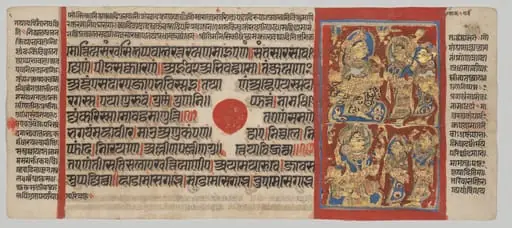 Queen Trishala's Grief and Happiness, Folio 29 (recto), from a Kalpa-sutra
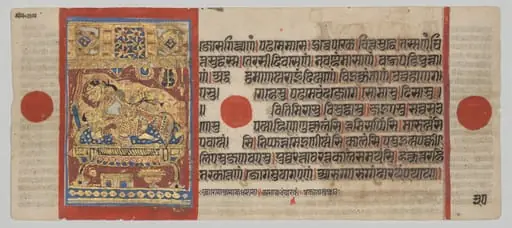 Birth of Mahavira, folio 30 (verso), from a Kalpa-sutra
 Text, Folio 31 (verso), from a Kalpa-sutra
 Text, folio 12 (verso), from a Kalpa-sutra
 Kalpa-sutra Manuscript with 24 Miniatures: Siddhartha Hears the Recitation of Trisala's Dreams
 Transfer of the Embryo of Mahavira, Folio 12 (recto), from a Kalpa-sutra