Artwork
Text, Folio 29 (verso), from a Kalpa-sutra
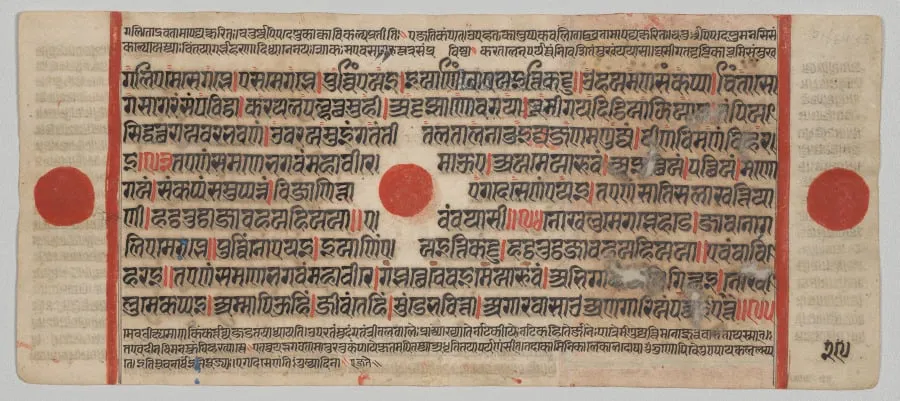
Text, Folio 29 (verso), from a Kalpa-sutra is an unspecified painting by the Mughal Painting artist Unknown. It dates from 1488 and is held in the collection of the Cleveland Museum of Art. This folio comes from a manuscript illustrating the Kalpa-sutra, a sacred Jain text detailing the lives of the Tirthankaras.
- Accession no.
- 1932.119.29.b
- Credit line
- Edward L. Whittemore Fund
About this work
Overview
This folio comes from a manuscript illustrating the Kalpa-sutra, a sacred Jain text detailing the lives of the Tirthankaras.
This folio comes from a manuscript illustrating the Kalpa-sutra, a sacred Jain text detailing the lives of the Tirthankaras. The scene depicts Queen Trishala during her pregnancy with Mahavira, the twenty-fourth Tirthankara. Rendered in the western Indian style of Gujarat, the painting uses flat planes of color and minimal detail to convey emotion and narrative, typical of early manuscript illumination in the region.
Subject & Meaning
The scene captures Queen Trishala’s distress over the sudden stillness of her unborn child. She questions her attendants, fearing loss, while the infant Mahavira, though unseen, is understood to be withholding movement out of compassion. His subtle reawakening reassures her, symbolizing divine empathy and the spiritual awareness present even before birth. The moment underscores Jain values of non-harm and sensitivity to others’ suffering.
Technique & Style
The artist employs a distinctive western Indian miniature style: bold outlines, unmodulated colors, and absence of perspective or shadow. Figures are arranged in a shallow space, with Queen Trishala seated on a patterned rug, surrounded by attentive handmaids. Facial expressions are simplified yet expressive, and clothing is rendered with decorative patterns rather than naturalistic folds, emphasizing symbolic meaning over realism.
History & Provenance
This folio originates from a 15th-century Jain manuscript produced in Gujarat, likely for a monastic or lay patron. Such manuscripts were used in ritual recitations and private devotion. The style aligns with other surviving folios from the same region and period, suggesting a local workshop tradition.
Its survival reflects the enduring importance of Jain textual culture in western India during the late medieval era.
Context
Jain manuscripts of this period often illustrated key moments from the lives of the Tirthankaras, blending religious doctrine with visual storytelling. The Kalpa-sutra was particularly revered for its biographical accounts. This scene, emphasizing maternal concern and fetal compassion, reflects Jainism’s ethical focus on non-violence and mindfulness, extending even to the prenatal realm.
Legacy
The visual language of this folio influenced later Jain and regional Indian painting traditions, particularly in the use of flat color and narrative clarity. Its preservation in collections today allows scholars to trace the transmission of Jain iconography across centuries. The scene remains a poignant example of how spiritual narratives were made tangible through art in pre-modern India.
Artist & collection









- Text, Folio 31 (verso), from a Kalpa-sutra
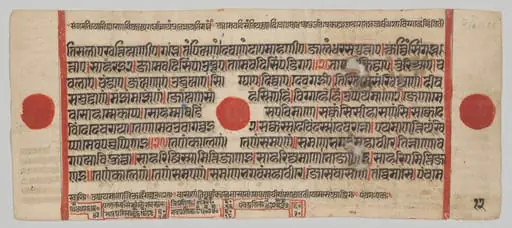 Text, folio 12 (verso), from a Kalpa-sutra
 Text, folio 24 (verso), from a Kalpa-sutra
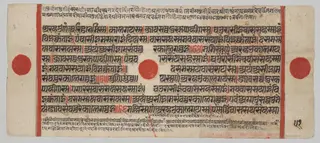 Text, Folio 51 (verso), from a Kalpa-sutra
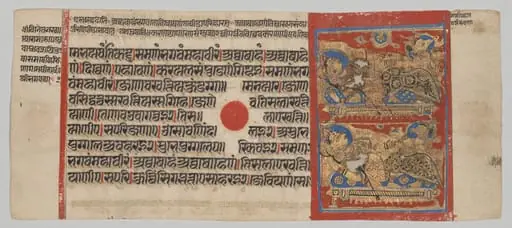 Transfer of the Embryo of Mahavira, Folio 12 (recto), from a Kalpa-sutra
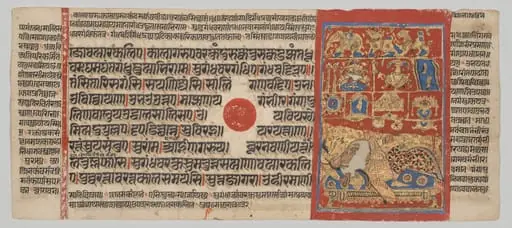 The Fourteen Dreams of Queen Trishala, folio 14 (recto), from a Kalpa-sutra