Artwork
Ravana addresses Sita in the garden of Lanka, from Chapters 53 and 54 of the Aranya Kanda (Book of the Forest) of a Ramayana (Rama’s Journey)
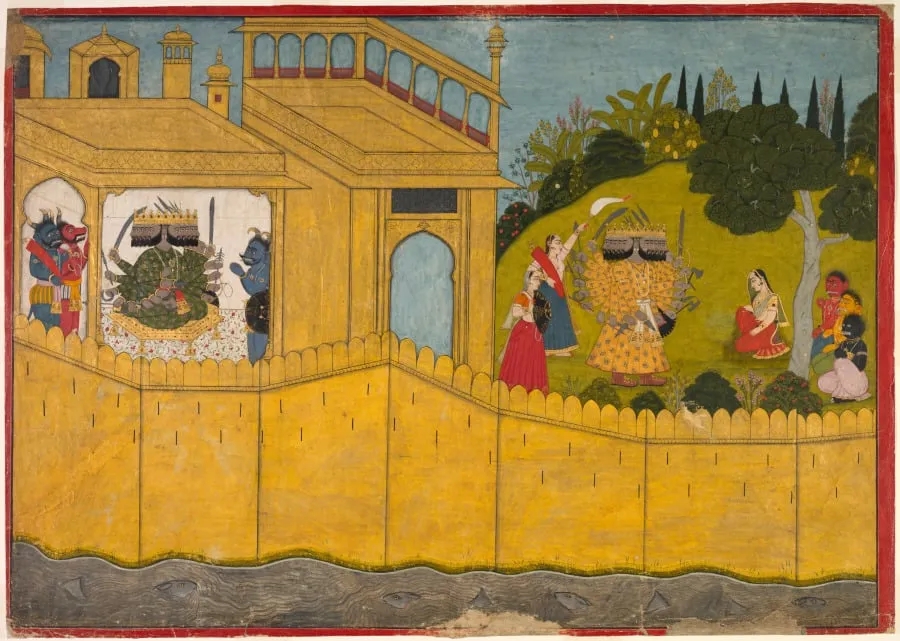
Ravana addresses Sita in the garden of Lanka, from Chapters 53 and 54 of the Aranya Kanda (Book of the Forest) of a Ramayana (Rama’s Journey) is an unspecified painting by the Baroque artist Unknown. It dates from 1725 and is held in the collection of the Cleveland Museum of Art.
- Accession no.
- 1966.143
- Credit line
- Gift of George P. Bickford
About this work
Overview
The work was likely created for a royal Pahari court, where illustrated epics served both aesthetic and didactic purposes.
This painting illustrates two key moments from the Aranya Kanda of the Ramayana, depicting Ravana’s attempt to persuade Sita to marry him while she remains imprisoned in Lanka. The composition unites two scenes, Ravana in his palace and Ravana confronting Sita in the garden, within a single frame. The golden walls of the city and the surrounding sea isolate the scene, reinforcing Sita’s entrapment.
The work was likely created for a royal Pahari court, where illustrated epics served both aesthetic and didactic purposes.
Subject & Meaning
Sita, seated beneath an ashoka tree, is surrounded by demonesses who guard her but do not threaten her. Ravana, shown twice, embodies both authority and futility: in the palace, he consults advisors; in the garden, he pleads with Sita, who refuses him steadfastly. His dual presence underscores his obsession without violence, highlighting her moral resilience. The scene conveys the tension between power and virtue, with Sita’s stillness contrasting Ravana’s multiplied form.
Technique & Style
The artist employs a detailed, luminous style typical of Pahari miniature painting, with fine brushwork and rich mineral pigments. The golden cityscape and intricate foliage are rendered with precision, while the repetition of Ravana’s figure creates a narrative rhythm. Spatial depth is suggested through layered architecture and atmospheric perspective, though the composition remains deliberately flat to prioritize storytelling over realism. Color and line guide the viewer’s eye across the dual scenes seamlessly.
History & Provenance
Created in the Pahari kingdoms of northern India during the 17th or 18th century, this painting belonged to a series illustrating the Ramayana for royal patrons. These illustrated manuscripts were commissioned by local rulers to affirm cultural and religious identity. The work’s scale and detail suggest it was intended for private courtly viewing, possibly during recitations of the epic, blending visual art with oral tradition.
Context
Pahari artists frequently depicted episodes from Hindu epics to serve devotional and political ends, aligning royal authority with divine narratives. The Ramayana’s themes of duty, loyalty, and righteousness resonated deeply in courtly circles. By showing Ravana’s failed persuasion without violence, the painting upholds Sita’s moral purity, a value central to the epic’s reception in north Indian courts, where such imagery reinforced ideals of feminine virtue and righteous resistance.
Legacy
This painting exemplifies the Pahari tradition of narrative compression, where multiple moments are unified in a single frame to enhance storytelling. Its influence can be seen in later regional styles that continued to illustrate epics with similar spatial ingenuity. Though not widely known outside scholarly circles, it remains a key example of how Indian miniature painting transformed sacred texts into visually coherent, emotionally resonant experiences for elite audiences.
Artist & collection









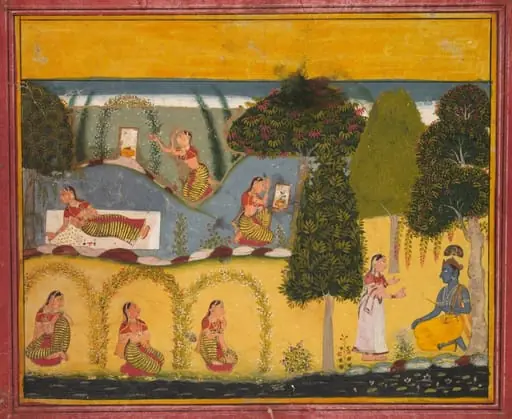 Radha Awaiting Reconciliation with Krishna, from a Gita Govinda of Jayadeva
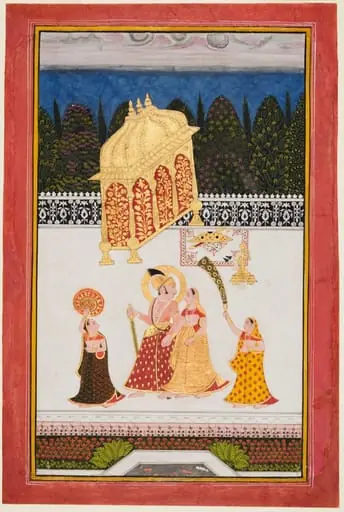 Maharana Ari Singh II of Mewar (r. 1761–73) with His Consort on a Terrace
 Shri Raga, from a Ragamala
![The Marriage of Rukmini [Mangal], by Unknown](https://artifactworldgallery.com/img/unknown--the-marriage-of-rukmini-mangal--7178947364f7bdb5-w320.webp) The Marriage of Rukmini [Mangal]
The Marriage of Rukmini [Mangal] A Man Dips His Hand into a Cauldron as Ladies of the Harem Stand in Amazement: A Page from a Manuscript of Religious History
 Untitled
 King Vikrama summons Madhava, folio 15 from a Madhavanala-Kamakandala
 Untitled
 Radha Awaiting Reconciliation with Krishna, from a Gita Govinda of Jayadeva
 A Disconsolate Lady on a Terrace with Attendants