Artwork
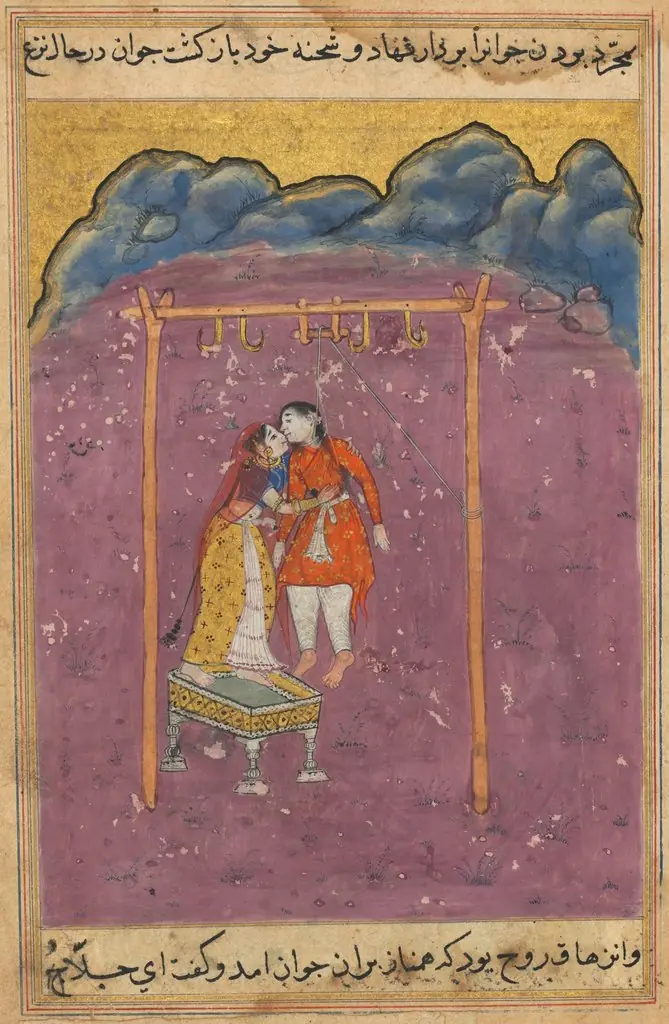
The lover of Hamnaz, who has been hanged from the gallows, bites off her nose when she kisses him, from a Tuti-nama (Tales of a Parrot): Twenty-fifth Night
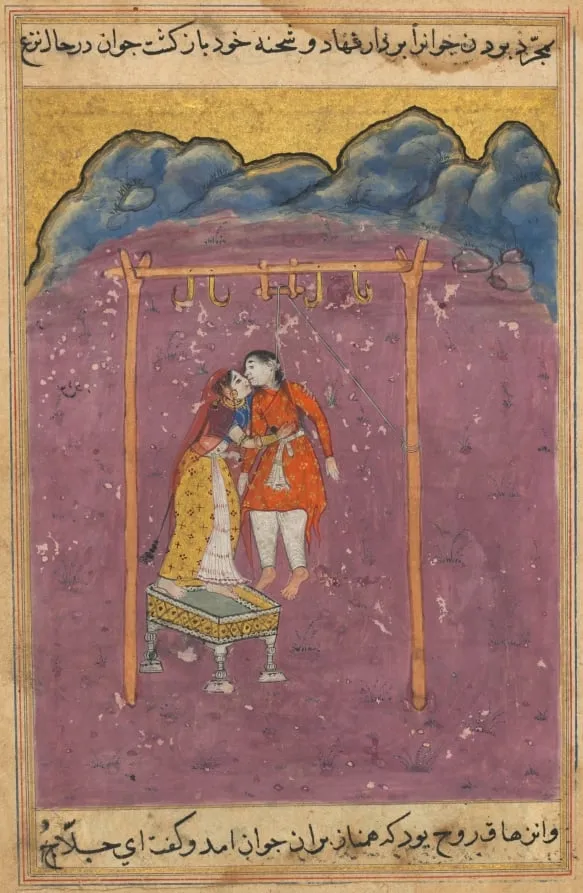
The lover of Hamnaz, who has been hanged from the gallows, bites off her nose when she kisses him, from a Tuti-nama (Tales of a Parrot): Twenty-fifth Night is an unspecified painting by the Mughal Painting artist Unknown. It dates from 1560 and is held in the collection of the Cleveland Museum of Art. This painting illustrates a moment from the Twenty-fifth Night of the Tuti-nama, a collection of moral tales framed by a parrot’s stories.
- Accession no.
- 1962.279.177.a
- Credit line
- Gift of Mrs. A. Dean Perry
About this work
Look up more paintings from Mughal India, court of Akbar (reigned 1556–1605) to see how artists pictured love and punishment.
A woman stands on a stool, kissing a man who hangs from a rope. Her teeth sink into his nose as she pulls away.
This painting comes from a book of parrot tales told in the Mughal court. The story says the woman bites off her own nose to ruin her beauty, her lover’s last act of revenge from beyond the grave. The bright colors and flat shapes make the scene feel like a storybook, not real life.
Look up more paintings from Mughal India, court of Akbar (reigned 1556–1605) to see how artists pictured love and punishment.
Overview
This painting illustrates a moment from the Twenty-fifth Night of the Tuti-nama, a collection of moral tales framed by a parrot’s stories. Created in the Mughal court during Akbar’s reign, it depicts a tragic scene of love and retribution. The composition is stylized, with vivid hues and flattened forms typical of illustrated manuscripts from this period, emphasizing narrative clarity over naturalism.
Subject & Meaning
Hamnaz, having been discovered in an illicit relationship, kisses her condemned lover as he hangs. In his final act, he bites off her nose, disfiguring her as punishment for her transgression. The act symbolizes both vengeance and the irreversible consequences of forbidden desire. The tale functions as a cautionary allegory, warning against passion that defies social and moral boundaries.
Technique & Style
The artist employs bold, saturated colors and sharply defined outlines to create a theatrical, almost symbolic scene. Figures are rendered in a flattened, decorative manner, with little attempt at perspective or shadow. This stylization aligns with Mughal manuscript traditions, where clarity of story and emotional intensity took precedence over realistic spatial depth.
History & Provenance
Commissioned under Emperor Akbar, this painting originates from a deluxe manuscript of the Tuti-nama, produced in the imperial atelier around 1560. Such manuscripts were created by teams of artists and calligraphers for royal patrons. The work reflects the court’s interest in Persian literary traditions adapted into Indian visual culture, serving both entertainment and moral instruction.
Context
The Tuti-nama was part of a broader Mughal project to translate and illustrate Persian literature, blending Islamic, Indian, and Central Asian influences. Stories of love, betrayal, and divine justice were favored for their didactic value. This scene, though extreme, resonated with courtly audiences familiar with themes of honor, punishment, and the fragility of desire.
Legacy
The painting exemplifies how Mughal artists translated literary violence into visually arresting imagery, influencing later illustrated manuscripts. Its unflinching depiction of bodily punishment and emotional extremity remains a distinctive feature of early Mughal narrative art, offering insight into the period’s complex attitudes toward morality, gender, and retribution.
Artist & collection









- The lover of Hamnaz, who has been hanged from the gallows, bites off her nose when she kisses him, from a Tuti-nama (Tales of a Parrot): Twenty-fifth Night
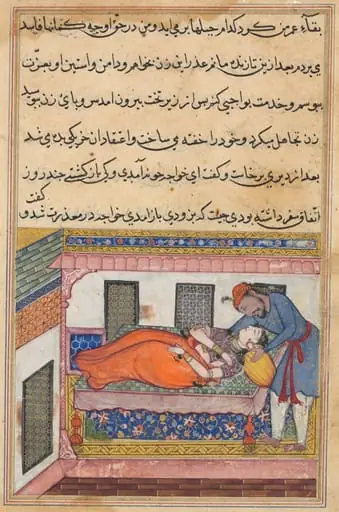 Shahr-Arai’s husband bends to kiss his wife who feigns sleep, from a Tuti-nama (Tales of a Parrot): Fortieth Night
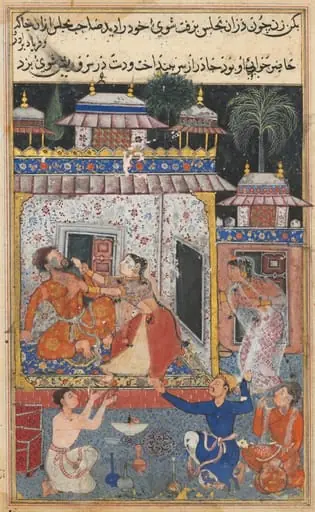 The deceitful wife assaults her erring husband, from a Tuti-nama (Tales of a Parrot): Eighth Night
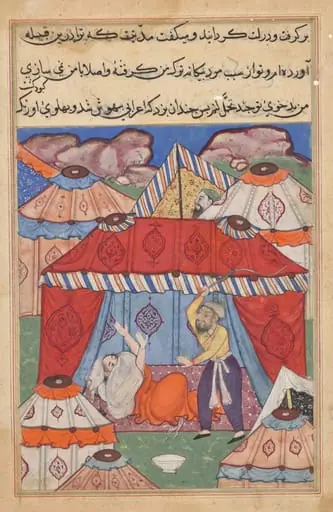 The disguised Arab, substituting for Habbaza, is whipped by her husband for refusing a bowl of milk, from a Tuti-nama (Tales of a Parrot): Twenty-fourth Night
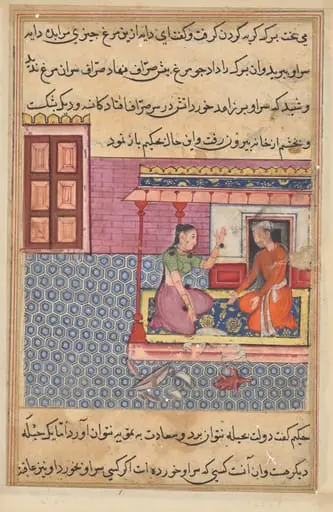 The pious man’s wife offers the seven-colored bird as food to her lover, but not finding its head, he breaks the pot and bowl in anger, from a Tuti-nama (Tales of a Parrot): Fifty-second Night
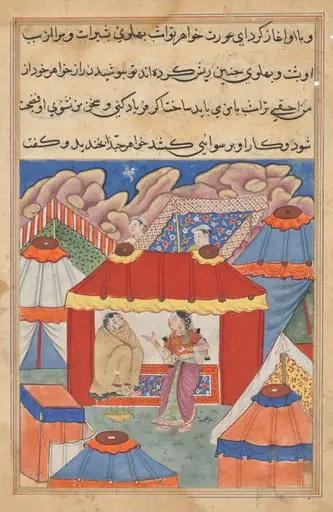 Habbaza’s sister, who is sent to console her, discovers the disguised Arab in her place, from a Tuti-nama (Tales of a Parrot): Twenty-fourth Night
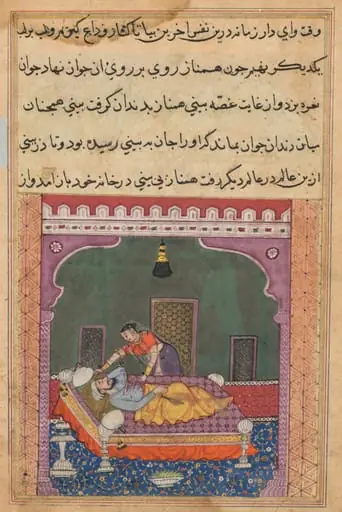 In order to falsely implicate her husband, Hamnaz places a knife by his side and lets the blood dripping from her nose stain his clothes, from a Tuti-nama (Tales of a Parrot): Twenty-fifth Night
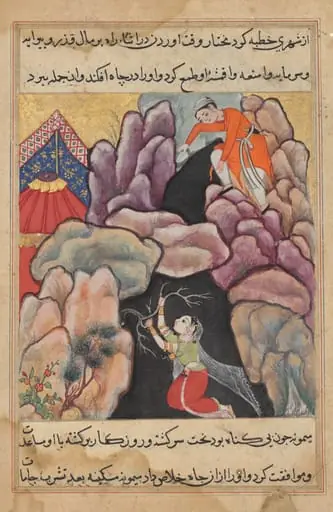 Mukhtar throws his wife Maimuna into the pit, but she saves herself, from a Tuti-nama (Tales of a Parrot): Twenty-fifth Night
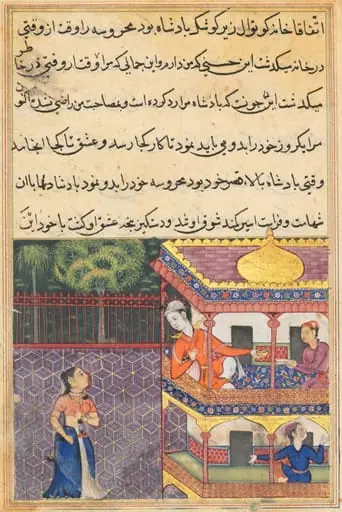 The king of Zabul sees Mahrusa from his palace balcony, from a Tuti-nama (Tales of a Parrot): Thirty-sixth Night
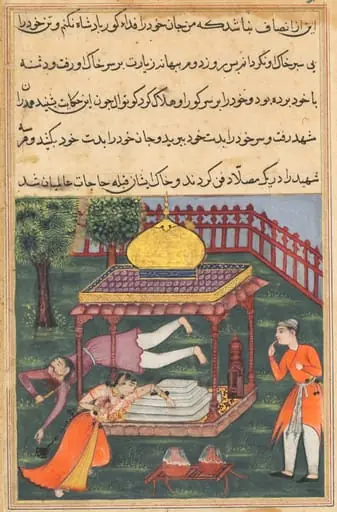 Mahrusa kills herself at the tomb of the king of Zabul, and her husband does likewise, from a Tuti-nama (Tales of a Parrot): Thirty-sixth Night