Artwork
Untitled

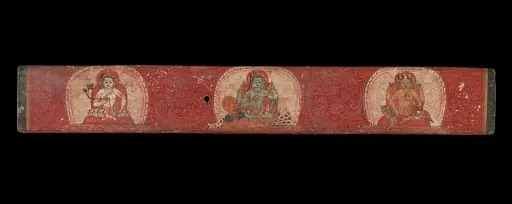
Untitled is a watercolor painting. It dates from 1116 and is held in the collection of the Metropolitan Museum of Art.
- Accession no.
- 1984.496.33a
- Credit line
- Gift of Marie-Hélène and Guy Weill, 1984
About this work
Subject & Meaning
The work's classification as religious art underscores its role in representing spiritual themes rather than secular subjects.
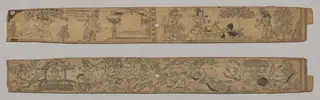
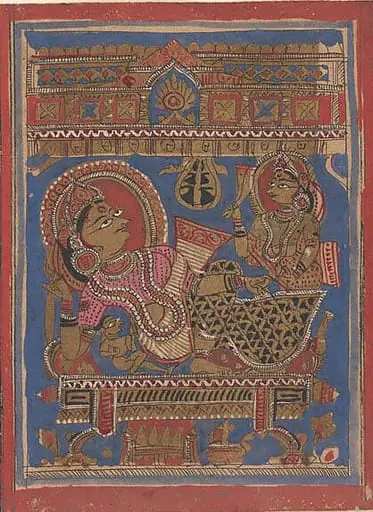
Created in 1116 in India, this opaque watercolor on wood functions as a religious artwork within the Jain tradition. The composition depicts a man and a woman, serving as the primary human figures within the scene. As a piece of Jain iconography, the presence of these figures likely illustrates specific narratives, doctrinal principles, or devotional contexts central to the faith.
The work's classification as religious art underscores its role in representing spiritual themes rather than secular subjects. While the specific identity of the anonymous painter remains unknown, the deliberate inclusion of male and female figures alongside Jain symbolism suggests a focused exploration of human interaction within a sacred framework. The artwork currently held by the Metropolitan Museum of Art exemplifies early Indian religious painting, utilizing its visual language to convey meanings intrinsic to Jainism during this historical period.
Technique & Style
Created in 1116 in India, this anonymous religious painting utilizes opaque watercolor applied directly onto a wooden support. The work measures 5.5 by 32.4 centimeters, presenting a narrow, elongated format typical of the period's devotional objects. Stylistically, the piece is classified within the Jain tradition, depicting male and female figures rendered in the specific conventions of Indian religious art from the early twelfth century.
The medium of opaque watercolor on wood allows for a distinct surface texture and durability suited to its function as a portable devotional image. The composition focuses on the representation of these figures within a religious context, adhering to the iconographic standards of Jainism prevalent at the time of its creation.
History & Provenance
The painting entered the Metropolitan Museum of Art in 1984 as accession number 1984.496.33a, where it has been catalogued as an anonymous work of the 12th century. Technical and stylistic analysis places its creation within a narrow window around 1116, aligning with the museum’s assigned date range. The work is a Jain devotional panel depicting paired figures, male and female, rendered in opaque watercolor on wood, consistent with contemporaneous Jain manuscript and shrine practices in western India. Its small portable format suggests use in domestic or monastic worship rather than as architectural decoration.
Untitled, an opaque watercolor on wood dating to 1116, is housed in the Metropolitan Museum of Art in New York, where it is catalogued under accession number 1984.496.33a. The work belongs to the religious genre and depicts Jain figures of a man and a woman. Its provenance indicates creation in India, and the Metropolitan Museum of Art’s collection records list it as a painting by an anonymous painter. Exhibition history is not documented in the available sources.
Overview
This untitled painting, rendered in opaque watercolor on a small wooden panel, depicts a vibrant scene. It features a man and a woman seated beneath a tree, encircled by an array of colorful flowers and various birds. Originating from Gujarat, India, in the early 13th century, this artwork exemplifies the artistic traditions of the region during that period.

Artist & collection

- Untitled
 Four bodhisattvas and two attendants flanking Vajrasattva, bottom cover, from a Manuscript of the Perfection of Wisdom in Eight Thousand Lines (Ashtasahasrika Prajnaparamita-sutra)
 Untitled
 Untitled
 Sudhana and an antelope, folio 73 (recto) from a Gandavyuha-sutra (Scripture of the Supreme Array)
 Manuscript of the Perfection of Wisdom in Eight Thousand Lines (Ashtasahasrika Prajnaparamita-sutra)
 Perfection of Wisdom in Eight Thousand Lines: Ashtasahasrika Prajnaparamita: Back Cover
 A Prince Performs Austerities (recto); Shiva and His Followers Return to Mount Kailash (verso), from a Romance of Chandrabhanu and Lavanyavati of Upendra Bhanja (1670–1740)
 Leaf from a Romance of Chandrabhanu and Lavanyavati of Upendra Bhanja (Indian, died 1740)
 Untitled
 Untitled
 Untitled