Artwork
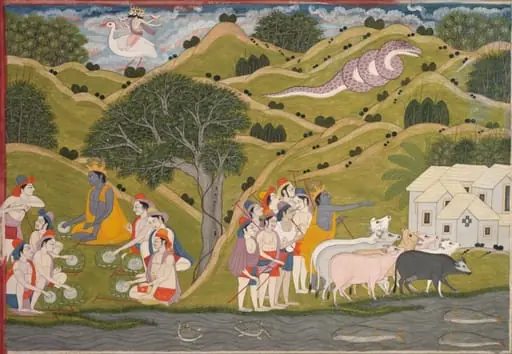
Vanasura's Sons Submit to Krishna: Scene from the Aniruddha Usha Section of Krishna Lila
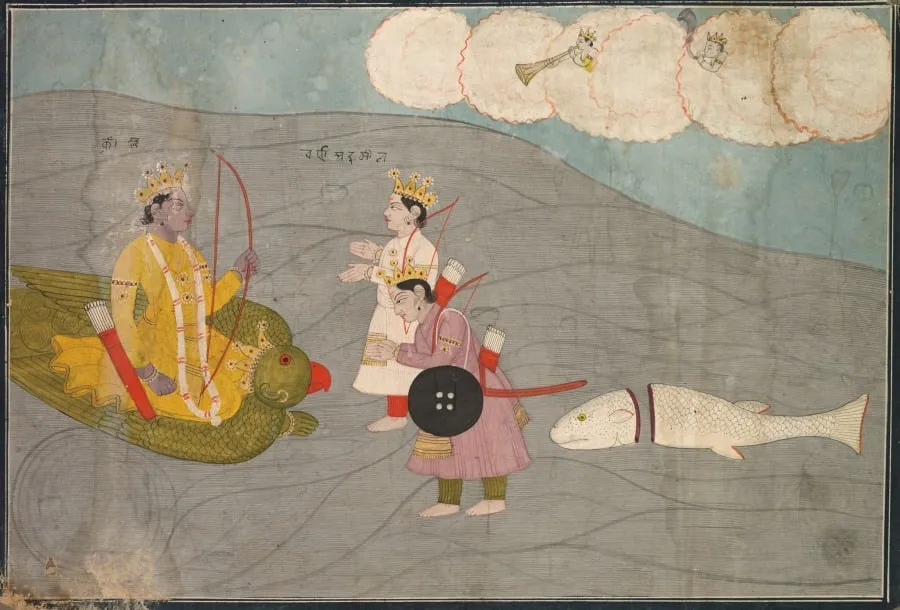
Vanasura's Sons Submit to Krishna: Scene from the Aniruddha Usha Section of Krishna Lila is an unspecified painting by the Pahari Painting artist Unknown. It dates from 1840 and is held in the collection of the Cleveland Museum of Art.
- Accession no.
- 1934.217
- Credit line
- Gift of Mrs. Charles Eisenman
About this work
Overview
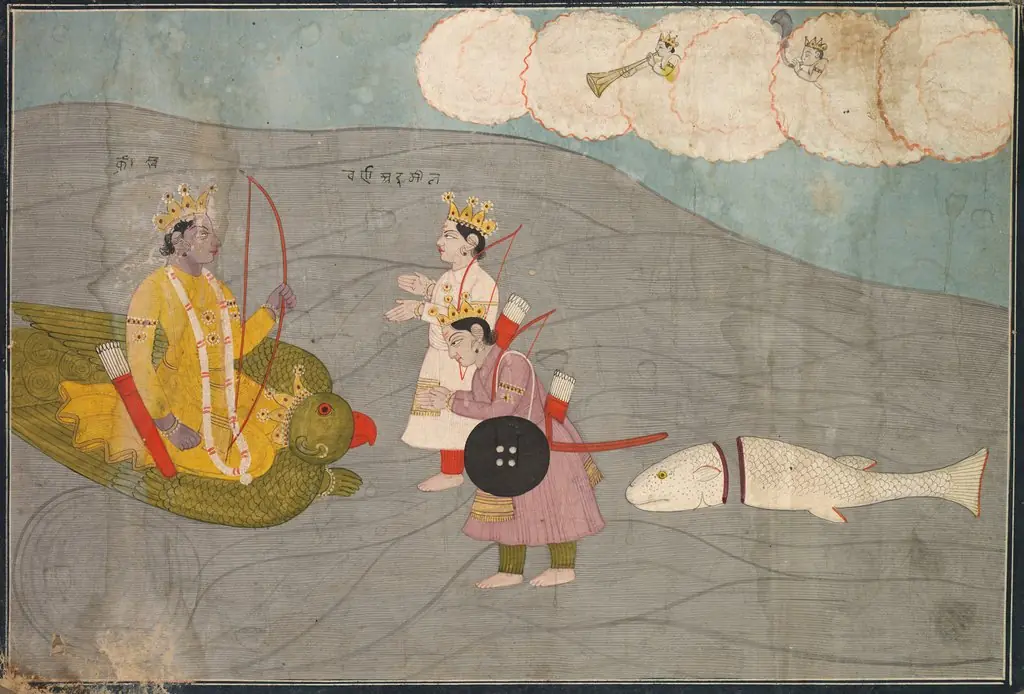
The work, titled Vanasura’s Sons Submit to Krishna: Scene from the Aniruddha Usha Section of Krishna Lila, portrays a mythological moment in which several figures kneel or bow before a central deity. Four human figures and a fish occupy the foreground, set against a muted hill and sky that suggest an outdoor setting. The composition conveys a mood of deference and ritualized surrender.
Subject & Meaning
The scene draws from the Krishna Lila narrative, specifically the episode in which the sons of the demon Vanasura acknowledge Krishna’s authority.
The scene draws from the Krishna Lila narrative, specifically the episode in which the sons of the demon Vanasura acknowledge Krishna’s authority. The central figure in pink, bearing a shield and sword, represents Krishna, while the surrounding men in yellow and white robes, each equipped with bows, symbolize the defeated warriors. The fish, a traditional emblem of purity, reinforces the sanctified atmosphere of the encounter.
Technique & Style
Executed in a Romantic idiom, the painting emphasizes emotive expression through vivid color contrasts, bright reds for weapons, a yellow robe, and a pink garment for the deity. The figures are rendered with fluid lines that suggest movement, while the background’s gray hill and blue sky are treated with softer brushwork, creating a sense of atmospheric depth without detracting from the foreground drama.
Context
The work belongs to a broader tradition of Indian narrative painting that visualizes episodes from the Bhagavata Purana and related texts. By focusing on a moment of surrender, the artist aligns with Romanticism’s interest in heightened feeling and the sublime, translating a spiritual story into a tableau that foregrounds emotional intensity.
Artist & collection









![Rama and Lakshmana Fighting Ravana, from a Dashavatara (Ten Incarnations [of Vishnu]) series, by Unknown](https://artifactworldgallery.com/img/unknown--rama-and-lakshmana-fighting-ravana-from-a-dashavatara-ten-in--5e1e27c9fffbe47d-w320.webp)