Artwork
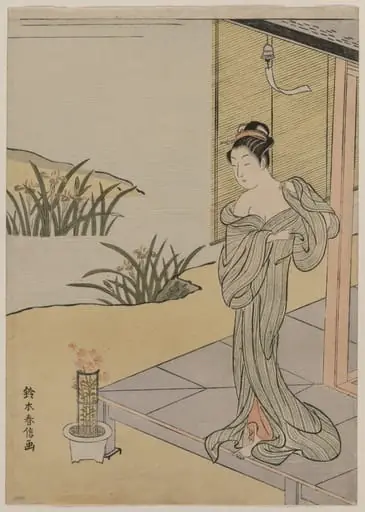
Woman Looking at the Moon
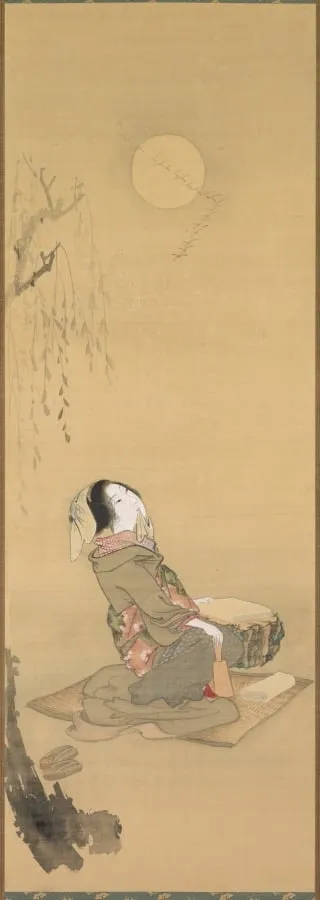
Woman Looking at the Moon is an unspecified painting by the Romanticist artist Unknown. It dates from 1804 and is held in the collection of the Cleveland Museum of Art.
- Accession no.
- 1985.260
- Credit line
- The Kelvin Smith Collection, given by Mrs. Kelvin Smith
About this work
Even the way she bites her kerchief hints at deeper feelings, maybe longing or distraction.
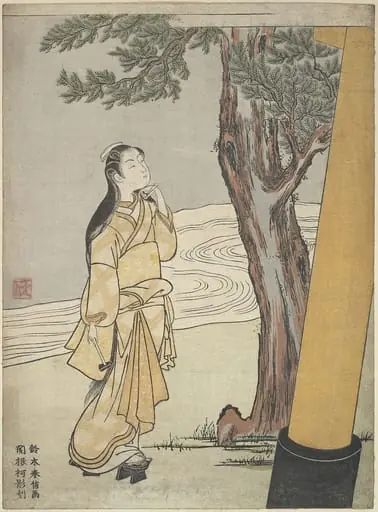
A woman in a pale kimono leans on a wooden block, biting her kerchief. Behind her, geese fly across a bright moon. She’s beating cloth with a mallet, part of a daily chore.
The scene is quiet but full of meaning. The moon, geese, and autumn leaves are old Japanese symbols for the season. Even the way she bites her kerchief hints at deeper feelings, maybe longing or distraction. The painting feels personal, like a private moment.
Look up japan, edo period (1615–1868) to see more works like this.
Overview
The work depicts a woman in a light‑coloured kimono pausing from the labor of fulling cloth to stare at a luminous full moon while a flock of geese passes overhead. She leans on a wooden fulling block, mallet in hand, and gently bites the edge of her kerchief, creating a quiet, contemplative scene that combines domestic activity with seasonal symbolism.
Subject & Meaning
The composition employs three traditional autumn motifs, full moon, migrating geese, and the act of fulling, to evoke the Japanese harvest season. The woman's pale face mirrors the moon’s surface, suggesting a reflective or yearning mood. The subtle gesture of biting the kerchief has been interpreted in East Asian visual culture as an allusion to suppressed desire or emotional distraction.
Technique & Style
Rendered in the ukiyo‑e aesthetic, the painting features flat colour areas, delicate line work, and a restrained palette typical of the Edo period. The treatment of light on the moon and the crisp outlines of the geese demonstrate a skillful handling of perspective and atmospheric effect, while the depiction of the fulling block and mallet reflects a realistic attention to everyday material culture.
History & Provenance
Although unsigned, the piece bears stylistic hallmarks associated with Teisai Hokuba, a noted disciple of Katsushika Hokusai. Hokuba’s oeuvre is characterised by refined line and a focus on quotidian subjects, aligning this work with his broader output. The painting’s provenance prior to its recent acquisition remains undocumented, but its attribution to Hokuba’s circle is widely accepted among scholars.
Context
The scene reflects the Edo‑period tradition of moon‑viewing festivals, especially the mid‑autumn celebration held on the fifteenth night of the eighth lunar month. Such gatherings were popular in Edo, where citizens gathered along the Sumida River to admire the harvest moon, a motif frequently celebrated in poetry and visual art of the time.
Artist & collection