Artwork
Grand Lavoir, Pampa del Sacramento
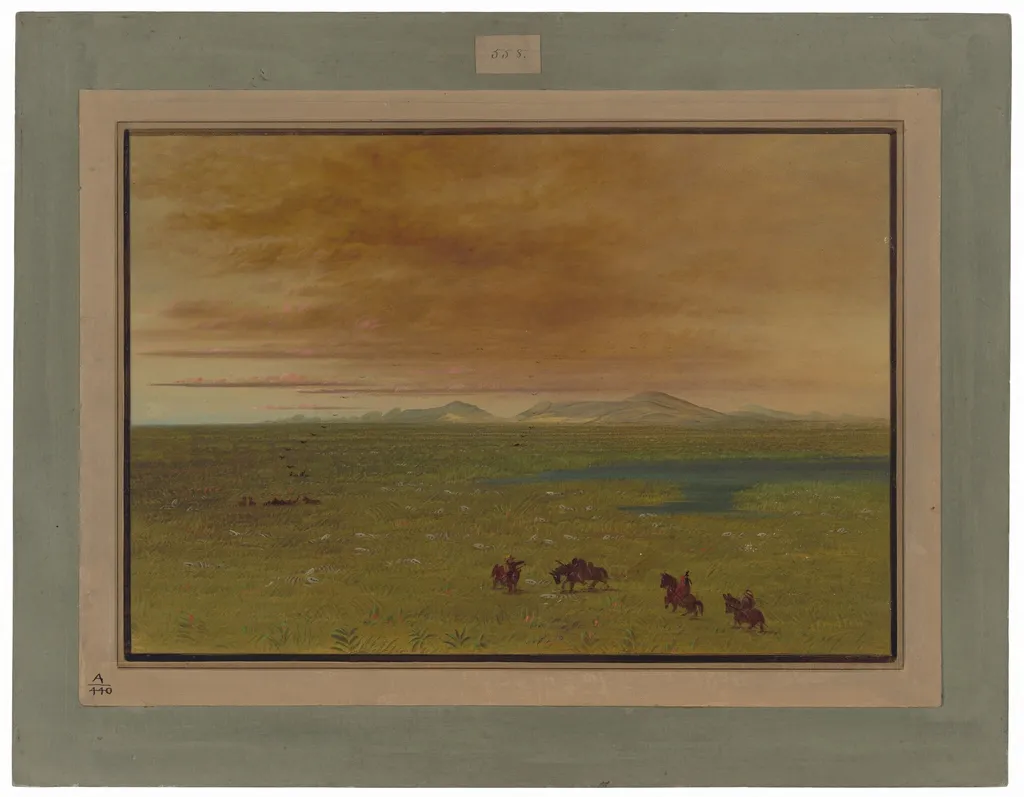
Grand Lavoir, Pampa del Sacramento is an oil painting by the Impressionist artist George Catlin. It dates from 1862 and is held in the collection of the National Gallery of Art.
About this work
Overview
2 cm, the work is executed in oil on card mounted on paperboard and belongs to Catlin's second major series, the Cartoon Collection.
Grand Lavoir, Pampa del Sacramento is an oil painting by American artist George Catlin, dated variously to 1861 or the broader span of 1854/1859-1869, depicting a vast South American plain with wild horses and mounted figures. Measuring 43.8 by 61.2 cm, the work is executed in oil on card mounted on paperboard and belongs to Catlin's second major series, the Cartoon Collection. It is now held by the National Gallery of Art in Washington, D.C., having entered the collection in 1965 as part of a landmark gift from Paul Mellon. The painting matters as a document of Catlin's late career shift toward South American subjects and as a characteristic example of the panoramic western landscapes that defined his output after the more famous Indian Gallery of the 1830s.
Subject & Meaning
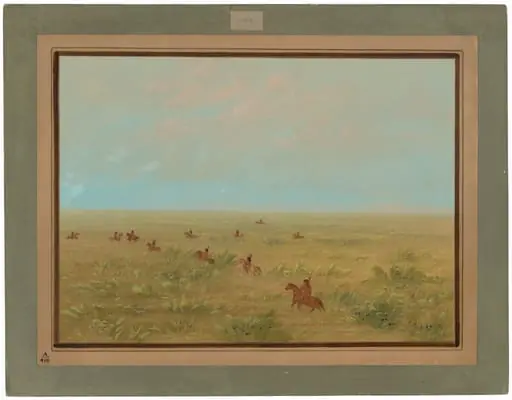
The painting depicts the Pampa del Sacramento, a grassy plain where wild horses gather at watering holes, or lavoirs. Catlin's own 1871 catalog entry for the work describes a scene of violent natural drama: vast herds of wild horses, driven mad by thirst, kill one another in terrible conflicts or die from over-drinking, leaving bones to whiten the plains for miles. The visual composition, however, presents a more restrained scene. The foreground shows four small mounted figures on horseback, rendered as dark silhouettes with touches of red, moving across the grass from left to right. Additional tiny figures and animals appear scattered in the middle distance. A narrow blue waterway or marsh cuts across the middle ground, leading the eye toward low rolling mountains on the far horizon. The sky, occupying roughly the upper half of the canvas, is filled with warm ochre, amber, and muted orange tones suggesting sunset or atmospheric haze, with soft horizontal cloud formations and faint pinkish streaks. The tension between Catlin's dramatic written description and the comparatively serene visual treatment creates a complex document of nineteenth-century American fascination with the sublime violence of western landscapes.
Technique & Style
The medium is oil on card mounted on paperboard, a support characteristic of Catlin's Cartoon Collection works, which were designed to be portable and reproducible. The surface shows smooth, detailed brushwork with careful gradations of tone. The grass is rendered with fine vertical strokes interspersed with small white and red flecks suggesting flowers. The mounted figures are handled as dark silhouettes with minimal detail, a technique Catlin employed to convey scale against the vastness of the landscape. The painting is mounted within wide beige and gray-green borders, with a small label reading 558 at top center and A 440 inscribed in the lower left corner. These markings correspond to Catlin's own cataloging system for the Cartoon Collection. The overall effect is of a panoramic, horizontally oriented landscape that emphasizes the immensity of the plain and the relative insignificance of human and animal presences within it.
History & Provenance
The painting descended from George Catlin through his daughters Clara Gregory Catlin, Louise Catlin Kinney, and Elizabeth Wing Catlin. In 1912, the American Museum of Natural History in New York purchased the work from Elizabeth Wing Catlin, acquiring a substantial portion of the surviving Cartoon Collection. The museum deaccessioned the work in 1959, selling it through Kennedy Galleries in New York to Paul Mellon of Upperville, Virginia. Mellon, a major collector of American art, purchased more than 300 paintings from the deaccessioned Cartoon Collection. In 1965, he gave 351 works from this collection to the National Gallery of Art, including this painting, which bears accession number 1965.16.297. The work was exhibited in 1973 at the Sordoni Art Gallery at Wilkes College in Wilkes-Barre, Pennsylvania, as part of George Catlin: Painter of the Indians of the Americas, where it appeared as catalogue number 34.
Context
Grand Lavoir, Pampa del Sacramento belongs to Catlin's Cartoon Collection, a second body of more than 600 works created during the 1850s and 1860s, following his earlier Indian Gallery of the 1830s. While the Indian Gallery, now largely at the Smithsonian American Art Museum, focused on portraits and scenes of Native American life from Catlin's travels on the upper Missouri and Mississippi rivers, the Cartoon Collection expanded geographically to include South American subjects. This shift reflected Catlin's travels to South America during the 1850s in search of new material after exhausting his North American repertoire. The work has been catalogued in successive National Gallery of Art publications in 1970, 1980, and 1992. Critical scholarship has focused on the tension between Catlin's documentary claims and the more romanticized or dramatized qualities of his written and visual accounts. The painting's dating has been variously given as 1861 and 1854/1869, reflecting uncertainty about when specific Cartoon Collection works were executed versus when they were catalogued or modified.
Legacy
As part of the 351-work Mellon gift, Grand Lavoir, Pampa del Sacramento helped establish the National Gallery of Art as a major repository for Catlin's late work, complementing the Smithsonian's holdings from the Indian Gallery. The Cartoon Collection has been recognized as essential for understanding Catlin's entire career, not merely as a footnote to his earlier achievements but as a distinct phase with its own geographic and thematic concerns. The painting's specific subject, the wild horse herds of the South American pampas, contributed to nineteenth-century American visual culture's broader fascination with untamed western landscapes and their apparent promise of inexhaustible natural abundance, even as Catlin's own text acknowledged the destructive violence underlying this pastoral vision. The work remains in the permanent collection of the National Gallery of Art, accessible to scholars and the public as a document of both Catlin's artistic evolution and the broader cultural project of American landscape painting in the decades before the closing of the western frontier.
Own this work as a print
Artist & collection

Artist
George Catlin ( KAT-lin; July 26, 1796 – December 23, 1872) was an American lawyer, painter, author, and traveler, who specialized in portraits of Native Americans in the American frontier.

 Bulls Fighting
 Expedition Encamped on a Texas Prairie. April 1686
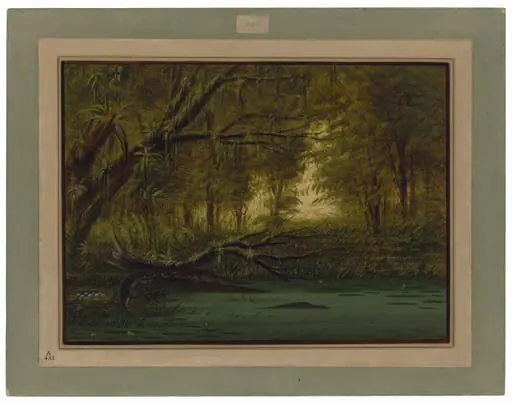 An Alligator's Nest
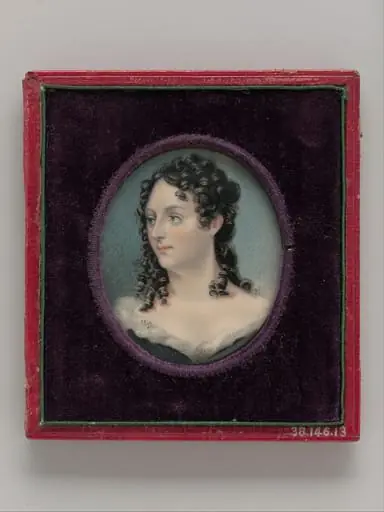 Mrs. George Catlin (Clara Bartlet Gregory)
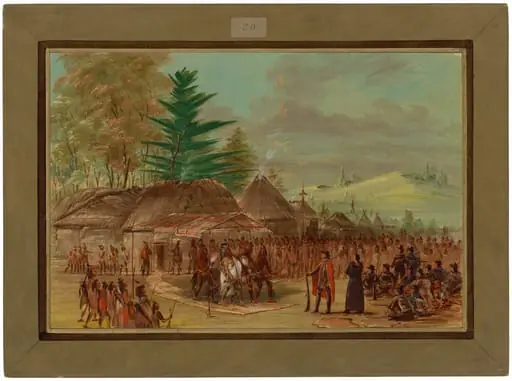 Chief of the Taensa Indians Receiving La Salle. March 20, 1682
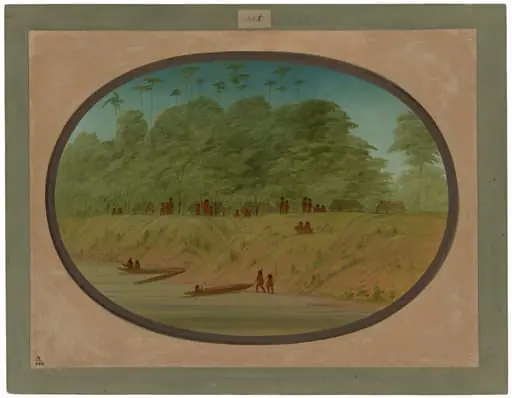 A Small Village - Payaguas Indians
 Omaha Chief, His Wife, and a Warrior
 Father Hennepin Leaving the Mississippi to Join La Salle. May 8, 1680
 Driving the Pampas for Wild Cattle - Connibo
 After the Buffalo Chase - Sioux
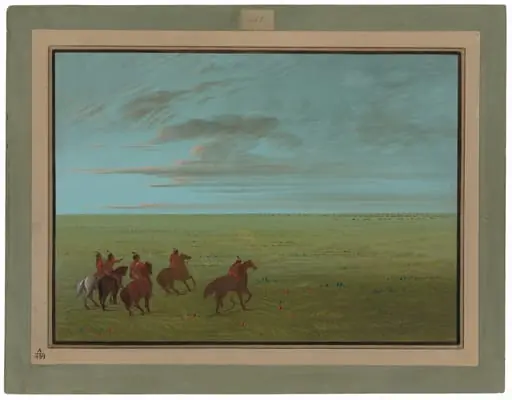 Connibos Starting for Wild Horses
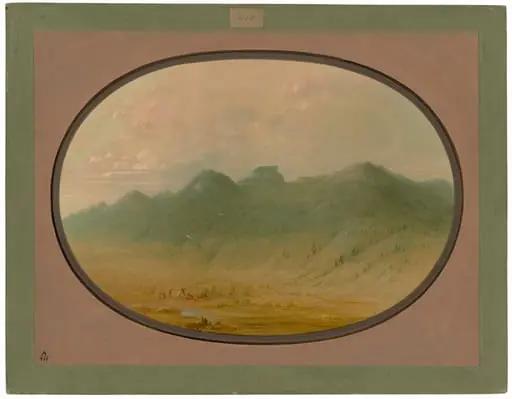 View of the Crystal Mountains, Brazil
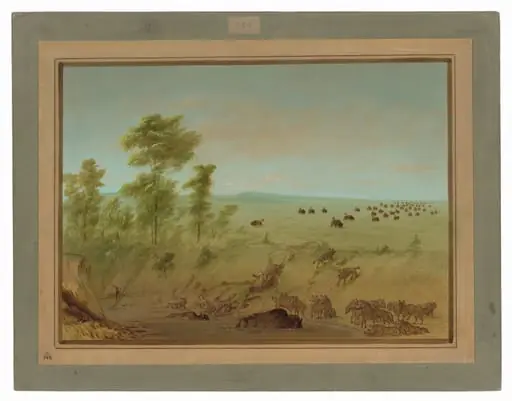 Mired Buffalo and Wolves
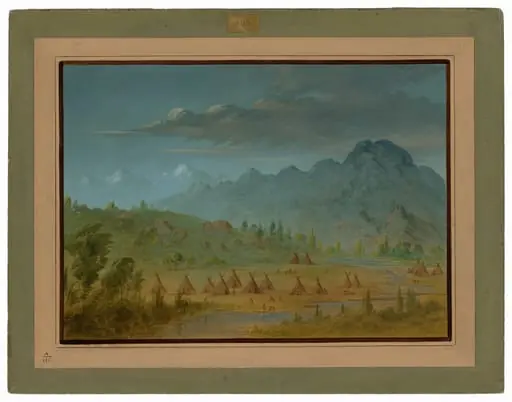 A Crow Village and the Salmon River Mountains
 A Sioux War Party
 Prairie Meadows Burning
 Salmon River Mountains
 Falls of the Snake River