Artwork
The Expedition Encamped below the Falls of Niagara. January 20, 1679
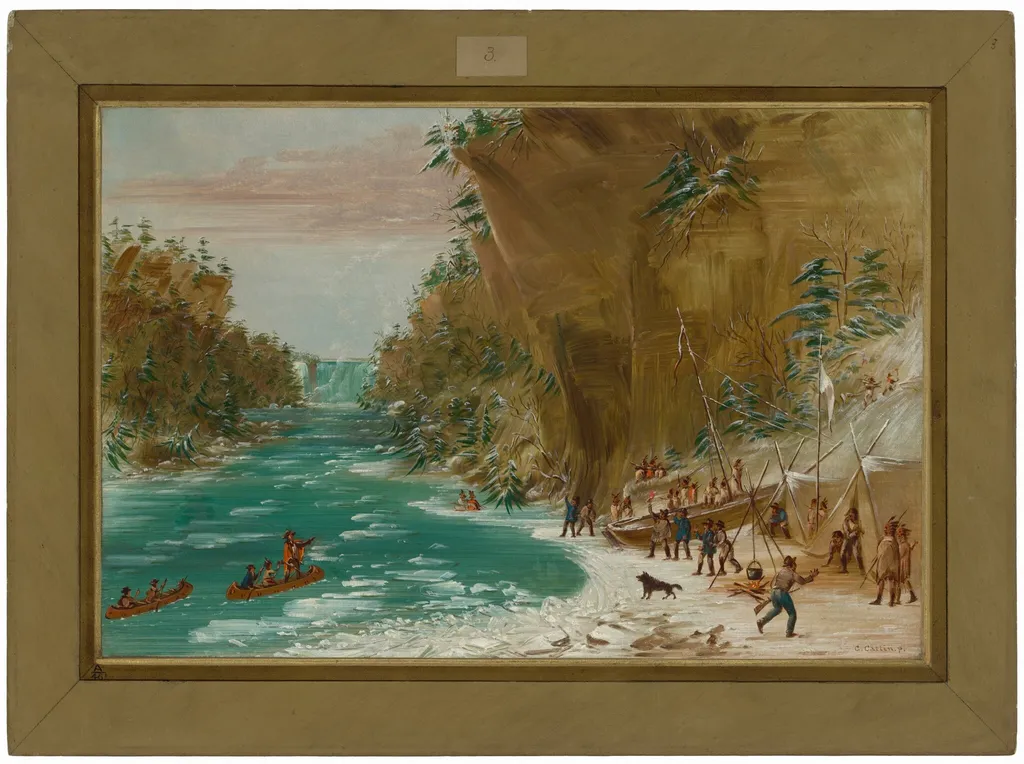
The Expedition Encamped below the Falls of Niagara. January 20, 1679 is an oil painting by the Romanticist artist George Catlin. It dates from 1848 and is held in the collection of the National Gallery of Art. The Expedition Encamped below the Falls of Niagara.
- Inscription
- Inscribed:lower right: G. Catlin. p.
About this work
Overview
2 centimeters (14 7/8 by 22 1/8 inches), the work is held in the collection of the National Gallery of Art in Washington, D.
The Expedition Encamped below the Falls of Niagara. January 20, 1679 is an oil on canvas painting by the American artist George Catlin, dated 1847/1848. Measuring 37.8 by 56.2 centimeters (14 7/8 by 22 1/8 inches), the work is held in the collection of the National Gallery of Art in Washington, D.C., where it entered in 1965 as part of a major gift from Paul Mellon. The painting belongs to Catlin's so-called Cartoon Collection, a second body of more than 600 works created during the 1850s and 1860s that complemented his earlier Indian Gallery of the 1830s. It is significant as a history painting that reconstructs a specific moment in early French colonial exploration in North America, demonstrating Catlin's sustained engagement with documenting and imagining the American past.
Subject & Meaning
The painting depicts a winter encampment of the French explorer Henri de Tonty and his companions on the shore of Lake Ontario, seven miles below Niagara Falls, on January 20, 1679. Catlin's own 1871 catalog entry for the work identifies the subject as DE TONTY and his companions, specifying the precise geographic and temporal setting. Visually, the scene presents a large encampment along a snow-covered shore beneath a tall brown cliff. On the right, numerous figures gather near several white tents and a large boat pulled to shore; some stand while others sit near a small fire with a hanging pot, and one figure in the foreground runs with arms outstretched. A dog stands nearby. Two canoes with seated figures occupy the turquoise river, which carries floating ice, while in the distant center a waterfall is visible between tree-lined banks. The painting thus commemorates a pivotal episode in the westward expansion of French exploration, associated with René-Robert Cavelier, Sieur de La Salle's voyages of discovery. The subject matter aligns with broader themes of United States westward expansion and the history of European exploration in North America.
Technique & Style
Executed in oil on canvas, the painting displays a palette dominated by browns, whites, and vivid turquoise. The brushwork varies across the composition: smooth handling characterizes the water and sky, while more textured application appears in the cliff and trees. Snow covers branches and ground throughout the scene. The sky is pale with soft pink-tinged clouds. The artist's inscription G. Catlin. p. appears in the lower right corner, though some sources note the work as not signed, possibly reflecting variations in how the inscription is cataloged. The painting is mounted in a wide tan mat with a small numbered tab at top center. The relatively small scale of the work, under fifteen inches in height, is typical of many pieces in the Cartoon Collection, which Catlin produced in considerable numbers during the later phase of his career.
Context
George Catlin (1796-1872) produced two major collections of paintings during his career. The first, his Indian Gallery, comprised more than 500 works completed during the 1830s, with most surviving examples now at the Smithsonian American Art Museum in Washington, D.C. The second, the Cartoon Collection of more than 600 works created during the 1850s and 1860s, included this painting. When Catlin exhibited the Cartoon Collection in New York in 1871, he published a catalog listing all works with entries that often provided additional information about subjects. The painting's catalog number was 423. The work has been discussed in successive editions of American Paintings and Sculpture: An Illustrated Catalogue published by the National Gallery of Art in 1970, 1980, and 1992. Smithsonian records associate the painting with the topic of United States westward expansion and identify René-Robert Cavelier, Sieur de La Salle as a related subject, placing the work within Catlin's broader series of history paintings documenting French colonial exploration.
Legacy
As part of the 351-work Paul Mellon gift to the National Gallery of Art in 1965, this painting helped establish one of the most significant public holdings of Catlin's later work. The extensive exhibition history of The Expedition Encamped below the Falls of Niagara demonstrates its role in shaping public understanding of Catlin as a painter of historical narratives, not merely a documentarian of Native American life. The painting's inclusion in the 2013-2014 exhibition On the Trails of the Iroquois at major German institutions indicates its continued relevance in international scholarship on American art and colonial history. Through its preservation and display, the work contributes to ongoing discussions about how nineteenth-century American artists visualized and mythologized the nation's pre-revolutionary European heritage.
Own this work as a print
Artist & collection

Artist
George Catlin ( KAT-lin; July 26, 1796 – December 23, 1872) was an American lawyer, painter, author, and traveler, who specialized in portraits of Native Americans in the American frontier.

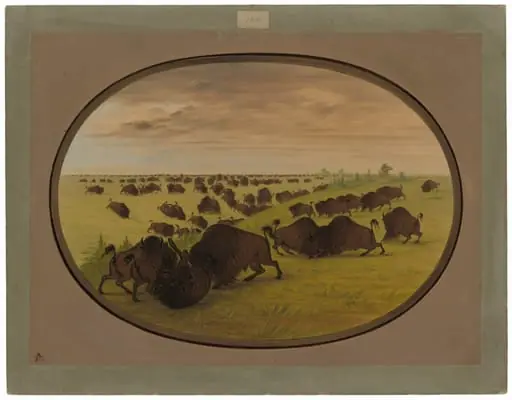 Bulls Fighting
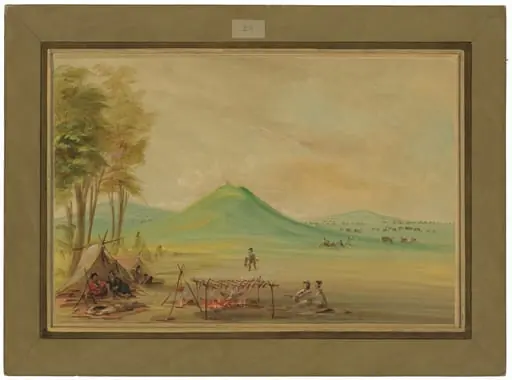 Expedition Encamped on a Texas Prairie. April 1686
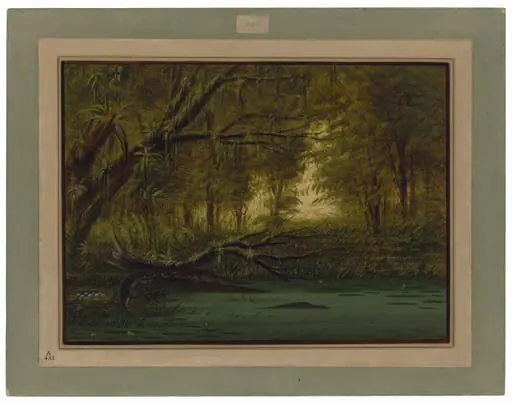 An Alligator's Nest
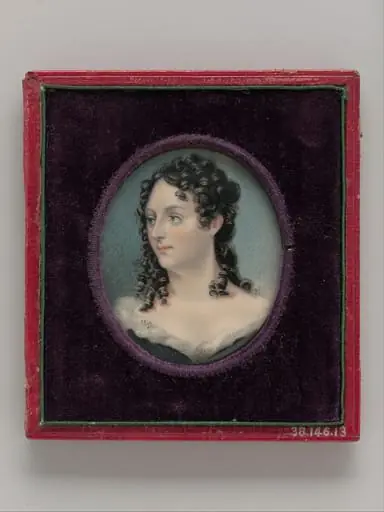 Mrs. George Catlin (Clara Bartlet Gregory)
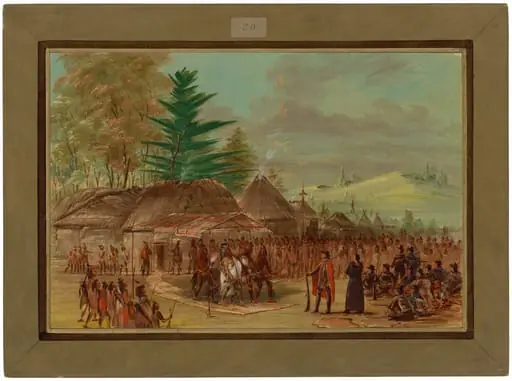 Chief of the Taensa Indians Receiving La Salle. March 20, 1682
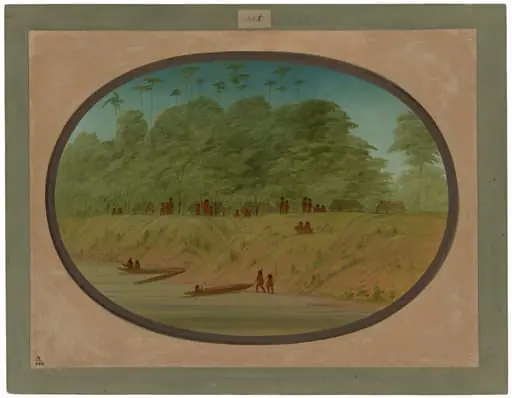 A Small Village - Payaguas Indians
 Omaha Chief, His Wife, and a Warrior
 Father Hennepin Leaving the Mississippi to Join La Salle. May 8, 1680
 La Salle Driving the First Bolt for the Griffin. January 26, 1679
 La Salle and Party Arrive at the Village of the Illinois. January 1, 1680
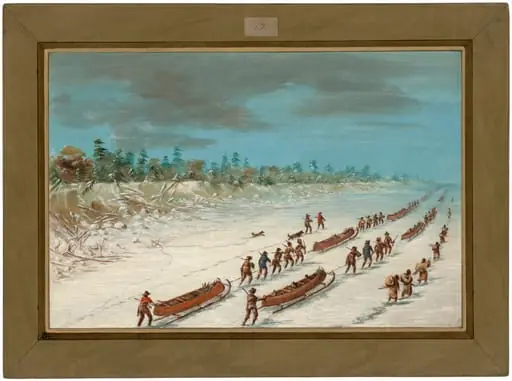 La Salle Crossing Lake Michigan on the Ice. December 8, 1681
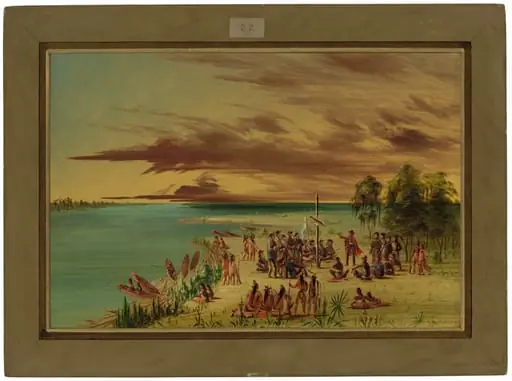 La Salle Claiming Louisiana for France. April 9, 1682
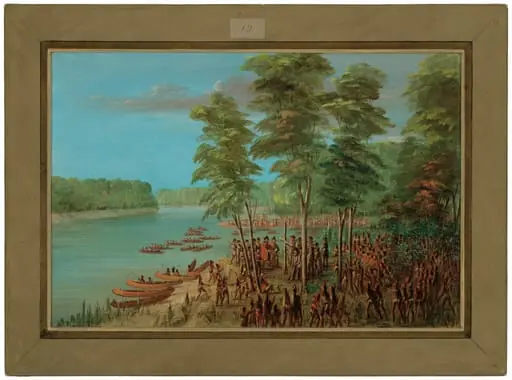 La Salle Taking Possession of the Land at the Mouth of the Arkansas. March 10, 1682
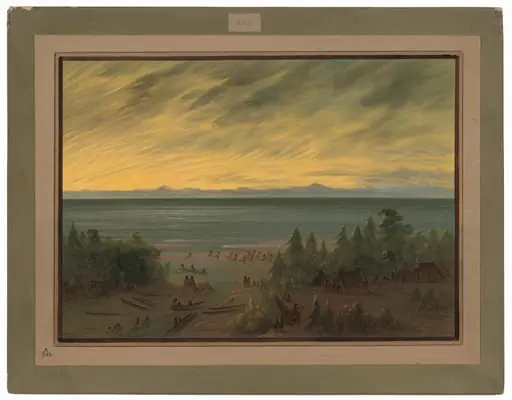 Nayas Village at Sunset
 The Cheyenne Brothers Starting on Their Fall Hunt