Artwork
Leda and the Swan
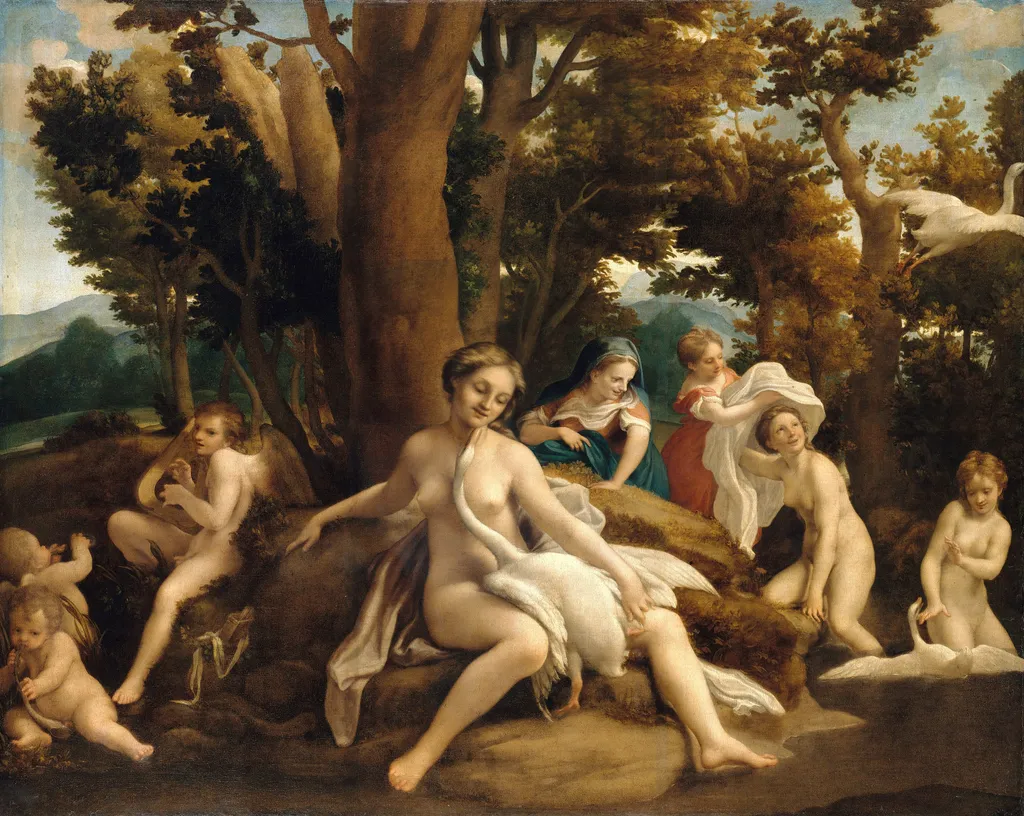
Leda and the Swan is an oil painting by the Mannerist artist Antonio da Correggio. It dates from 1532 and is held in the collection of the Gemäldegalerie Berlin.
About this work
Subject & Meaning
The painting depicts the myth of Leda seduced by Jupiter in the form of a swan, a popular 16th‑century subject that Correggio treated as part of his Amori di Giove series. The composition shows three narrative moments: on the right Leda first resists the bird, in the centre she sits frontally with the swan between her thighs, guiding it with her left hand while Cupid with a lyre and two flute‑playing putti attend, and on the far right the swan flies away as Leda dresses. Iconographically the nude Leda, the intertwined swan, the attendant cherubs and the women preparing to bathe convey sensual love, fertility and the transformation of divine desire into human intimacy, a balance of naturalist detail and poetic transfiguration that marks the work's significance in secular mythological painting.
Technique & Style
The work is executed in oil on canvas. Its support is a canvas measuring roughly 152 × 191 cm, and the surface has suffered significant damage: in 1721 the painting was cut into three pieces and the head of Leda was lost, with subsequent restorations by Delyen, Prud'hon and Schlesinger replacing the missing portions. Stylistically, Correggio arranged the composition into three narrative episodes – the encounter, the act of union, and the departure – creating a delicate balance between naturalistic detail and poetic transfiguration.
The figures are rendered with soft modelling, a harmonious colour scheme, and a dynamic spatial layout that distinguishes the work from earlier mythological treatments.
History & Provenance
Its provenance thus traces a chain of ownership from Mantua to Spain, Prague, Sweden, Orléans, Prussia, France, and finally Berlin.
Commissioned by Federico II Gonzaga, Duke of Mantua, the work formed part of his Amori di Giove series, likely intended for the Sala di Ovidio or as a gift for Charles V. Antonio da Correggio painted it in oil on canvas around 1532. The painting entered the Spanish royal collection, was bought by Emperor Rudolf II in 1601 and taken to Prague, and later passed to Christina of Sweden, the Orléans family, and Frederick II of Prussia before Napoleon seized it; the work was subsequently fragmented in 1721, restored, and reassembled in the Gemäldegalerie, Berlin. Its provenance thus traces a chain of ownership from Mantua to Spain, Prague, Sweden, Orléans, Prussia, France, and finally Berlin.
Context
Correggio's Leda and the Swan belongs to his Amori di Giove series, conceived after the success of Venus and Cupid with a Satyr and comprising four canvases, paired by dimensions, whose chronology remains debated. Vasari attributes the commission of Leda and a Venus (Danaë) to Federico II Gonzaga, Duke of Mantua, as a gift for Charles V; a later study instead situates the series in Mantua's Sala di Ovidio, intended for Isabella Boschetti, with the works entering the Spanish royal collections only after Federico II's death in 1540. Correggio drew on Michelangelo's lost Leda, combining the seated pose with the swan between the legs and a frontal orientation.
The series is credited with advancing mythological and secular painting through a new equilibrium between naturalistic rendering and poetic transfiguration. The painting's later history, passing through Rudolf II, Christina of Sweden, the Orléans collection, Frederick the Great, and Napoleon, culminated in mutilation by Louis, the Duke of Orléans' son, who slashed the canvas around 1721, prompting successive repaintings of Leda's head.
Legacy
Correggio's work significantly advanced secular mythological painting by balancing naturalism with poetic transfiguration, influencing the genre's development in the 16th century. The painting's legacy is also marked by a turbulent history of damage and restoration that altered its original appearance. After the son of the Duke of Orléans slashed Leda's face in the 1720s, deeming it too licentious, subsequent restorers replaced the head multiple times.
These interventions, particularly those by Delyen and Schlesinger, replaced Correggio's intended expression with a more reserved countenance, effectively altering the original composition. Despite these damages, the work's provenance through major royal collections, from the Gonzaga family to the Spanish, Swedish, and Prussian crowns, underscores its enduring prestige. Today it remains in the Gemäldegalerie in Berlin, serving as a key example of Renaissance mythological narrative, though its current appearance reflects centuries of restoration rather than the artist's initial vision.
Overview
Correggio's "Leda and the Swan," an oil painting from 1530–31, depicts the mythological encounter between Leda and Jupiter, who assumes the form of a swan. This work, also known as "Leda" in Italian, is currently housed in the Gemäldegalerie in Berlin. The composition unfolds across multiple moments, illustrating the unfolding narrative of the divine seduction within a natural setting.
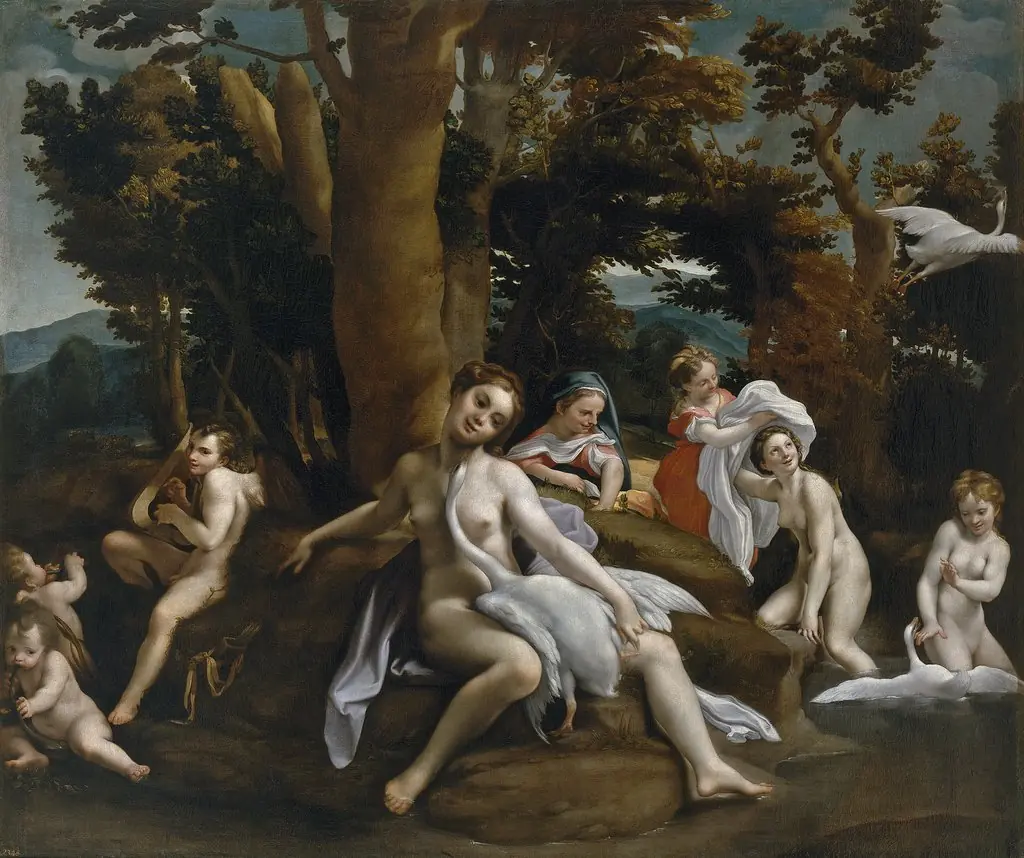
Own this work as a print
Artist & collection

Artist
Antonio Allegri da Correggio, usually known as just Correggio, was an Italian Renaissance painter who was the foremost painter of the Parma school of the High Renaissance, who was responsible for some of the most…