Artwork
The Jester Named Don John of Austria
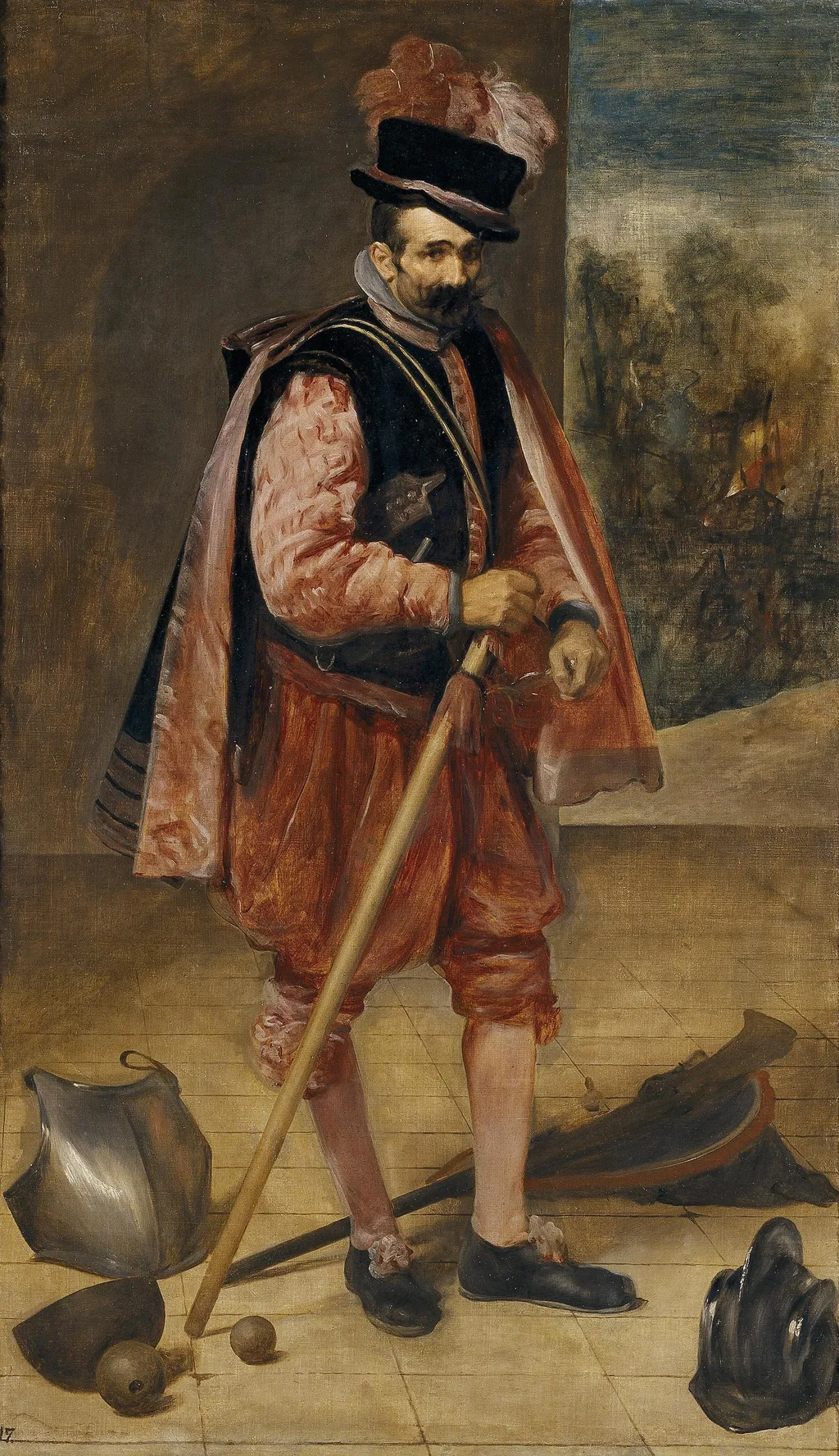
The Jester Named Don John of Austria is an oil painting by the Early Baroque Italian artist Diego Velázquez. It dates from 1632 and is held in the collection of the Museo del Prado.
About this work
Subject & Meaning
Dressed in an elaborate black and pink velvet military costume, the jester holds a baton in his left hand and a sword in his right.
The painting depicts a court jester or entertainer named Don Juan de Austria, who served in the household of King Philip IV between 1624 and 1654, rather than the historical 16th-century military commander of the same name. Dressed in an elaborate black and pink velvet military costume, the jester holds a baton in his left hand and a sword in his right. Scattered on the tiled floor are an arquebus, artillery shells, and pieces of armor, while a naval battle scene in the background alludes to the Battle of Lepanto.
This imagery mimics the historical Don Juan of Austria's famous victory, possibly mocking the jester's delusions of grandeur or serving as a broader symbol of Spanish decadence. Rather than portraying the jester in a humorous pose, Velázquez emphasizes his interiority and stern demeanor, contrasting the figure's military trappings with his true court role.
Technique & Style
Diego Velázquez executed this full-length portrait in oil on canvas, measuring 210 by 123 cm. Belonging to his series of court jester portraits, the informal nature of the commission allowed him greater expressive freedom and technical experimentation compared to his official royal portraits. He employed a fluid handling of paint, building forms through nearly transparent layers of diluted color. Jonathan Brown notes that Velázquez applied wet paint over previously applied layers that were not yet dry, giving the face a slightly unfocused appearance when viewed up close.
This effect is further achieved through extremely light, almost transparent brushstrokes used for modeling, such as the subtle crimson of the garment, painted with nearly liquid red lake and fine white touches to create a veil-like glaze. Julián Gállego observed that this virtually impasto-less application, with an "aquarelle" tonality in the breeches, evokes the texture of worn velvet. Conversely, the naval battle in the background is rendered with long, disorderly strokes and thick, heavily loaded black impasto. Radiographic evidence reveals a technique consistent with his other Buen Retiro jester portraits.
History & Provenance
Painted by Diego Velázquez around 1632, this work was originally created for the Palacio del Buen Retiro in Madrid. A 1632 document recording the delivery of a black and pink velvet costume to a court entertainer named Don Juan de Austria provides the primary evidence for this dating. The painting appeared in the 1701 inventory of the Buen Retiro as a portrait of a jester, but its identity was obscured over the following century.
Upon moving to the Royal Palace in 1772, it was misidentified as an artilleryman, and later as a Spanish general in 1789. By 1816, after transferring to the Real Academia de Bellas Artes de San Fernando, it was mistakenly cataloged as a portrait of the Marquis of Pescara.
The work entered the Museo del Prado in 1827, yet its correct identification as a court jester was not restored until 1872, when Pedro de Madrazo published his comprehensive catalogue. Historical records indicate that an entertainer known by this name served in the court of Philip IV between 1624 and 1654, adopting the moniker of the famous illegitimate son of Emperor Charles V.
The painting is held in the Museo del Prado, Madrid, with accession number P01220.
It entered the museum in 1827 after earlier residence at the Palacio del Buen Retiro (recorded in the palace’s 1701 inventory as a portrait of a jester “named Don Juan de Austria with various harnesses”), the Royal Palace of Madrid (1772–1816), and the Real Academia de Bellas Artes de San Fernando (1816–1827). By 1789 the work had been re-identified in inventories as “Spanish general with various armors on the floor,” and in 1816 it was confused with a portrait of the Marquis of Pescara before its correct title was restored in 1872.
Context
The Jester Named Don John of Austria is a central work in Diego Velázquez’s series of court portraits, specifically those depicting jesters and “men of pleasure” commissioned for the secondary rooms of the Buen Retiro Palace. These informal commissions allowed the artist to experiment with expressive techniques and greater freedom than in official royal portraiture. Scholars note that the painting’s fluid brushwork and the slightly blurred facial treatment suggest a date around 1632–1634, aligning it with other works like The Forge of Vulcan.
The composition, featuring a jester in exaggerated military attire against a backdrop evoking the Battle of Lepanto, serves as a complex social commentary. It juxtaposes the historical heroism of Don John of Austria with the reality of a court entertainer, possibly mocking the figure or highlighting the tragic dignity of the subject. Art historians such as José Camón Aznar have described the work as a symbol of decay and one of Velázquez’s most tragic portraits, emphasizing the artist’s ability to convey interiority rather than mere grotesque deformation.
Legacy
The painting's reputation underwent significant shifts due to historical misidentifications. After moving to the Royal Palace of Madrid in 1772, the work was cataloged as a portrait of an artilleryman, and by 1789, it was elevated in status to a depiction of a Spanish general. In 1816, it was erroneously attributed to a portrait of the Marquis of Pescara upon entering the Royal Academy of Fine Arts of San Fernando.
The correct identification as a court jester named Don John of Austria was not restored until 1872, when Pedro de Madrazo published a comprehensive Prado catalog. Within Velázquez's oeuvre, the work is recognized for its expressive freedom, allowing the artist to experiment with techniques unavailable in official royal portraits. Modern critics regard it as a tragic symbol of decay, contrasting the figure's military attire with his status as a fool, and some consider it the most tragic portrait in Velázquez's entire body of work.
Overview
Diego Velázquez’s oil painting, titled The Jester Don John of Austria, belongs to the Spanish Baroque period and dates from roughly the middle of the 17th century, around 1630‑1650. The work portrays a court jester attired in a richly detailed military costume, reflecting Velázquez’s ongoing interest in the varied personalities of the royal household.
Artist & collection
Artist
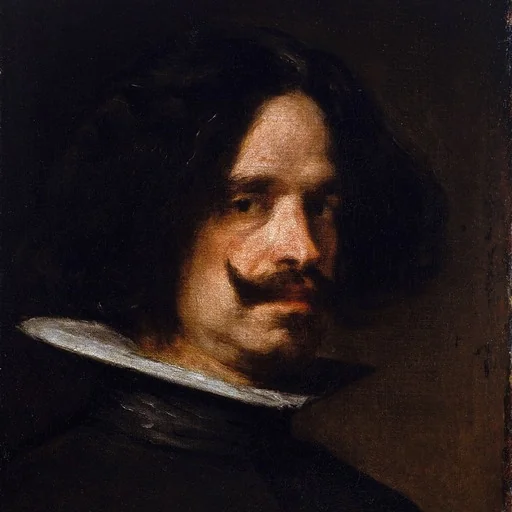
Diego Rodríguez de Silva y Velázquez was a Spanish Baroque painter, the leading artist in the court of King Philip IV of Spain and Portugal, and of the Spanish Golden Age.