Artwork
The Immaculate Conception with Saint Joachim and Saint Anne
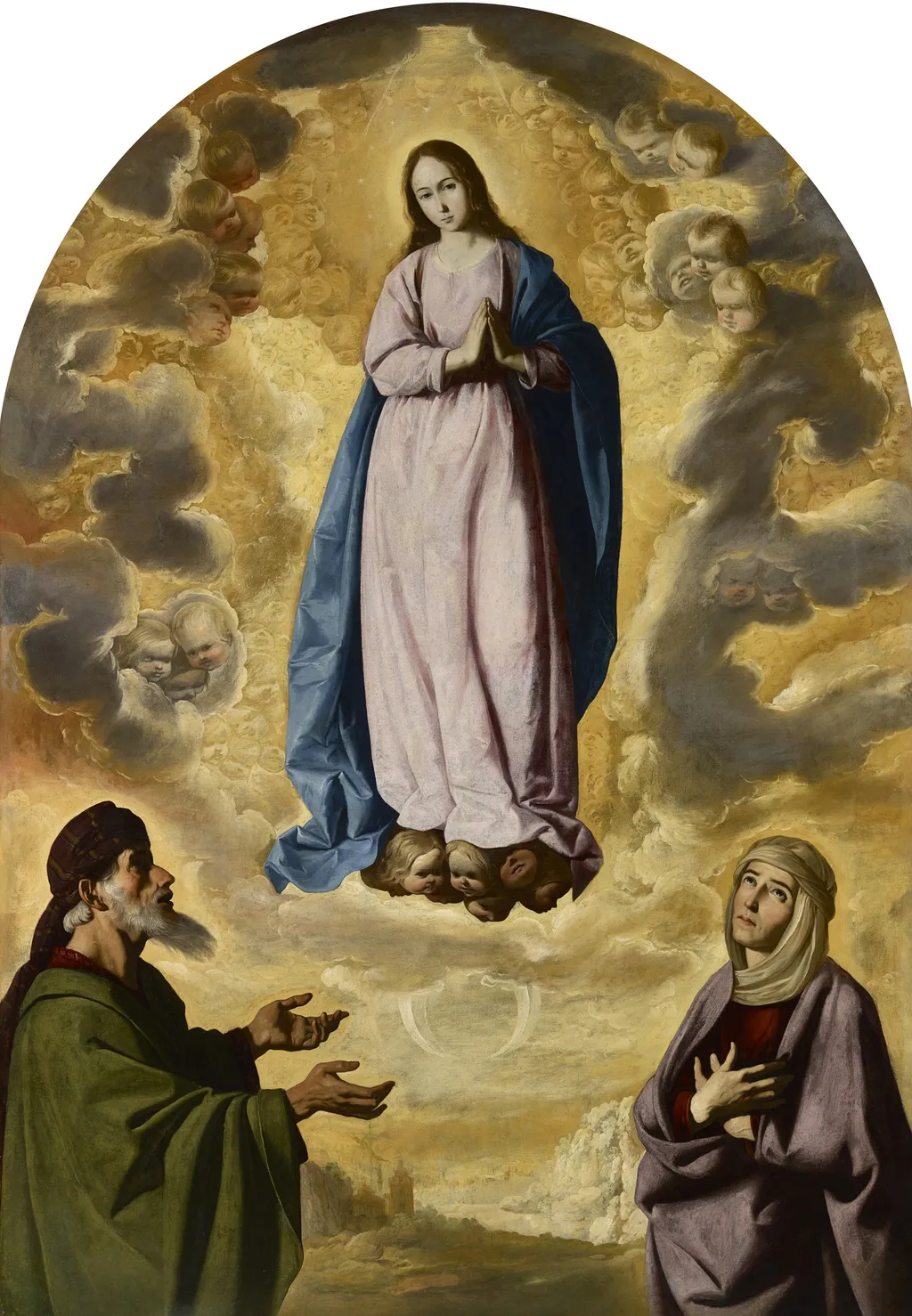
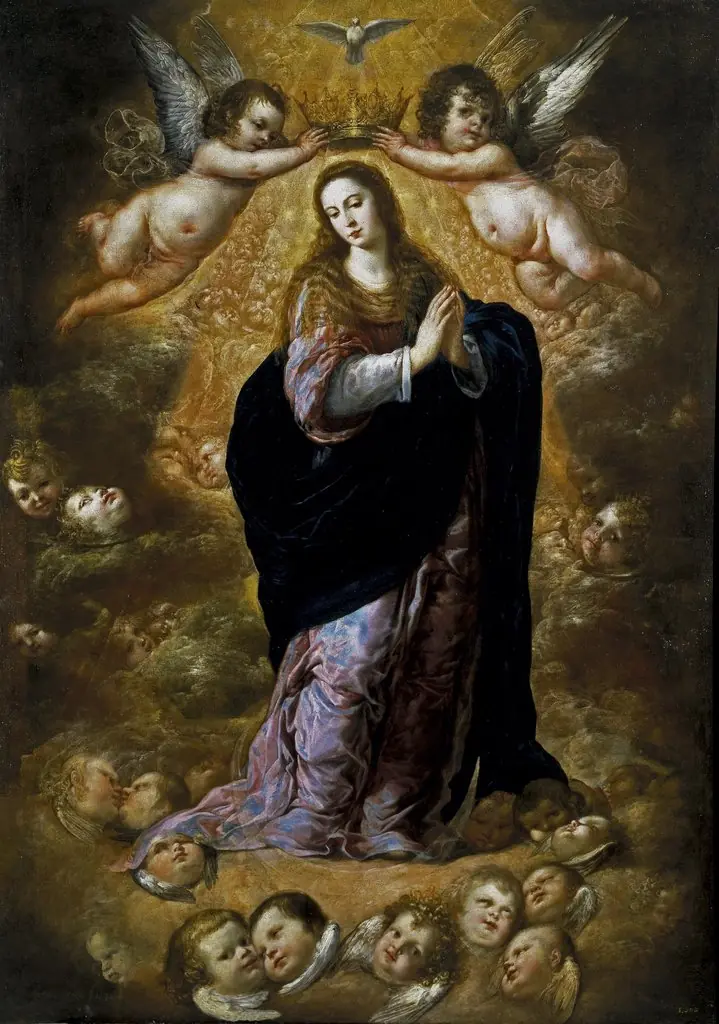
The Immaculate Conception with Saint Joachim and Saint Anne is an oil painting by the Baroque artist Francisco de Zurbarán. It dates from 1639 and is held in the collection of the Scottish National Gallery.
About this work
Subject & Meaning
This specific iconography aligns with traditional devotions of the Carthusian order, which celebrated the feast of the Immaculate Conception starting in 1509.
The painting depicts the Immaculate Conception of the Virgin Mary, a subject rarely portrayed alongside her parents, Saint Joachim and Saint Anne, in seventeenth-century art. This specific iconography aligns with traditional devotions of the Carthusian order, which celebrated the feast of the Immaculate Conception starting in 1509. The composition draws from apocryphal texts rather than canonical Gospels, presenting the elderly, previously sterile couple adoring their daughter as a divine vision.
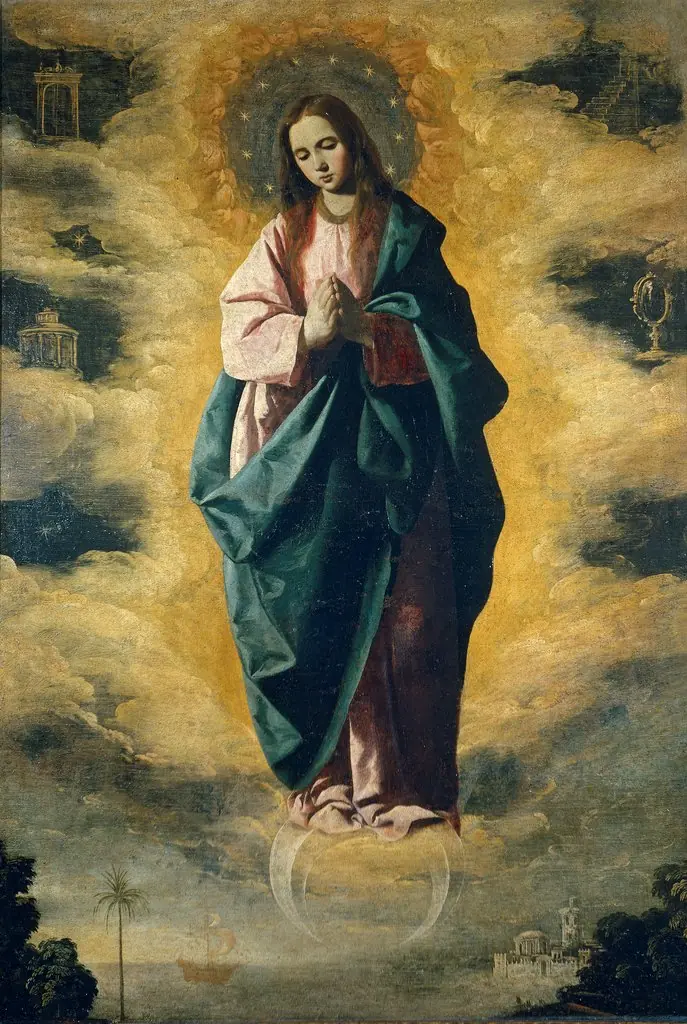
Mary appears as a youthful figure floating above a crescent moon amidst clouds and cherubim, wearing a pale pink tunic and dark blue mantle. In contrast to this idealized celestial form, Joachim and Anne are rendered with realistic features in the terrestrial foreground. Joachim stands in profile with open hands expressing admiration, while Anne gazes upward with crossed hands, dressed in dark red and violet. The work visually separates the earthly reality of the parents from the heavenly manifestation of the Virgin.
Technique & Style
The painting is executed in oil on canvas, measuring 255.5 cm in height by 177 cm in width. The brushwork is characterized by Zurbarán's characteristic simplicity, naturalism, and monumental treatment of figures, enhancing the clarity of the sacred narrative. The Virgin Mary is depicted youthfully and modestly, floating on a crescent moon amid a celestial sky filled with angelic heads, her pale pink tunic and dark blue mantle contrasting with the surrounding tones.
Below, Saints Joachim and Saint Anne are rendered in half-length, their realistic, earthy portrayal set against a lightly detailed landscape, with Joaquín shown in profile and offering his hands in reverence, while Saint Anne, veiled in beige and draped in a violet mantle, gazes thoughtfully at Mary. The composition emphasizes a vertical axis, with the divine apparition centered and the earthly figures arranged in balanced contrapposto, reflecting Baroque stylistic conventions of spiritual elevation and tactile materiality.
History & Provenance
Painted by Francisco de Zurbarán around 1638–1640, this work is cataloged as number 139 in Odile Delenda's critical raisonné. The painting likely originated from the Capilla de La Antigua at the Cartuja de Jerez de la Frontera, where it may have served as a pendant to a Virgin of the Rosary, potentially undergoing later truncation. It remained in the monastery until approximately 1810 before entering the Spanish gallery of Louis Philippe I in Paris between 1838 and 1848.
The work was sold at Christie's in London on May 7, 1853, to Hickman for 90 pounds, subsequently passing through the collections of Lord Elcho and the Royal Institution. It was acquired by the Royal Institution in 1859 and officially transferred to the National Galleries Scotland in 1867.
The painting is held by the National Galleries Scotland at the Scottish National Gallery in Edinburgh, where it bears the accession number NG 340. Its provenance traces back to the Charterhouse of Jerez de la Frontera before entering the Spanish Gallery of King Louis Philippe I in Paris between 1838 and 1848. Following the collection's sale at Christie's in London on May 7, 1853, the work was acquired by the Royal Institution in 1859 and subsequently transferred to the Scottish national collection in 1867.
Historically, the canvas was exhibited at the Art Treasures Exhibition in Manchester in 1857. It was also featured in the exhibition "An Exhibition of Spanish Paintings from El Greco to Goya." The work underwent restoration in 1954 and is catalogued as number 139 in Odile Delenda's critical raisonné.
Context
The painting depicts the Immaculate Conception of Mary with her grandparents Saint Joachim and Saint Anne, a subject rare in 17th-century Spanish art but aligned with Carthusian devotional practices that celebrated the feast from 1509 onward. Its rounded upper format suggests a possible origin as a pendant in the Carthusian monastery of Jerez de la Frontera, potentially linked to a now-lost work of the Virgin of the Rosary. Art historian Odile Delenda identifies the work as catalog number 139 in her critical catalogue of Zurbarán’s oeuvre, confirming its execution circa 1638–1640.
The composition features a youthful, ethereal Virgin floating on a crescent moon, surrounded by angelic heads, while Joachim and Anne are rendered in a more naturalistic, earthly manner, positioned below in half-length figures. Zurbarán employs his characteristic simplicity, naturalism, and monumental figures, using delicate color contrasts, such as the Virgin’s pale pink tunic and dark blue mantle, to heighten spiritual reverence. The work was acquired by the Royal Institution in 1859 and later transferred to the National Gallery of Scotland in 1867, having previously entered the collection of Lord Elcho and Gemís via a London auction in 1853.
Its provenance includes an earlier presence in the Chapel of La Antigua at the Charterhouse of Jerez and a documented exhibition in Manchester in 1857 as part of a Spanish painting exhibition.
Overview
Francisco de Zurbarán’s oil on canvas, dated 1639, presents a devotional scene titled The Immaculate Conception with Saint Joachim and Saint Anne. The work is part of the collection of the Scottish National Gallery, where it is displayed among the museum’s Baroque holdings.
Own this work as a print
Artist & collection
Artist
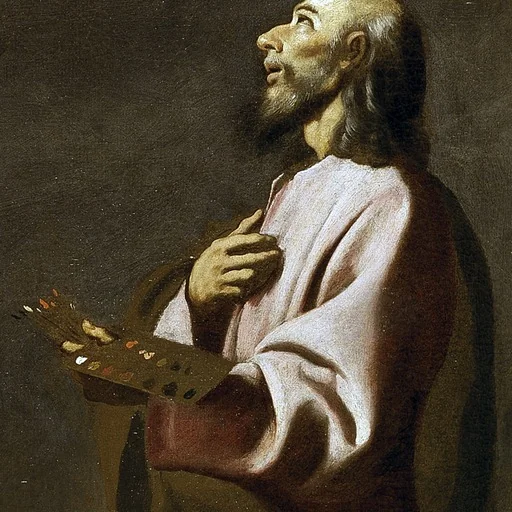
Francisco de Zurbarán was a Spanish Baroque painter. He is known primarily for his religious paintings depicting monks, nuns, and martyrs, and for his still-lifes. Zurbarán gained the nickname "Spanish Caravaggio",…