Artwork
Holy Allegory
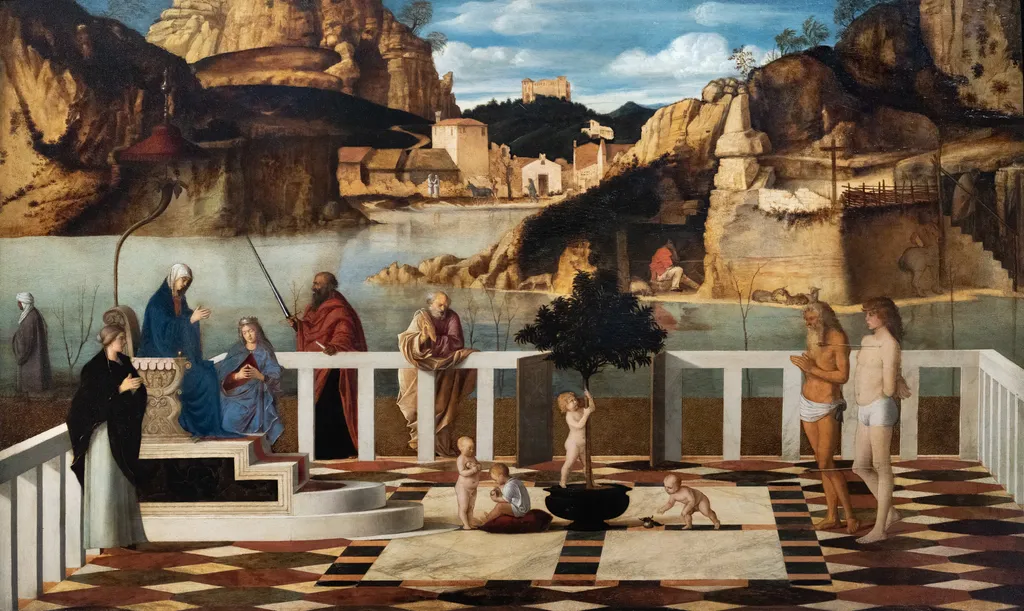
Holy Allegory is an oil painting by the Early Renaissance artist Giovanni Bellini. It dates from 1496 and is held in the collection of the Uffizi Gallery.
About this work
Overview
The painting depicts a sacred vision set on a broad terrace overlooking a distant lake, populated by religious figures, saints, and playing children.
Holy Allegory is an oil on panel painting by the Italian Renaissance master Giovanni Bellini, created circa 1490 to 1500. Measuring 73 by 119 centimeters, the work is one of the most enigmatic paintings of its era, resisting a single definitive interpretation of its complex iconography. The painting depicts a sacred vision set on a broad terrace overlooking a distant lake, populated by religious figures, saints, and playing children. It is currently held in the Uffizi Gallery in Florence.
Subject & Meaning
The composition is divided between a foreground terrace enclosed by a white balustrade and a distant landscape. On the left, the Virgin Mary sits enthroned under a red baldachin supported by a cornucopia, symbolizing her fertility. The throne features a frieze depicting the myth of Marsyas, interpreted as a parallel to the Passion of Jesus. Beside Mary are two unidentified female figures, possibly saints or virtues; one wears a crown, and the other appears to float, an effect possibly caused by paint loss. In the center, four children play with a potted tree bearing silver fruits, perhaps the tree of knowledge. To the right stand the nearly nude Saint Sebastian, bearing arrows, and a bearded male figure, identified as either Job or Saint Onuphrius. Behind the balustrade stand Saint Paul, holding his attribute of a long sword, and Saint Joseph or Saint Peter. Paul advances toward a man in a turban, possibly an infidel or the blinded magician Elymas being expelled. The background landscape features a lake reflecting rocky cliffs, a village, a fortress, a hermit in a grotto, a shepherd, and a centaur. Scholars have proposed various readings for the assembly. In the early 20th century, Ludwig interpreted the scene as a visual translation of the 14th-century French poem Le Pelerinage de l'Ame by Guillaume de Deguileville, representing the soul's path of purification. In this reading, the terrace is the Paradise Garden where souls in Purgatory wait, the hermit is Saint Anthony the Abbot descending his hermitage, the centaur represents worldly obstacles, and the river is the Lethe. Other scholars view the work as a rotated sacred conversation, a vision of Paradise, an allegory of the four daughters of God, or a meditation on the Incarnation and Redemption.
Technique & Style
Executed in oil on a wooden panel, the painting demonstrates the chromatic perspective characteristic of the Venetian school. The surface reveals smooth, controlled brushwork with precise architectural details, while the distant landscape receives a softer, more atmospheric treatment. Light falls evenly across the foreground, casting subtle shadows beneath the figures and architecture. Bellini models the forms through a skillful modulation of light and color rather than visible line drawing; contour lines disappear, and the subjects emerge as bodies shaped primarily by light and color. The palette features deep blues, warm reds, and ochres, enveloped in a golden atmospheric light. The naturalism is subtle and total, with the landscape playing a vital role in the overall composition.
History & Provenance
No documentation survives regarding the commission or original location of the painting. By the 18th century, it had entered the Austrian Imperial collections in Vienna. In 1793, the director of the Uffizi, Luigi Lanzi, exchanged another work for this painting to enhance the museum's representation of the Venetian Renaissance. At the time of the exchange, the painting was attributed to Giorgione. In 1871, the Italian art historian Giovanni Battista Cavalcaselle, alongside Joseph Archer Crowe, correctly identified the work as a Bellini, an attribution now widely accepted, though the scholar Morelli once proposed Marco Basaiti as the creator. The painting underwent restoration in 2002 and again in 2010. It remains in the Uffizi Gallery under accession number 1890 n. 903.
Context
Dating for the work has oscillated between 1487 and 1504. It relates to Bellini's mature masterpieces from the end of the 15th and beginning of the 16th centuries, such as his sacred conversations, the Madonna del Prato, and his Four Allegories. The painting likely belonged to the genre of poesie, poetic and atmospheric pictures filled with learned allusions created for the humanist-educated circles at Northern Italian courts, such as Ferrara, Urbino, and Mantua, to decorate their studioli. One hypothesis suggests Isabella d'Este commissioned it for her studiolo, though the painting's dimensions and lack of documentation make this unlikely. The riddling nature of the imagery was intended for a refined elite capable of deciphering obscure sources, such as Maffeo Vegio's account of Saint Anthony meeting a centaur, a motif present in late medieval and early Renaissance art.
Legacy
The painting has endured as one of the most mysterious works of the Renaissance, resisting any conclusive and universally accepted interpretation. Its elusive iconography places it among a series of contemporary court paintings that continue to challenge art historical scholarship. The work has also captured the attention of cultural figures outside traditional art history, most notably the French historian Paul Veyne, who included the painting in his personal musée imaginaire, discussing it in his book of the same name.
Own this work as a print
Artist & collection

Artist
Giovanni Bellini (Italian: ; Venetian: Zuane Belin; c. 1430 – 29 December 1516) was an Italian Renaissance painter, probably the best known of the Bellini family of Venetian painters. He was raised in the household of…

- Adoration of the Child with St. Benedict and Angels
 Calling of the sons of Zebedee
 Holy Family and Donors
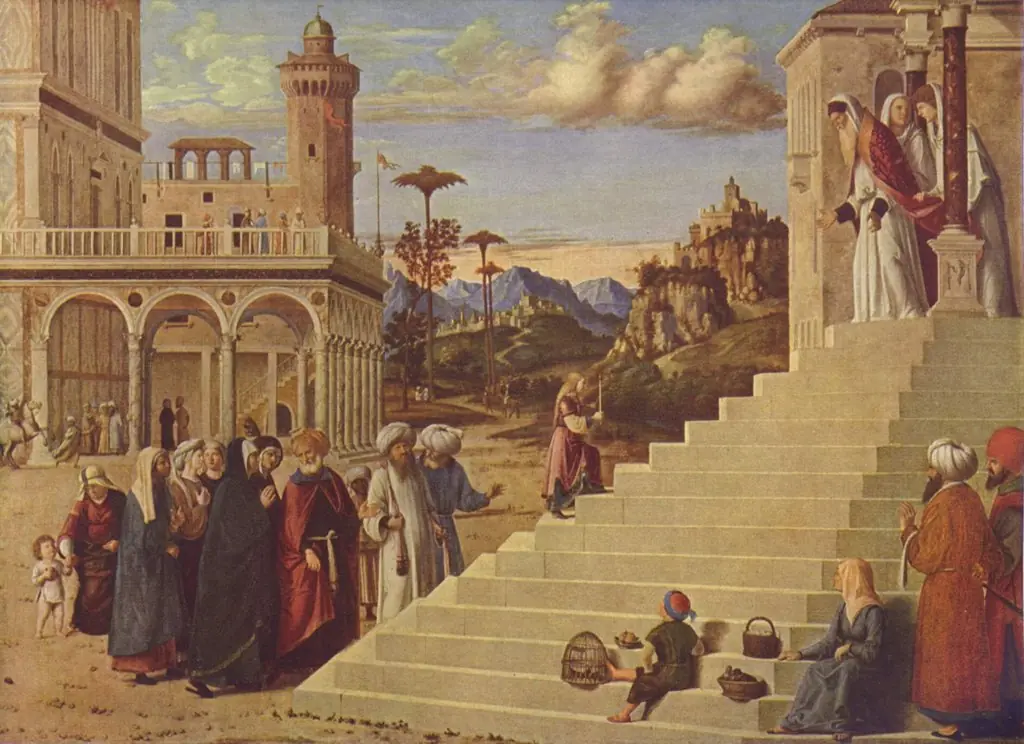 Presentation of the Virgin Mary at the Temple
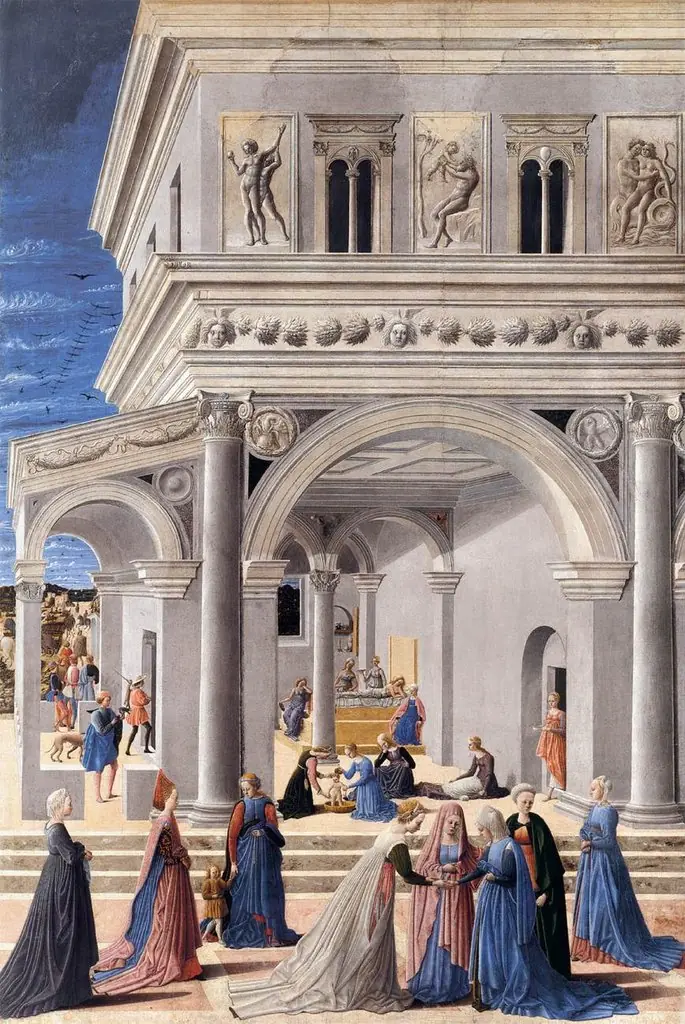 The Birth of the Virgin
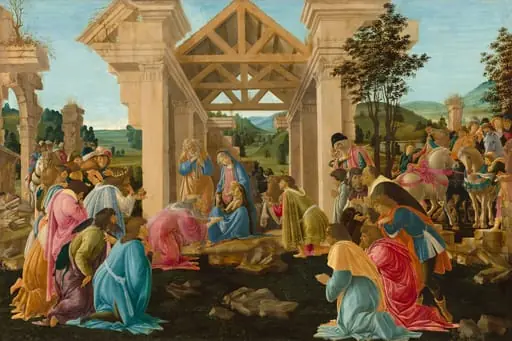 The Adoration of the Magi
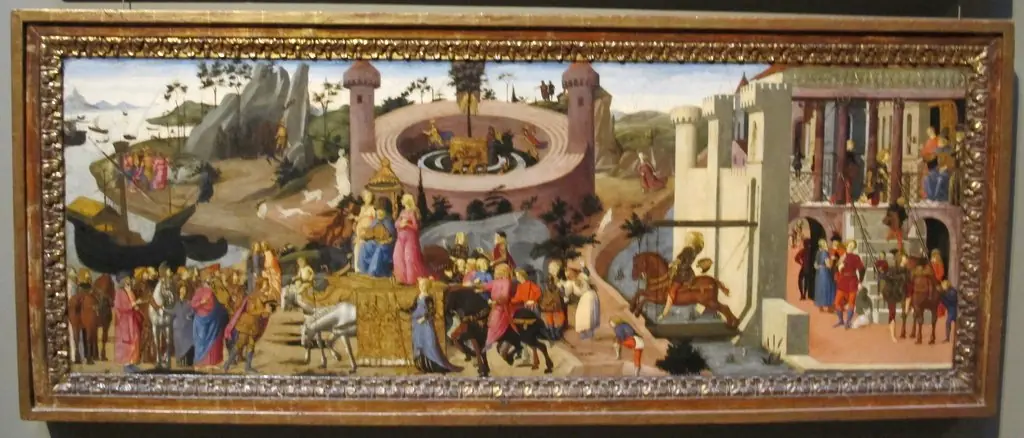 scene con storie degli argonauti
 Rest on the Flight into Egypt
 The Madonna and Child with the Infant Saint John the Baptist
 Madonna and Child with St Catherine, St John the Baptist, St Dorotea and St Anthony the Abbot
 Landscape with biblical scenes and scenes from the legends of saints
 Adoration of the Three Kings