Artwork
Primavera
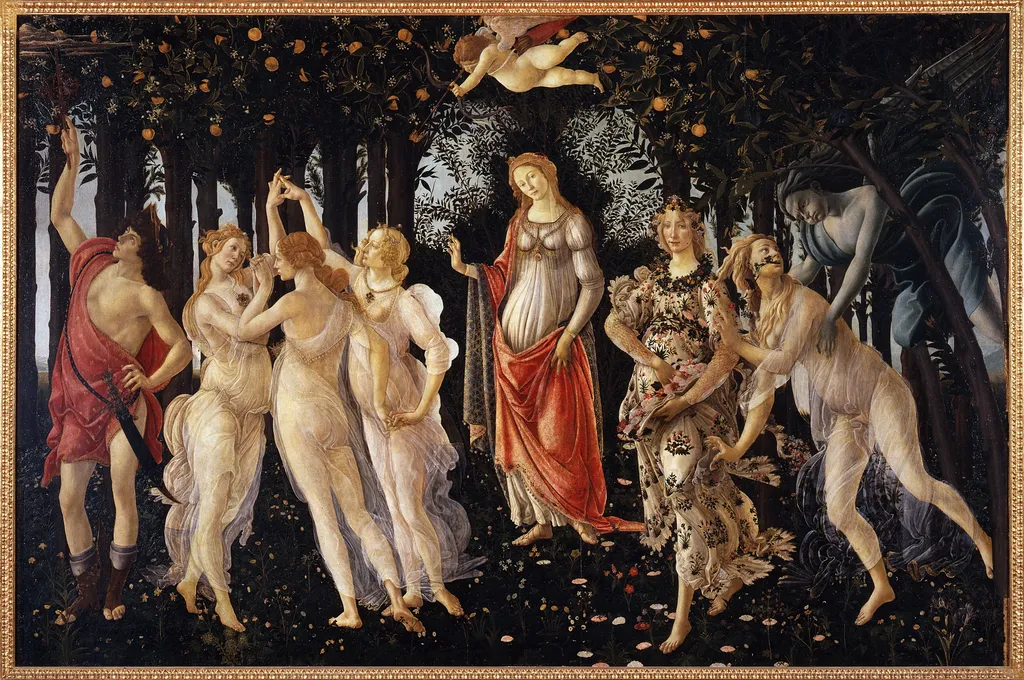
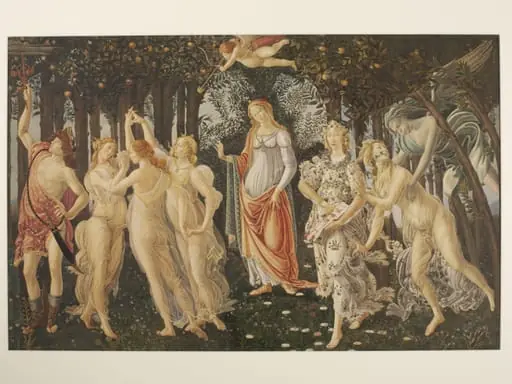
Primavera is a tempera painting by the Early Renaissance artist Sandro Botticelli. It dates from 1490 and is held in the collection of the Uffizi Gallery.
About this work
Subject & Meaning
Primavera depicts a mythological allegory of spring's burgeoning fertility within an orange grove, featuring figures from classical antiquity.
Primavera depicts a mythological allegory of spring's burgeoning fertility within an orange grove, featuring figures from classical antiquity. The composition moves from right to left, beginning with Zephyrus abducting the nymph Chloris, who transforms into Flora and scatters roses. Central to the scene stands Venus, the goddess of love, flanked by the Three Graces and watched over by a blindfolded Cupid, while Mercury dispels clouds on the far left to preserve eternal spring.
Although no single ancient narrative unites these characters, the work is widely interpreted as a complex symbol of Renaissance Neoplatonism, representing the transformation of material desire into spiritual love. Scholars also suggest the painting alludes to contemporary Medici politics or marriage celebrations, drawing literary inspiration from Ovid, Lucretius, and Poliziano. The inclusion of over 500 plant species, many blooming out of season, reinforces the theme of lush, idealized growth.
Technique & Style
Primavera is a large panel painting executed in tempera on wood, measuring approximately 203 cm in height and 314 cm in width. The work exhibits a distinctively flat composition where figures are arranged side-by-side like pearls on a string, lacking deep spatial recession. This arrangement, combined with the absence of flowers shrinking in perspective, evokes the aesthetic of contemporary Flemish millefleur tapestries rather than strict Renaissance linear perspective.
Botticelli employs sharp contours and precise, delicate lines to render the figures, who appear graceful and almost weightless against a dense orange grove. The artist demonstrates meticulous attention to botanical detail, depicting over 500 identified plant species and roughly 190 different flowers, though not all bloom simultaneously in spring. The costumes blend contemporary Florentine fashion with quasi-theatrical elements designed for civic festivals, contributing to the painting's allegorical and pageant-like quality.
History & Provenance
The exact commission and creation history of Primavera remain uncertain, though the work is generally dated to the late 1470s or early 1480s, with specific estimates ranging from 1478 to 1482. Scholars frequently attribute the commission to Lorenzo di Pierfrancesco de' Medici, possibly intended as a wedding gift for his marriage in 1482, or as a gift from his cousin Lorenzo the Magnificent. The painting was likely conceived with intellectual input from the poet Poliziano and reflects Neoplatonic ideas prevalent in Florence.
Giorgio Vasari first described the work in 1550 at the Villa Castello, though earlier inventories from 1499 reveal it originally hung in the Medici palace in Florence in a room associated with Lorenzo di Pierfrancesco. The painting remained at Villa Castello until 1815, when it was transferred to the Uffizi Gallery, where it has resided since 1919 in Room 10.
Context
Primavera has been described as "one of the most written about, and most controversial paintings in the world" and "one of the most popular paintings in Western art." The subject was first identified as Primavera by Giorgio Vasari, who saw it at Villa Castello by 1550. Aby Warburg, founder of iconology, traced its literary sources in his 1893 Strasbourg dissertation, citing Ovid's Fasti, Horace, Virgil, Lucretius, Alberti, and Poliziano, and proposed the "reign of Venus" reading.
Later Warburg-school scholars Edgar Wind and Ernst Gombrich linked the imagery to Renaissance Neoplatonism as taught by Marsilio Ficino at the Medici court. Leopold Ettlinger summarized the proliferation of readings as a "descent into the ridiculous," comparing the work to a Wagnerian pantomime.
The painting is invariably discussed alongside Botticelli's Birth of Venus, the pair being icons of the Italian Renaissance and virtually unprecedented large-scale classical subjects since antiquity. Its format echoes millefleur Flemish tapestries, and Botticelli's refined, linear style places it among the foremost examples of secular Early Renaissance painting.
Legacy
Primavera is widely regarded as one of the most popular, written-about, and controversial paintings in Western art, standing alongside The Birth of Venus as an icon of the Italian Renaissance. Although largely unseen by the general public until the mid-19th century, its reputation grew significantly following scholarly interventions. Aby Warburg's 1893 dissertation established the work's importance in iconology by linking its imagery to classical literature and Neoplatonic philosophy, a framework later expanded by art historians like Ernst Gombrich and Edgar Wind.
The painting's enigmatic meaning has generated countless interpretations regarding its function in Medici dynastic politics, yet no single theory has achieved universal acceptance. Its status as a masterpiece is cemented by its frequent reproduction and its central role in discussions of mythological allegory, despite the persistent lack of consensus on its precise symbolic narrative.
Overview
Primavera, meaning "Spring," is a monumental tempera painting by Sandro Botticelli, created in the late 1470s or early 1480s. This large panel depicts a gathering of figures from classical mythology within a verdant garden setting. It stands as one of the most recognized and frequently discussed artworks from the Italian Renaissance, celebrated for its intricate composition and allegorical depth.
Own this work as a print
Artist & collection
Artist
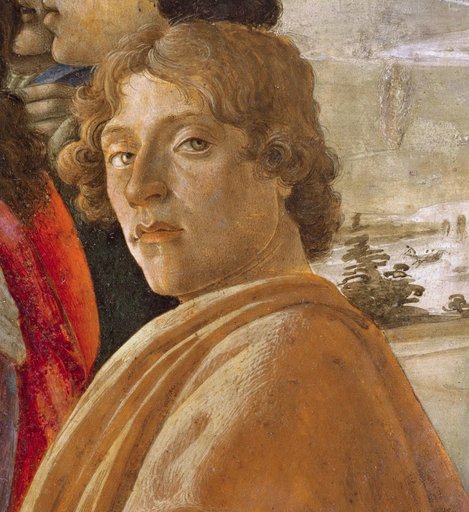
Alessandro di Mariano di Vanni Filipepi, better known as Sandro Botticelli or simply Botticelli, was an Italian painter of the Early Renaissance.