Artwork
The Return of the Prodigal Son
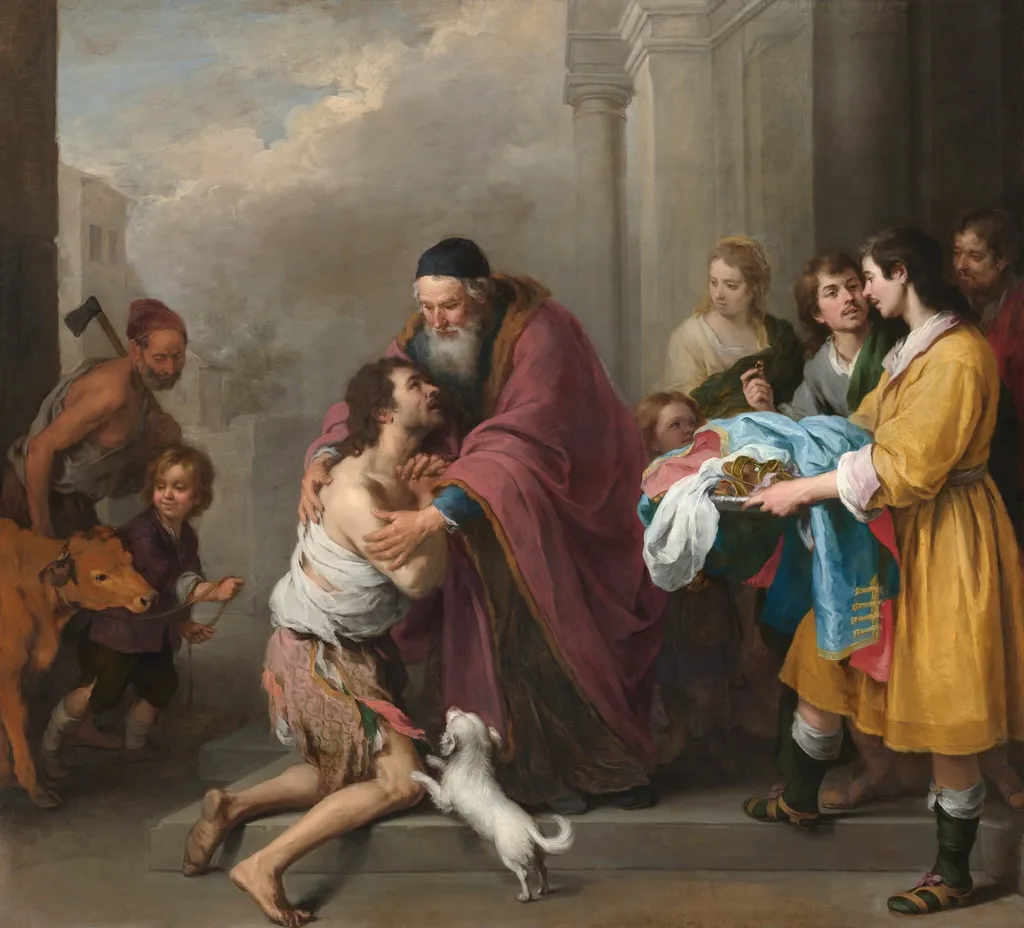
The Return of the Prodigal Son is an oil painting by the Baroque artist Bartolomé Esteban Murillo. It dates from 1668 and is held in the collection of the National Gallery of Art.
About this work
Subject & Meaning
Murillo infuses the biblical event with human realism, including a small white dog jumping to greet the returnee and a smiling child near the animal.
This painting illustrates the Parable of the Prodigal Son from the Gospel of Luke, specifically depicting the moment the repentant younger son returns to his father's house. The composition centers on a pyramidal group where the father, representing God, bends to embrace his kneeling son, who is shown with dirty feet and joined hands in prayer. This scene symbolizes divine forgiveness granted to those who sincerely repent.
Surrounding figures reinforce the narrative: a servant displays sumptuous new garments and a ring, signaling the son's restoration to his former social rank, while a fatted calf is led to slaughter for a celebratory feast. Murillo infuses the biblical event with human realism, including a small white dog jumping to greet the returnee and a smiling child near the animal. Commissioned for the Hospital de la Caridad, the work visually aligns with the brotherhood's statutes regarding Christian charity and active faith-based service.
Technique & Style
The work is an oil painting on canvas, executed circa 1667‑1670. It measures approximately 236.3 cm in height and 261 cm in width. The composition centers on a pyramidal grouping of the father and the returning son, rendered larger than life, with the most vivid colors reserved for the servant bearing the youth’s new garments.
Murillo’s handling combines Baroque theatricality with naturalistic details, such as the prodigy’s dirty feet, a welcoming puppy, and a grinning child beside the fatted calf, to convey a deeply human moment. Stylistically, the painting exemplifies Spanish Baroque religious art, emphasizing dramatic grouping, expressive color, and a focus on charitable themes.
History & Provenance
Commissioned around 1667–1670 by Miguel Mañara, president of the Confraternity of Charity in Seville, the painting was part of a program of eight works depicting Christian charity for the hospital’s interior; Murillo, a member of the confraternity, created the piece as one of the series. The work, an oil on canvas dated 1668, portrays the Prodigal Son’s return, a biblical episode from Luke 15. Its early history includes removal from the hospital in 1810, seizure by Marshal Soult in 1812, and sale in 1835 to the 2nd Duke of Sutherland, whose family retained it through successive dukes.
The painting was sold on 7 January 1948 to Thomas Agnew & Sons, London, and on 30 December 1948 to the Avalon Foundation, which gifted it to the National Gallery of Art, Washington, D.C., in 1948.
The painting is held at the National Gallery of Art in Washington, D.C., where it has been since 1948. It entered the museum's collection as a gift from the Avalon Foundation that year, following its purchase from Thomas Agnew & Sons, Ltd, London on 30 December 1948.
The work's provenance traces back to its commission for the Hospital de la Caridad in Seville. It was removed by government decree to the Alcázar, Seville in 1810, then taken to Paris in 1812 by Marshal Nicolas Jean de Dieu Soult, Duke of Dalmatia. Soult sold it in 1835 to George Granville Sutherland-Leveson-Gower, 2nd Duke of Sutherland, at Cleveland House, London.
It descended through the dukes of Sutherland until George Granville Sutherland-Leveson-Gower, 5th Duke of Sutherland, sold it on 7 January 1948 to Thomas Agnew & Sons.
Legacy
Murillo’s The Return of the Prodigal Son (1668) has endured as a defining exemplar of Spanish Baroque religious painting, shaping both artistic and devotional interpretations of the parable. Commissioned for Seville’s Hospital de la Caridad, an institution dedicated to charitable works, the painting’s emotional immediacy and humanist detail became a touchstone for later depictions of mercy and reconciliation. Its removal during the Napoleonic Wars (1810–1812) and subsequent display in European collections amplified its influence, exposing audiences to Murillo’s synthesis of naturalism and sacred narrative.
Post-1948, the work’s acquisition by the National Gallery of Art in Washington, D.C., cemented its global reputation. Art historians and theologians frequently cite its compositional innovations, such as the pyramidally arranged figures and the inclusion of quotidian details like the prodigal’s dirty feet, as pivotal in bridging sacred and secular visual traditions. The painting’s legacy is further underscored by its recurrent appearance in exhibitions and scholarly analyses, where it is often juxtaposed with Rembrandt’s treatment of the same theme to highlight divergent Baroque sensibilities.
Overview
Bartolomé Esteban Murillo's painting, The Return of the Prodigal Son, created between approximately 1667 and 1670, is an oil on canvas work. It is housed in the National Gallery of Art in Washington, D.C., a gift from the Avalon Foundation in 1948. This piece was originally part of a significant series commissioned for the Hermandad de la Caridad in Seville, an organization to which Murillo himself belonged.
Own this work as a print
Artist & collection
Artist
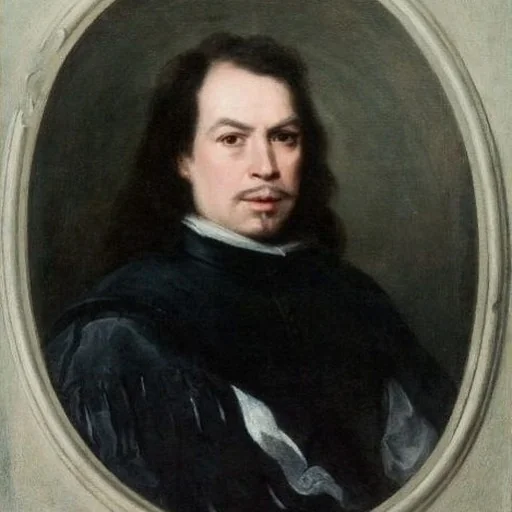
Bartolomé Esteban Murillo ( mure-IL-oh, m(y)uu-REE-oh, Spanish:; late December 1617, baptised 1 January 1618 – 3 April 1682) was a Spanish Baroque painter.