Artwork
Le Fumeur de pipe (The Smoker)
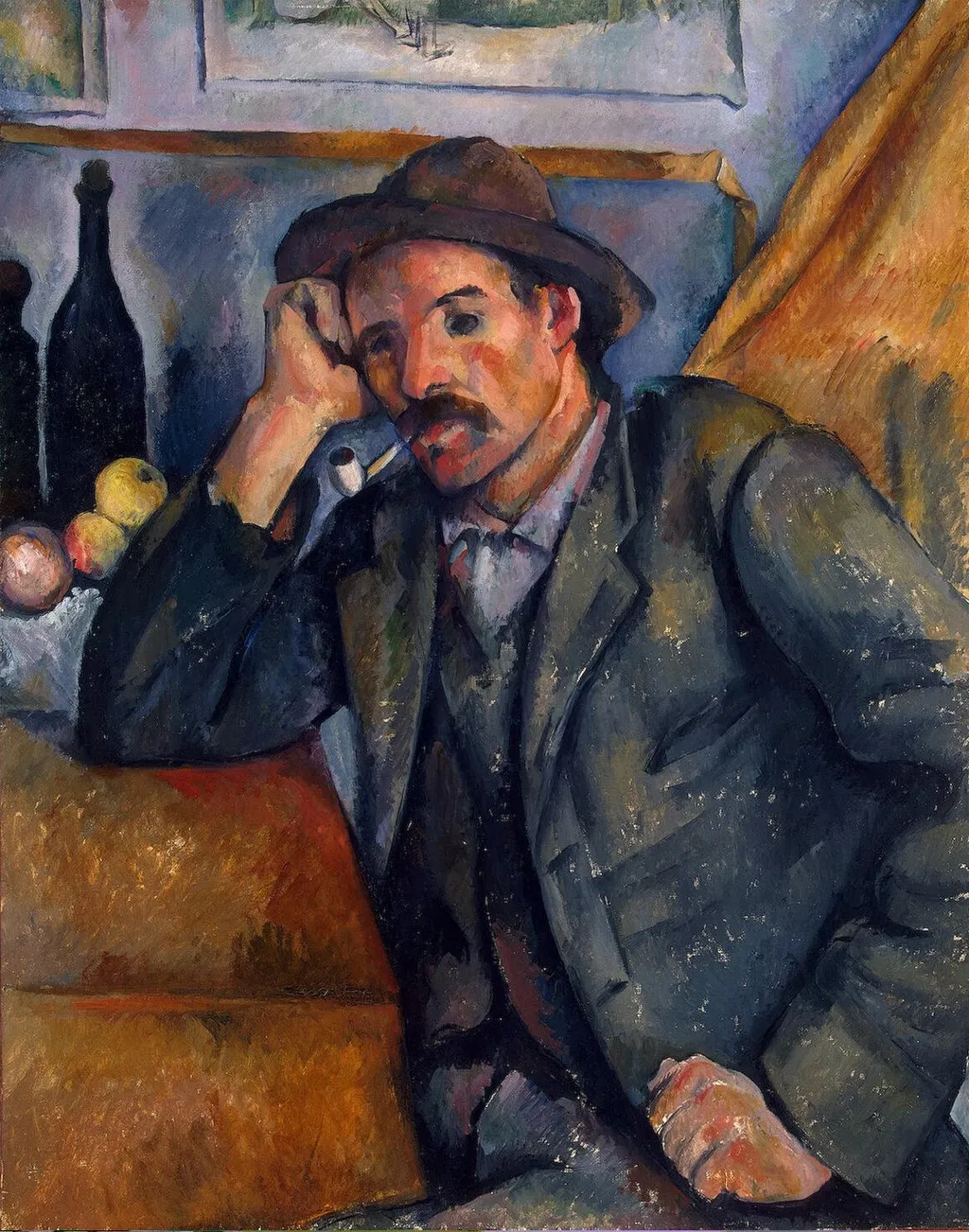
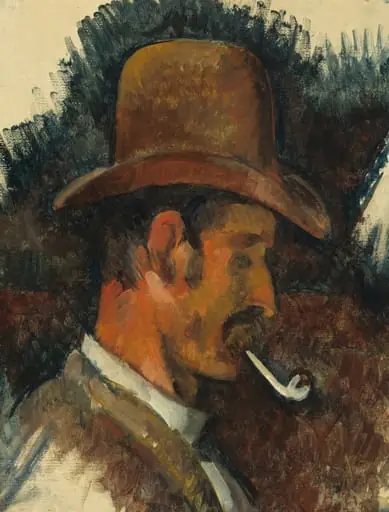
Le Fumeur de pipe (The Smoker) is an oil painting by the Post-Impressionist artist Paul Cézanne. It dates from 1896 and is held in the collection of the Hermitage Museum.
About this work
Subject & Meaning
He is dressed in a thick grey-blue waistcoat and jacket, and a modest still life of a wine bottle and apples appears on the table.
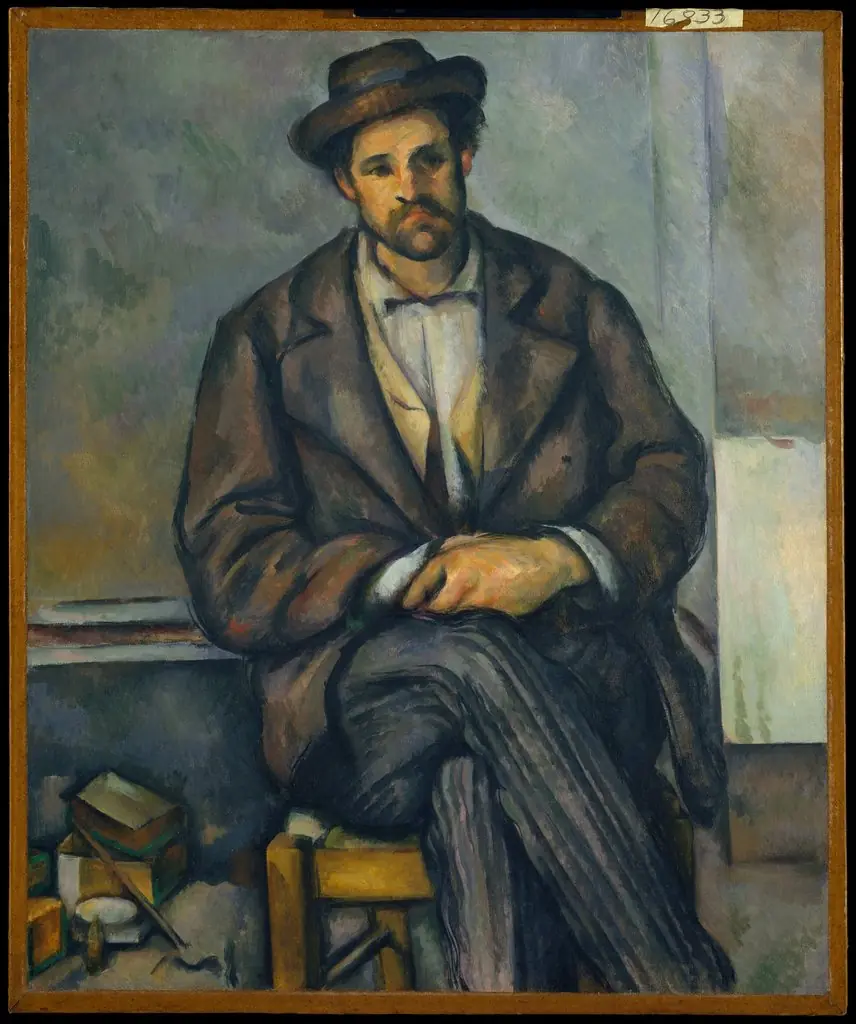
The painting depicts a young peasant man seated in the kitchen of the Jas de Bouffan estate, smoking a white clay pipe while resting his elbow on a brown table covered with a napkin. He is dressed in a thick grey-blue waistcoat and jacket, and a modest still life of a wine bottle and apples appears on the table. This figure, identified as Paulin Paulet, posed for several of Cézanne's works, including the card-player series.
Cézanne, who came from an alpine farming background, often portrayed peasants engaged in daily activities such as smoking, working the land, or playing cards, reflecting his affinity for the rural working class. A related, more austere version of the subject is held in the Kunsthalle Mannheim, where the composition emphasizes a diagonal axis formed by the pipe and the sitter's hands, conveying a 'force of nature' that Cézanne sought to capture. The Hermitage Museum in Saint Petersburg owns the original 1891 oil on canvas, which measures 92.5 × 73.5 cm.
Technique & Style
Le Fumeur de pipe is an oil painting on canvas executed by Paul Cézanne in 1891. The support measures 92.5 × 73.5 cm, placing it in a vertical portrait format. The work belongs to the Post-Impressionist movement and is classified as a portrait genre painting.
Cézanne constructs depth through color modulation rather than traditional linear perspective, modeling form through tonal shifts on the background wall, which transitions from blue to mauve, and on the figure's brown garment, which shifts toward blue depending on the light. The composition centers on a young peasant seated at a kitchen table covered with a brown cloth, his elbow resting on the surface beside a small still life of a wine bottle and apples. The handling reflects Cézanne's characteristic constructive brushwork, building solidity through patches of modulated color that emphasize the sitter's robust, sculptural presence.
History & Provenance
Painted in 1891, Le Fumeur de pipe was created at the Jas de Bouffan, the Cézanne family estate acquired in 1859. The work depicts Paulin Paulet, a young peasant from the property, who posed for the artist in the estate's kitchen for a fee of five francs per session. This specific sitting contributed to a series of portraits, including variations on card players, reflecting Cézanne's affinity for representing the local agricultural workforce.
Following its creation in France, the painting entered the collection of the Russian collector Ivan Morozov. It is currently housed in the Hermitage Museum in Saint Petersburg, where it remains part of the permanent holdings. A distinct, more stripped-down version of the subject, often titled Le Fumeur accoudé, was executed later and is conserved in Mannheim.
Le Fumeur de pipe (The Smoker) is held in the Hermitage Museum in Saint Petersburg. It entered the collection through the ownership of Ivan Morozov and was accessioned under the Hermitage's inventory system. The work was first exhibited publicly in the late 19th century as part of the museum's emerging post-impressionist displays and was included in a 1905 retrospective of Cézanne's paintings at the Hermitage.
It was later featured in the 1991 exhibition "Cézanne et ses mécènes" at the Hermitage and again in the 2011 exhibition "Cézanne: The Late Still Lifes and the Portraits of the 1890s" which traced the development of this motif. A related version, Le Fumeur accoudé, is housed in the Kunsthalle Mannheim.
Context
Le Fumeur de pipe is emblematic of Cézanne’s late-1880s to early-1890s focus on peasant sitters drawn from his family’s Jas de Bouffan estate in Provence, grounding his Post-Impressionist practice in quotidian laborers rather than academic models. The sitter, Paulin Paulet, a local farmworker paid five francs per session, recurs across Cézanne’s oeuvre, underscoring the artist’s affinity for rural life and shared ancestry in peasant stock. Critics such as Joachim Gasquet and Ambroise Vollard later emphasized Cézanne’s ambition to render peasant figures as elemental ‘forces of nature,’ their physical energy distilled through structured composition and modulated color planes rather than narrative anecdote.
Scholarly attention to the work has centered on its technical innovations, Cézanne’s modulation of hue to articulate space, as seen in the shifting brown-to-blue passages of the subject’s clothing and the blue-to-mauve gradations of the wall, foregrounding the painting’s role in the transition from Impressionist light to Cézanne’s constructive solidity. The painting’s inclusion in Cézanne’s late corpus, alongside the related Jas de Bouffan peasant series and the contemporaneous Card Players, situates Le Fumeur de pipe within the artist’s evolving dialogue with tradition and modernity.
Overview
Created in 1896, Le Fumeur de pipe is an oil painting by French artist Paul Cézanne. Executed on canvas, the work portrays a seated figure absorbed in smoking a pipe. It resides in the collection of the State Hermitage Museum in St. Petersburg.
Artist & collection

Artist
Paul Cézanne ( say-ZAN, UK also siz-AN, US also say-ZAHN; French: ; Occitan: Pau Cesana; 19 January 1839 – 22 October 1906) was a French Post-Impressionist painter whose work introduced new modes of representation,…

 Harlequin
 The Card Players
 Mont Sainte-Victoire and the Viaduct of the Arc River Valley
 Still Life with Milk Jug and Fruit
 Le Golfe de Marseille vu de l'Estaque (The Gulf of Marseille Seen from L'Estaque)
 Houses in Provence: The Riaux Valley near L'Estaque
 Louis Guillaume
 Still Life with Jar, Cup, and Apples