Artwork
Portrait of Jeremias de Decker
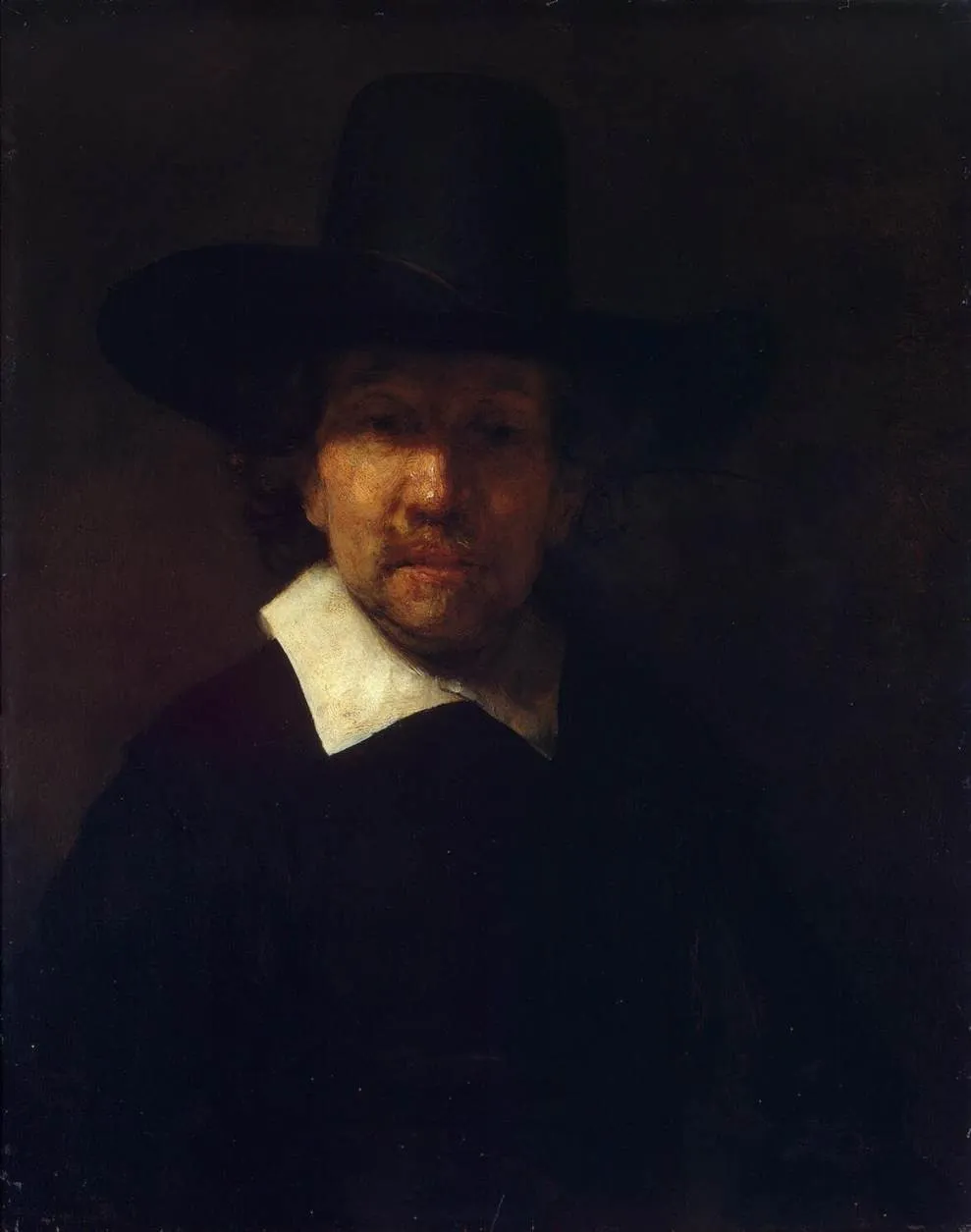
Portrait of Jeremias de Decker is an oil painting by the Dutch Golden Age artist Rembrandt van Rijn. It dates from 1656 and is held in the collection of the Hermitage Museum. Created in 1655, this oil-on-panel work by Rembrandt depicts the Dutch poet Jeremias de Decker.
About this work
Overview
Its attribution and dating have been subjects of scholarly discussion, reflecting broader debates about Rembrandt's chronology in the 1650s and 1660s.
The Portrait of Jeremias de Decker is an oil on panel painting by Rembrandt van Rijn, dated 1656, depicting the Dutch poet Jeremias de Decker. Measuring 71 by 56 centimeters, the work is held in the collection of the Hermitage Museum in Saint Petersburg, Russia. The painting exemplifies Rembrandt's mature portraiture of literary figures in the Dutch Golden Age and represents a significant example of the artist's engagement with Amsterdam's intellectual circles. Its attribution and dating have been subjects of scholarly discussion, reflecting broader debates about Rembrandt's chronology in the 1650s and 1660s.
Subject & Meaning
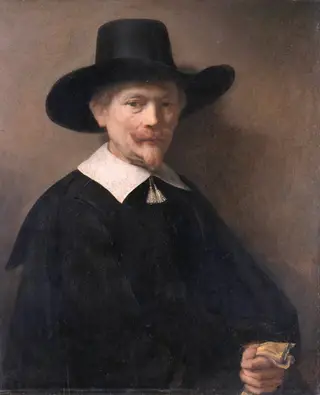
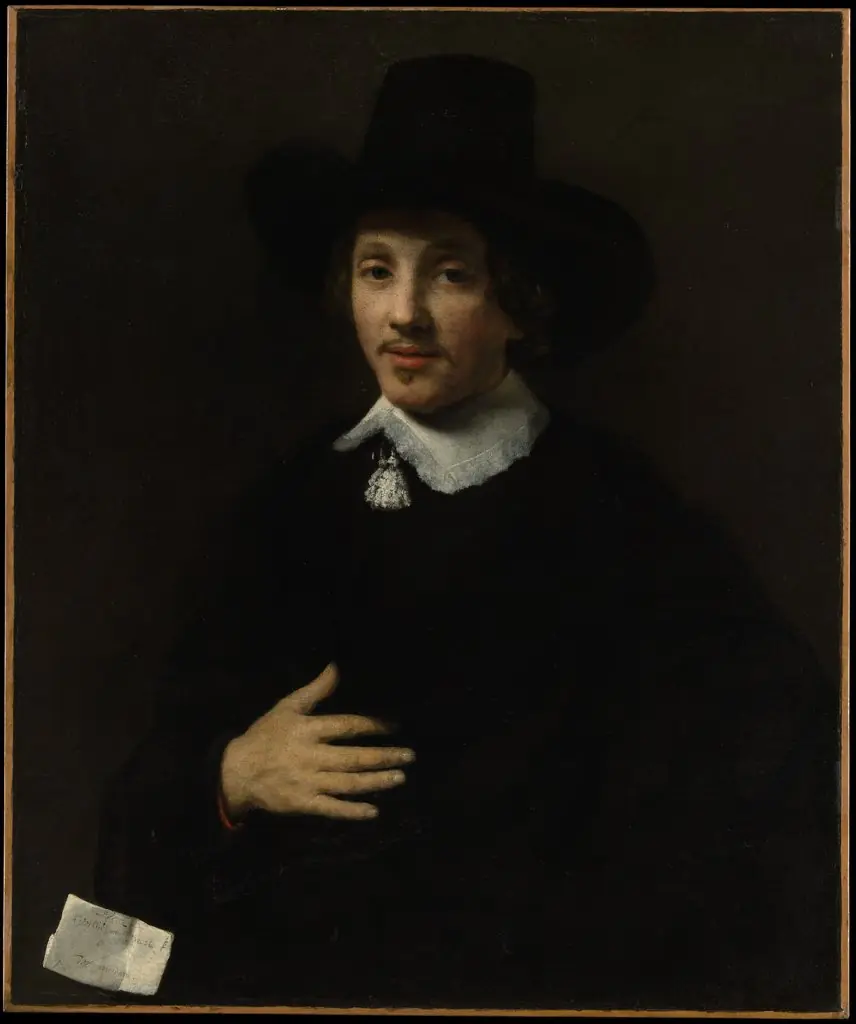
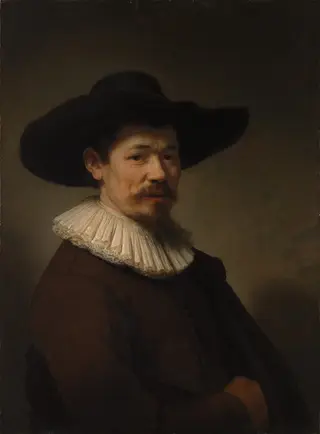
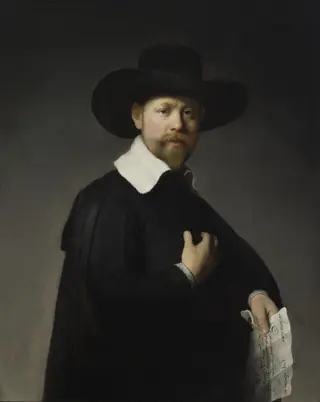
The portrait depicts Jeremias de Decker (1609-1666), a Dutch poet and personal friend of Rembrandt. De Decker composed several poems on themes related to Rembrandt's works, including verses specifically about this portrait itself. According to these poems, the painting was executed without charge and presented as a gift by Rembrandt, underscoring the personal bond between artist and sitter rather than a formal commission. The composition presents de Decker as a solitary male figure, centrally positioned and facing forward with his head turned slightly. He wears a tall, wide-brimmed black hat that casts shadow across his forehead, while a large white collar rises stiffly above dark garments that merge into the background. The absence of objects, setting details, or attributes beyond the figure himself focuses attention entirely on the poet's presence and character. The uniformly dark and undefined background isolates the sitter, a convention in Rembrandt's portraiture that emphasizes psychological depth over environmental context. The portrait also served as the source for an anonymous engraving of the poet, which was included in an edition of de Decker's collected works, extending the image's reach beyond the painted original.
Technique & Style
The work is executed in oil paint on panel, a support Rembrandt frequently employed for his portraits during this period. The handling of paint varies significantly across the composition: the face is modeled with smooth blending of warm browns and ruddy tones, with light striking the left side more strongly, while thicker, more visible brushstrokes characterize the collar and costume. This variation in surface texture, moving from refined finish in the flesh to looser handling in the clothing, is characteristic of Rembrandt's mature technique. The overall palette is dominated by deep browns, blacks, and warm highlights, creating a restrained but resonant tonal harmony. The stiff white collar stands in pronounced contrast against the dark garments and background, drawing the viewer's eye upward to the illuminated face. The brushwork in the costume areas approaches the dissolution of form into paint that would become increasingly pronounced in Rembrandt's later works, though here it remains subordinate to the clear legibility of the sitter's features and expression.
History & Provenance
The painting is signed and dated in the lower right with 'Rembrandt / f.[ecit] 1666,' though this inscription has been the subject of considerable scholarly debate. The date has been read variously as 1656 or 1666, with the second digit disputed due to possible damage or restoration affecting whether the final numeral is a 5 or 6. A poem by H. F. Waterloos indicating that Rembrandt painted de Decker before 1660 has led some scholars to hypothesize that two portraits may have existed, with an earlier version now lost. However, the style of the extant painting aligns more closely with Rembrandt's work of the 1650s, supporting the earlier dating. The work was acquired in 1781 by Catherine II of Russia along with the collection of the Comte de Baudouin from Paris. Since that acquisition, it has remained in the Hermitage Museum. The painting's presence in the Hermitage collection places it among the significant group of Rembrandt portraits dispersed from the Netherlands to Russian imperial collections in the eighteenth century.
Context
The portrait belongs to Rembrandt's extensive series of depictions of Amsterdam's intellectual and cultural elite during the Dutch Golden Age. De Decker's status as both friend and poetic commentator on Rembrandt's work places this painting within a network of artistic and literary exchange that characterized the artist's milieu. The poet's plan to compose inscriptions for Rembrandt's paintings, though never realized, indicates the close integration of visual and verbal arts in this circle. The dating controversy surrounding the work, pitting 1656 against 1666, intersects with broader scholarly efforts to establish a secure chronology for Rem Rembrandt's output in the middle and later decades of his career, a project central to the Rembrandt Research Project and subsequent scholarship. Ernst van de Wetering's 2014 corpus volume addresses the painting, reflecting its importance within the overall oeuvre. The portrait also illustrates Rembrandt's practice of painting friends and associates without always requiring formal payment, a pattern that contributed to his financial difficulties despite his artistic reputation.
Legacy
The portrait's afterlife includes its function as the source for an anonymous engraving of de Decker, which circulated as part of the poet's published works and thus transmitted Rembrandt's image to a wider audience than the painting alone could reach. The work's residence in the Hermitage since 1781 has made it a fixture of one of the world's most important collections of Dutch Golden Age painting, though its location in Russia has limited its accessibility to Western scholars and audiences compared to Rembrandts held in European and American institutions. The painting continues to be cited in scholarship on Rembrandt's portraiture, his relationships with literary figures, and the dating of his works in the 1650s and 1660s. The Hermitage's online presentation of the work under the title 'Portrait of the Poet Jeremias de Decker' emphasizes the sitter's literary identity, maintaining the connection between image and word that de Decker himself cultivated in his poems about Rembrandt's art.
Artist & collection

Artist
Rembrandt Harmenszoon van Rijn, known mononymously as Rembrandt, was a Dutch Golden Age painter, printmaker, and draughtsman.