Artwork
Self-portrait as the Apostle Paul
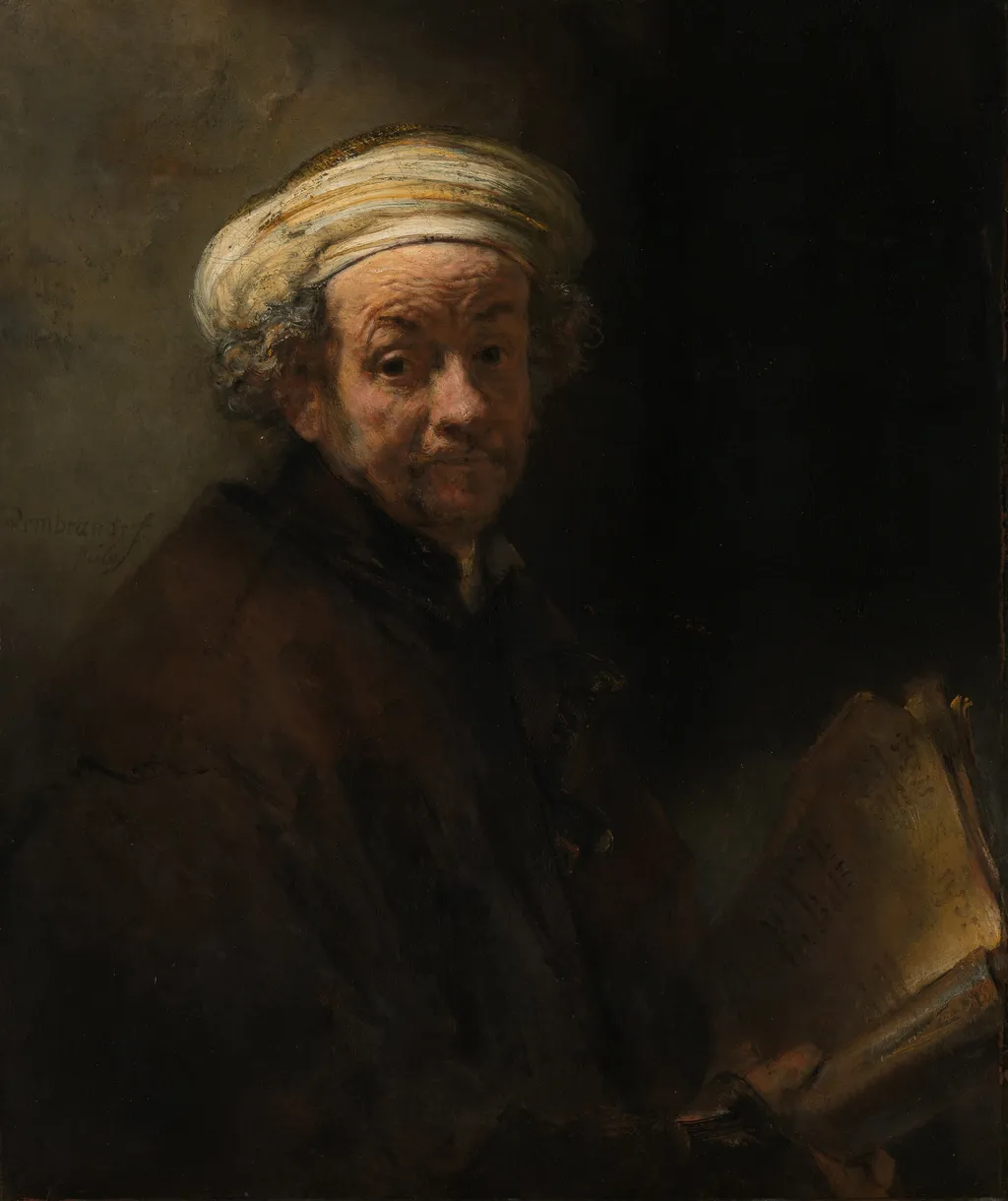
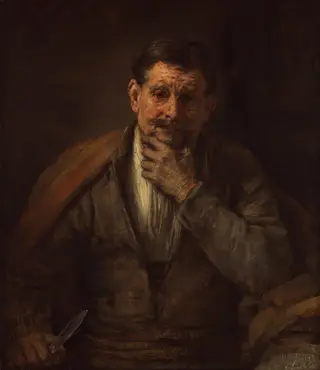
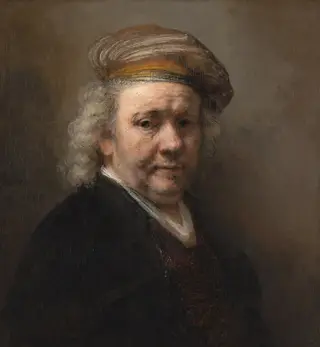
Self-portrait as the Apostle Paul is an oil painting by the Dutch Golden Age artist Rembrandt van Rijn. It dates from 1661 and is held in the collection of the Rijksmuseum.
About this work
This is Rembrandt’s 1661 Self-portrait as the Apostle Paul. He painted it in oil on canvas when he was in his late fifties. It’s one of more than forty self-portraits he made over his lifetime.
Artists often use these portraits to explore how faces change with age. Rembrandt did that here too, showing his own lined face with quiet focus.
Look up his other self-portraits next.
Subject & Meaning
Rembrandt depicts himself as the Apostle Paul, identifiable by the sword at his side and an open manuscript bearing Hebrew letters.
Rembrandt depicts himself as the Apostle Paul, identifiable by the sword at his side and an open manuscript bearing Hebrew letters. The white turban and the illuminated page contrast with the dark background, emphasizing light on his face and foreground details such as the rolled leather of the book. Art historians note the work belongs to the self‑portrait historié tradition, where the artist assumes the guise of a biblical figure to explore themes of faith, imperfection and reliance on divine grace.
The painting reflects Rembrandt’s personal identification with Paul’s role as teacher and his Protestant context, using symbolic attributes to convey spiritual and existential concerns.
Technique & Style
The work is an oil painting on canvas, measuring 91 cm in height and 77 cm in width. It is signed and dated "Rembrandt.f./1661" near the sitter's left-hand shoulder. According to art historian Ernst Van de Wetering, Rembrandt may have employed the wet-on-wet technique to achieve the painting's visual effects, demonstrating refined control over the distribution of light and dark across the figure and background, as well as varied brushwork.
Rapid strokes in the white turban contrast with impasto applied to the illuminated forehead, where built-up paint accentuates reflected light and produces the appearance of wrinkles. Pages of the held book curl slightly at the top, emphasized by the lighting, while the rolled leather binding recedes into shadow in bluish-gray strokes that stand apart from the otherwise cohesive brown and beige palette. Van de Wetering speculates that Rembrandt's likeness drew on earlier self-portraits rather than direct mirror observation.
History & Provenance
Completed in 1661, the painting is signed and dated “Rembrandt.f./1661.”
The work’s early provenance traces to Paris, where it appears in the 1695 inventory of Everhard Jabach as a portrait of Rembrandt wearing a white cloth around his head. By mid-century it was owned by the French painter Nicolas Vleughels in Rome. In 1750 his widow sold it to Cardinal Neri Maria Corsini for 100 scudi; it remained at the Corsini Palace until at least 1799, when it was engraved by Giuseppe Longhi.
In 1807 the London dealer William Buchanan brought the painting to England, selling it for 500 guineas before 2 January 1809 to Charles Kinnaird of Rossie Priory. It descended through successive Kinnaird heirs until 1936, when it was bought for £47,500 by Isaac de Bruyn and Johanna Geertruida van der Leeuw. The couple gave it to the Rijksmuseum in 1960, having lent it since 1956.
The painting has been part of the Rijksmuseum collection in Amsterdam since 1956, having been placed on loan by collectors Isaac de Bruyn and Johanna Geertruida de Bruyn-van der Leeuw in December of that year. The couple officially bequeathed the work to the museum in 1960. Prior to this acquisition, the artwork remained within the Kinnaird family estate at Rossie Priory until its sale in 1936.
Earlier provenance records indicate the piece was sold by the widow of Nicolas Vleughels to Cardinal Neri Maria Corsini in Rome in 1750. It subsequently entered the British market around 1807 via dealer William Buchanan before being purchased by Charles Kinnaird prior to January 1809. An inventory from 1695 suggests the work may have previously belonged to Everhard Jabach in Paris.
Context
Scholars view Rembrandt’s 1661 Self-portrait as the Apostle Paul as the culmination of his late self-fashioning, aligning the aging artist with a Protestant saint whose teachings on grace resonated with Rembrandt’s own later-life struggles. The painting exemplifies the self-portrait historié, a genre revived in the 1660s, in which Rembrandt had also cast himself as Zeuxis. Ernst van de Wetering notes how Rembrandt used rapid strokes in the turban to contrast with the thick impasto on the forehead, sharpening the perception of light and space to heighten the apostolic presence.
The work’s inclusion in the BBC’s 100 Great Paintings underscores its canonical status within the canon of Western portraiture.
Art-historical readings link the choice of St Paul to Rembrandt’s identification with a figure who, like the artist, experienced public criticism and financial hardship yet articulated a theology of redemption. This interpretation is supported by the presence of a Hebrew Old Testament and a partially visible sword, attributes that emphasize the apostle’s role as both teacher and martyr. The painting’s later provenance, from the Corsini collection through London dealers to Dutch ownership, reflects its recognition across European collections by the late eighteenth century.
Legacy
The painting's identity as a self-portrait historié was first established by Frederik Schmidt Degener in 1919, transforming its reception from a generic likeness to a specific theological statement. This interpretation was solidified in the 1990s when restoration work revealed a barred window in the background, visually confirming the apostle's history of imprisonment. The work has achieved significant cultural prominence, appearing in the BBC's 100 Great Paintings series.
Art historians view the piece as a key example of Rembrandt's late style, demonstrating his mastery of light and wet-on-wet techniques to convey spiritual introspection. Currently held in the Rijksmuseum since its bequest in 1960, the painting remains a central work in the study of the artist's final years and his complex identification with the Apostle Paul.
Overview
Rembrandt van Rijn created Self-portrait as the Apostle Paul in 1661, an oil on canvas painting. This work is one of over forty self-portraits the Dutch artist produced throughout his career, depicting himself in his late fifties. The painting is currently housed in the Rijksmuseum in Amsterdam. It is recognized as a significant example of his late period, showcasing his introspective approach to self-representation.
Own this work as a print
Artist & collection

Artist
Rembrandt Harmenszoon van Rijn, known mononymously as Rembrandt, was a Dutch Golden Age painter, printmaker, and draughtsman.