Artwork
The Great Jewish Bride
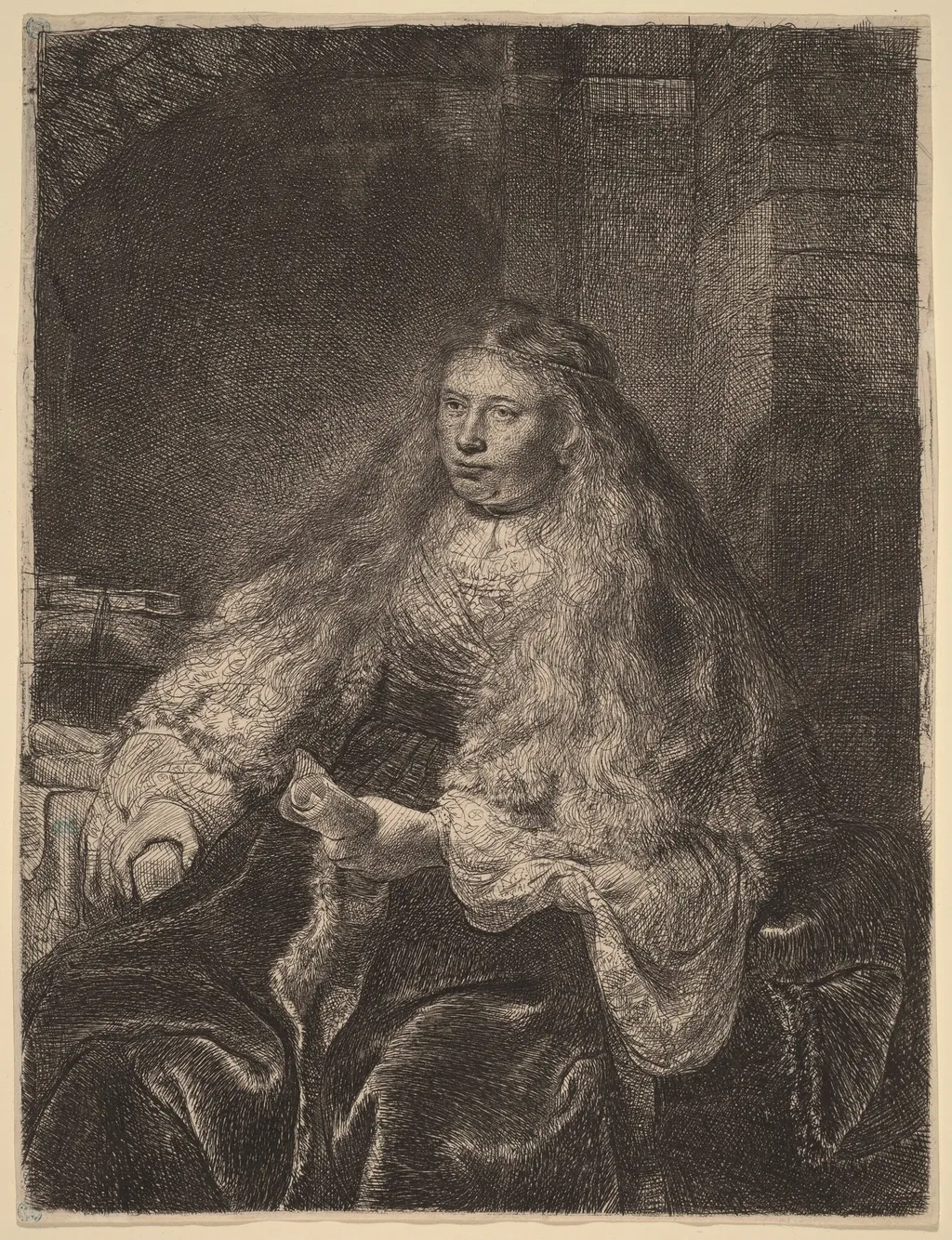
The Great Jewish Bride is an ink print by the Baroque artist Rembrandt van Rijn. It dates from 1635 and is held in the collection of the National Gallery of Art.
- Inscription
- Inscribed:recto: in plate, at lower left: R / 1635 [in reverse]; verso: at lower center in graphite in later hand: B 340
- Markings
- Marked:recto: stamped in blue ink at top left and bottom left corners: Kungliga Museum, Stockholm (Lugt 1638); verso: Nationalmuseum Dublett (Lugt 4967); Lessing J. Rosenwald (Lugt 1760b); National Gallery of Art (Lugt 1932d)
About this work
Overview
The Great Jewish Bride is a 1635 print by Rembrandt van Rijn, executed as an etching combined with drypoint on laid paper. The work presents a solitary female figure seated with her hands placed calmly in her lap, enveloped in a voluminous cloak that drapes over her shoulders and arms. Rendered entirely in monochrome, the image relies on line and tone rather than colour.
Subject & Meaning
The composition depicts an unnamed woman, often interpreted as a bride or a figure of contemplation, whose still posture and modest gesture convey a sense of quiet dignity. The heavy garment and the intimate setting suggest themes of domesticity and personal identity, while the title, added later, frames the scene within a cultural context that invites reflection on Jewish customs and marital symbolism.
Technique & Style
This combination yields a rich, layered texture, especially evident in the rendering of the woman's hair and the folds of her cloak.
Rembrandt employed a hybrid process, first incising the design into a copper plate with a burin for the etching, then adding drypoint lines that produce a characteristic burr and softer, fuzzier edges. This combination yields a rich, layered texture, especially evident in the rendering of the woman's hair and the folds of her cloak. The scratchy, overlapping strokes create depth and a tactile quality uncommon in purely etched works.
History & Provenance
Created in the mid‑1630s, the print belongs to a prolific period in Rembrandt’s printmaking career, when he explored the expressive possibilities of drypoint alongside traditional etching. Surviving impressions are held in several major collections, including the Rijksmuseum and the British Museum, tracing a provenance that reflects the work’s early circulation among collectors of Dutch graphic art.
Own this work as a print
Artist & collection

Artist
Rembrandt Harmenszoon van Rijn, known mononymously as Rembrandt, was a Dutch Golden Age painter, printmaker, and draughtsman.

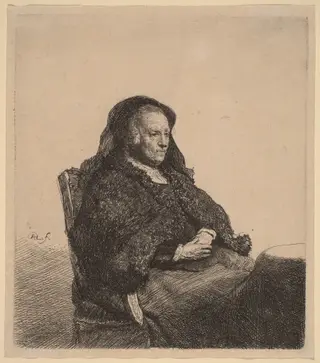 The Artist's Mother Seated at a Table, Looking Right
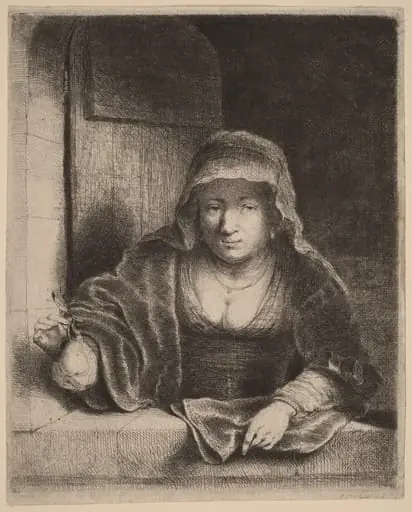 The Woman with the Pear
 The Artist's Mother Seated, in an Oriental Headdress
 The Woman with the Pear
 The Artist's Mother Seated, in an Oriental Headdress
 The Artist's Mother Seated at a Table, Looking Right
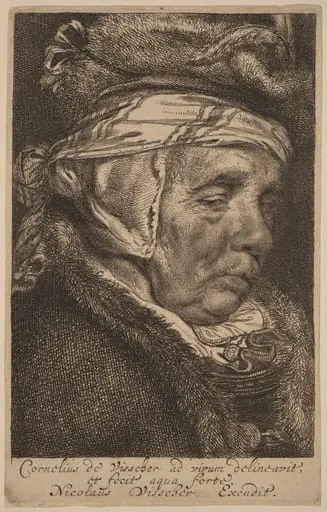 Head of an Old Woman (Visscher's Mother)
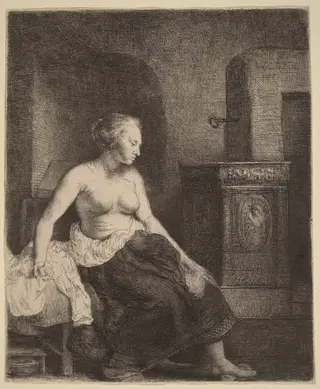 Woman Sitting Half Dressed beside a Stove