Artwork
The Fall of Phaeton
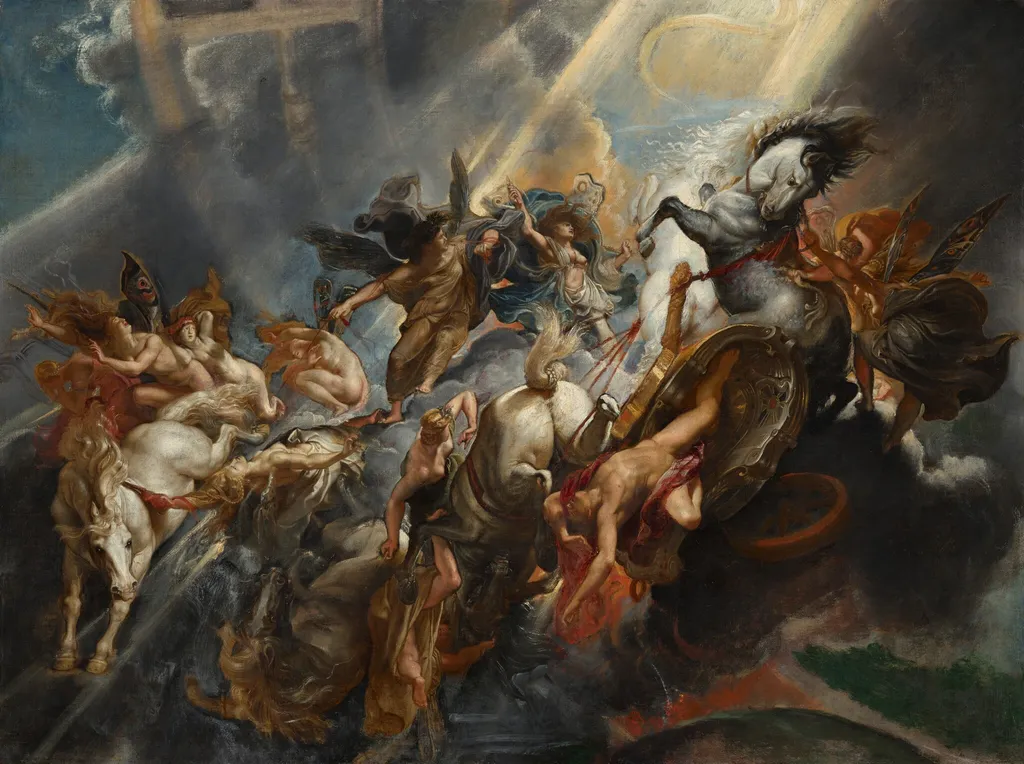
The Fall of Phaeton is an oil painting by the Baroque artist Peter Paul Rubens. It dates from 1604 and is held in the collection of the National Gallery of Art.
About this work
Subject & Meaning
The work thus serves as a visual allegory of divine retribution and the dangers of overreaching ambition.
The painting illustrates the Ovidian myth of Phaeton, the sun‑god Helios’ son who, after borrowing his father’s chariot, loses control and is struck down by Zeus’ thunderbolts for his hubristic attempt to drive the sun. Rubens captures the moment of impact, placing Zeus outside the frame while the lightning bolts flash from the right, illuminating the terrified faces of Phaeton, his horses, and the surrounding figures. Butterfly‑winged female forms represent the hours and seasons, reacting in horror as the day‑night cycle is disrupted; the great astrological arch that encircles the heavens is likewise broken.
Bodies are arranged in a diagonal oval that separates dark and light zones, guiding the viewer’s eye around the composition and underscoring the collapse of cosmic order. The work thus serves as a visual allegory of divine retribution and the dangers of overreaching ambition.
Technique & Style
The Fall of Phaeton is an oil on canvas measuring 98.4 by 131.2 cm, executed in 1605 and probably reworked around 1606–1608. Rubens set the composition as a diagonal oval of intertwined bodies at the center, dividing the canvas into dark and light halves. The thunderbolts of Zeus, cast from the right, supply the principal illumination, throwing the terrified faces of Phaeton, the plunging horses, and the butterfly-winged Hours and Seasons into sharp relief against the surrounding gloom.
A great astrological circle arches across the heavens, its disrupted order reinforcing the cosmic disorder of the scene. The arrangement of figures guides the eye continuously around the central oval, sustaining the painting's rotational drama.
History & Provenance
The Fall of Phaeton is held by the National Gallery of Art in Washington, D.C. The work entered the museum’s collection on 5 January 1990, an acquisition recorded in the gallery’s provenance files. Its earlier history is documented in an Antwerp inventory of 6 July 1657 that lists it among the possessions of Susanna Willemsens, and it subsequently passed through the collections of the earls of Caledon before being sold at Christie’s in 1939. The painting has been part of the National Gallery’s exhibitions since its acquisition, allowing public viewings of Rubens’s baroque treatment of the myth.
Context
The Fall of Phaeton has been examined as a pivotal work in Rubens’s early Roman period, where his engagement with classical sources and dynamic compositional strategies first crystallized. Scholarship emphasizes its synthesis of Ovidian narrative with a dramatic, spiraling figural arrangement, using light and shadow to heighten emotional and cosmic disruption. The painting’s reception has centered on its technical ambition, evident in pentimenti and pentiments identified through material analysis, and its role in establishing Rubens’s mature mythological idiom.
Within art history, the work is situated alongside contemporaneous studies of motion and natural forces, prefiguring his later large-scale mythologies and reinforcing the Flemish Baroque’s dialogue with Italian High Renaissance dynamism.
Overview
Peter Paul Rubens's painting, The Fall of Phaeton, executed in oil on canvas, captures a climactic moment from ancient Greek mythology. This work portrays the dramatic downfall of Phaeton, whose reckless attempt to drive the sun chariot leads to cosmic disruption. Rubens employs a dynamic composition and vivid imagery to convey the chaos and terror of the event, making it a powerful example of his Flemish Baroque style.
Own this work as a print
Artist & collection
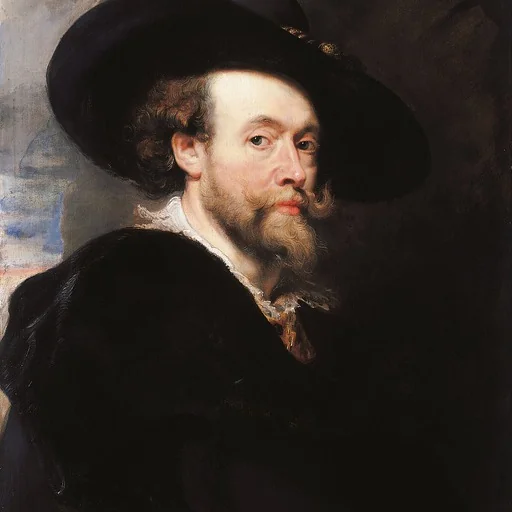
Artist
Sir Peter Paul Rubens ( ROO-bənz; Dutch:; 28 June 1577 – 30 May 1640) was a Flemish artist and diplomat.