Artwork
The Birth of Venus
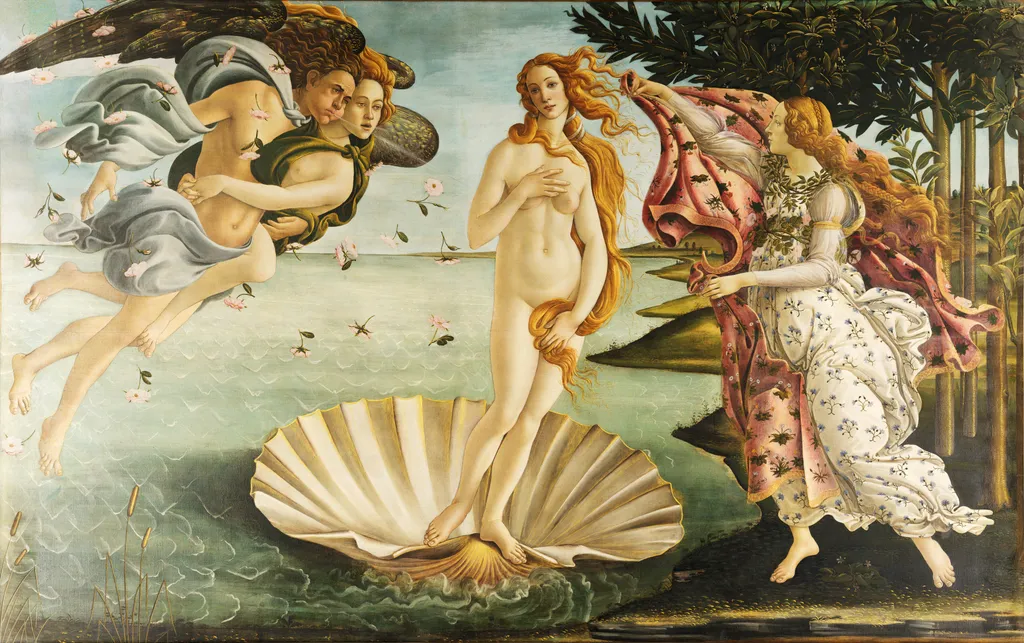
The Birth of Venus is a tempera painting by the Early Renaissance artist Sandro Botticelli. It dates from 1493 and is held in the collection of the Uffizi Gallery.
About this work
Subject & Meaning
She stands in a contrapposto pose derived from the Venus Pudica type, covering her nudity with her hands and hair to signify spiritual rather than carnal love.
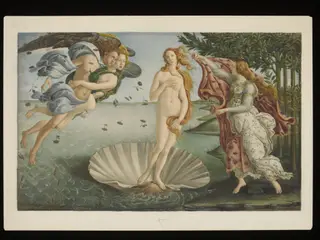
The painting depicts the arrival of the goddess Venus on the shore of Cyprus or Cythera, rather than her actual birth, as she emerges from the sea fully grown in the guise of Venus Anadyomene. Central to the iconography is a giant, imaginary scallop shell, a classical motif symbolizing the goddess's origin from sea foam. She stands in a contrapposto pose derived from the Venus Pudica type, covering her nudity with her hands and hair to signify spiritual rather than carnal love.
To the left, the wind god Zephyr, often accompanied by the nymph Chloris or the personification Aura, blows her toward land. On the right, one of the Horae, likely representing Spring, awaits to clothe her in a rich mantle adorned with floral patterns. The work synthesizes classical mythology with Renaissance Neo-Platonism, presenting Venus as an allegory for idealized, divine love, potentially inspired by the poetry of Angelo Poliziano and the beauty of Simonetta Vespucci.
History & Provenance
The Birth of Venus is generally dated to the early 1480s, with most scholarship placing its execution between 1482 and 1485.
The painting’s creation history is commonly linked to the Medici family. Early modern sources, notably Vasari, attribute the work to a commission by Lorenzo di Pierfrancesco de’ Medici for the Villa di Castello, a Medici country residence near Florence, where Vasari later recorded seeing it alongside Primavera. Modern research has questioned this tradition, suggesting instead that the two works may not have been paired in origin nor necessarily commissioned by the same patron. Documentary proof of the patron remains lacking, leaving the identity of the commissioner uncertain.
After its creation, the painting remained at the Villa di Castello until 1815, when it was transferred to the Uffizi Gallery in Florence.
The Birth of Venus is permanently housed in the Uffizi Gallery in Florence, Italy, specifically located in Rooms 11–12, known as the Botticelli Room. The painting is not assigned a specific public accession number in the provided sources, though it is cataloged within the gallery's collection. Historically, the work was kept at the Villa di Castello, the country estate of Lorenzo di Pierfrancesco de' Medici, where it was observed by Giorgio Vasari in the 16th century.
It remained at this villa until 1815, at which point it was transferred to the Uffizi Gallery. The painting underwent a significant restoration in 1987, during which a yellowed varnish layer was removed. While the sources mention its status as a world-famous icon alongside the Primavera, they do not list specific dates for temporary exhibitions or loans outside of its permanent residence.
Context
Executed in the mid-1480s, The Birth of Venus stands as a revolutionary work in Western art, marking one of the first large-scale depictions of a mythological subject and a nude female figure since classical antiquity. While traditionally linked to the Medici villa at Castello and interpreted through the lens of Florentine Neo-Platonism, modern scholarship debates its specific commission and whether it serves as a complex allegory or a more accessible, sensory celebration of beauty. Art historians frequently analyze the painting alongside Botticelli's Primavera, noting their shared emulation of ancient models like the Venus Pudica and literary sources such as Poliziano's verses.
Although the title suggests a nativity scene, the image actually portrays Venus's arrival on shore, a distinction that underscores Botticelli's unique synthesis of Gothic linear rhythm and classical form. Its enduring fame rests on this unprecedented revival of pagan themes during an era dominated by religious iconography.
Legacy
The Birth of Venus is counted among the most famous paintings in the world and is regarded as an icon of Italian Renaissance painting, with the work better known than Botticelli's companion mythological painting, the Primavera. At the time of its creation it was revolutionary, presenting a large-scale nude female figure and an exclusively mythological subject without religious justification, in a period when biblical themes dominated painting. The work has been endlessly analysed by art historians, who have debated its classical sources, possible Neo-Platonist readings, and its commission, while agreeing that its appeal is sensory and broadly accessible.
It remained at the Medici Villa di Castello until 1815, when it was transferred to the Uffizi Gallery, where it underwent restoration in 1987 with the removal of a yellowed varnish layer. A detail of the painting has been reproduced on an Italian euro coin, evidencing its continued presence in popular visual culture.
Overview
Sandro Botticelli's The Birth of Venus, likely completed in the mid-1480s, depicts the goddess Venus emerging fully formed from the sea and arriving at shore. This tempera painting, housed in Florence's Uffizi Gallery, is among the most recognized works of the Italian Renaissance. It presents a classical mythological subject on an ambitious scale, featuring a prominent nude figure.
Technique & Style
Executed in tempera, the painting achieves a luminous quality and smooth finish. Botticelli renders Venus with serene composure, her pale form contrasting with the mother-of-pearl shell. The ethereal quality of the floating figures' drapery, along with the delicate scattering of pink blossoms and the tranquil sea and sky, contribute to the work's distinctive visual poetry and refined aesthetic.
Own this work as a print
Artist & collection
Artist
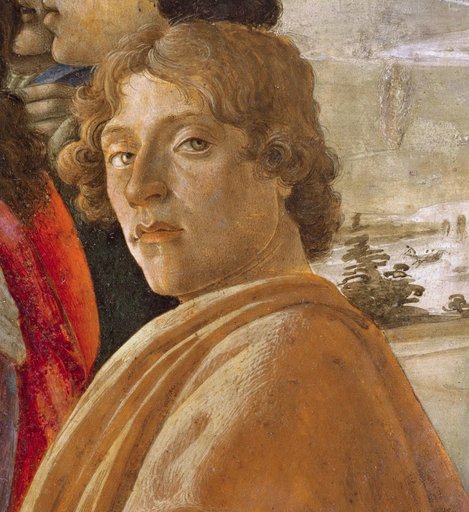
Alessandro di Mariano di Vanni Filipepi, better known as Sandro Botticelli or simply Botticelli, was an Italian painter of the Early Renaissance.