Artwork
Saint Sebastian
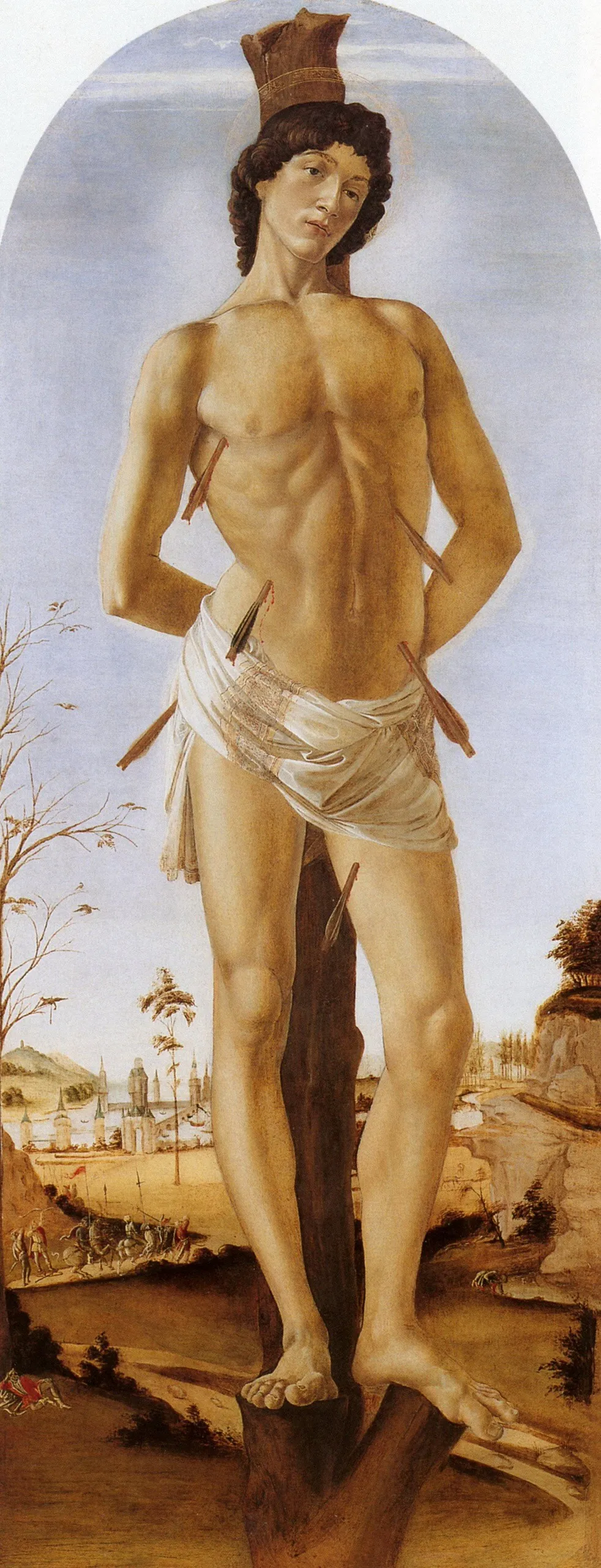
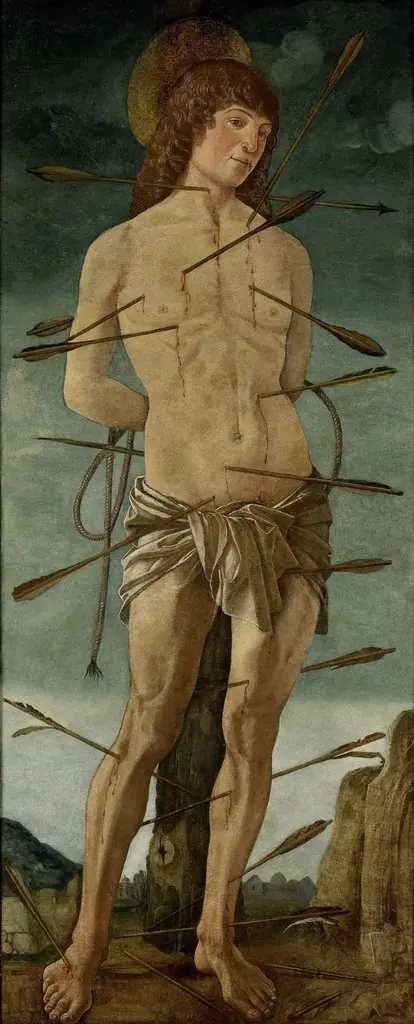
Saint Sebastian is an unspecified painting by the Early Renaissance artist Sandro Botticelli. It dates from 1474 and is held in the collection of the Gemäldegalerie Berlin.
About this work
Subject & Meaning
The iconography adheres to the conventional Renaissance portrayal of Sebastian as a youthful, serene figure enduring his martyrdom with divine composure.
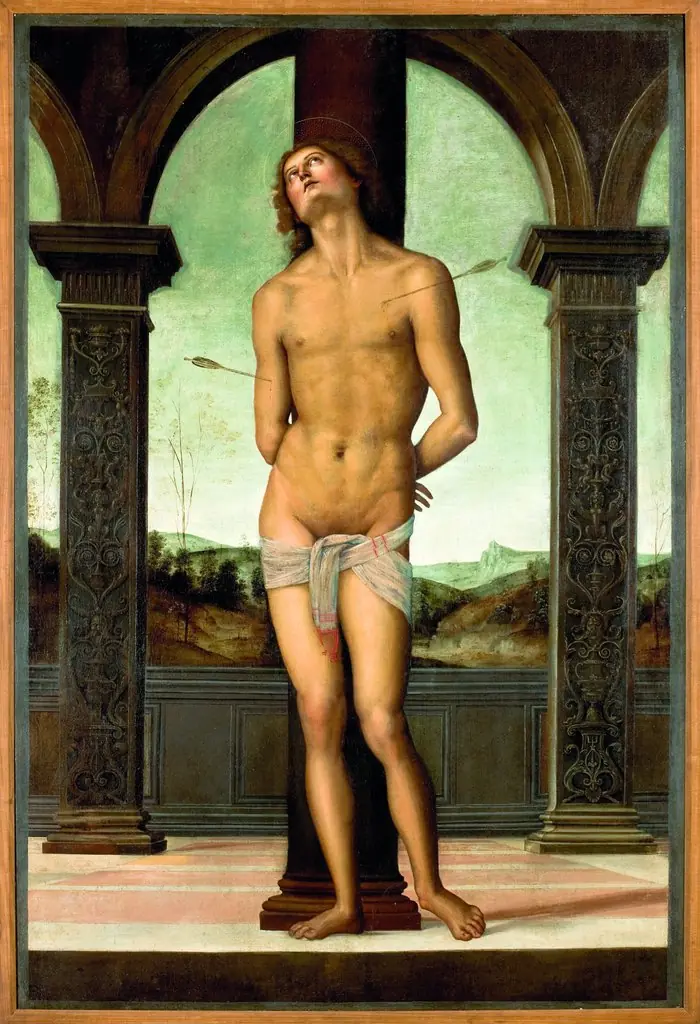
Botticelli’s Saint Sebastian depicts the Christian martyr bound to a truncated tree trunk, his near-nude body pierced by six arrows, two on each side of his torso, one in his left thigh, and another in his right upper thigh. The iconography adheres to the conventional Renaissance portrayal of Sebastian as a youthful, serene figure enduring his martyrdom with divine composure. The saint’s contrapposto stance and golden halo underscore his spiritual transcendence, while the receding landscape and departing soldiers emphasize his isolation and the completion of his suffering.
Symbolically, the work reflects Neoplatonic ideals prominent in Medici circles, where Sebastian’s physical beauty and stoic endurance represent the soul’s ascent toward the divine, contrasting with the material world’s brutality. His elevated, almost suspended pose and the ethereal light framing him further evoke this metaphysical tension, suggesting both martyrdom and spiritual elevation.
Technique & Style
The panel is executed in tempera on a thin poplar board, a support typical of early Florentine altarpieces (1,2). Measuring roughly 195 × 75 cm, the rectangular format was originally intended for wall mounting on a church pillar (2). Botticelli renders Saint Sebastian half‑naked, bound to a dry trunk, with six arrows piercing his flesh; the figure is placed centrally in a shallow, classically balanced composition that combines a restrained contrapposto with a luminous golden aureole (4,5).
The background landscape recedes in atmospheric perspective, while the saint’s calm, almost transcendent expression and precise anatomical rendering reflect the influence of Medici‑sponsored neoplatonic thought (5). The work’s condition is stable, though subtle asymmetries in the feet reveal its early execution phase (4).
History & Provenance
The panel titled Saint Sebastian was painted by Sandro Botticelli in the early 1470s, with documentary evidence placing its execution before January 1474. It was created as a devotional work for the Florentine church of Santa Maria Maggiore, where it was originally installed on a pillar and later removed. The work remained in that church until it entered the collection of the Gemäldegalerie in Berlin, where it has been displayed since its acquisition. The painting reflects Botticelli’s early exploration of the male nude, predating his more celebrated mythological subjects.
Sandro Botticelli's Saint Sebastian is currently housed in the Gemäldegalerie in Berlin, part of the Staatliche Museen. The panel, measuring 195 by 75 or 100 centimeters depending on the source, entered the museum's collection via the Solly Collection. Historically, the work was originally installed on a pillar of the Church of Santa Maria Maggiore in Florence, where it was endowed or placed on January 20, likely in 1473 or 1474, to coincide with the saint's feast day.
The painting was later removed from its ecclesiastical setting before arriving in Berlin. Its exhibition history includes the show Botticelli Reimagined.
Context
Executed circa 1474 on poplar panel (195 × 75 cm), Botticelli’s Saint Sebastian was originally installed in the nave of Florence’s Santa Maria Maggiore before entering the Gemäldegalerie, Berlin (1,2). Kenneth Clark praised its “harmonious repose” reminiscent of classical sculpture, noting the work’s contrast with the restless Florentine predilection for dynamic nudes (3). The painting reflects the neoplatonic milieu of the Medici academy, where divine and material principles intersected, and it stands as one of the earliest large‑scale male nudes in Renaissance art since Donatello’s David (3,5).
Its restrained contrapposto, aureole, and idealised anatomy embody Early Renaissance goals of balance and spiritual elevation, positioning the piece at a pivotal moment in the evolution of sacred imagery.
Legacy
Critics such as Kenneth Clark highlighted the work’s harmonious repose, linking it to classical sculpture and to the restless Florentine temperament. Rilke’s 1907 poem “Sankt Sebastian” reflects the painting’s mood, showing its poetic resonance.
Later artists adopted the subject: Piero del Pollaiolo created a more dynamic Martirio di San Sebastiano, while Francesco Botticini echoed Botticelli’s composition. The painting is often cited as the first full‑scale male nude in Florentine art since Donatello’s David, marking a stylistic milestone.
Overview
This painting, titled Saint Sebastian, is an early work by the Italian Renaissance artist Sandro Botticelli. Executed on a poplar panel, the artwork depicts the Christian martyr Saint Sebastian. It was completed prior to January 1474, marking its creation in the early period of Botticelli's career.
The piece showcases the artist's developing style and his engagement with religious themes prevalent during the Florentine Renaissance.
Artist & collection
Artist
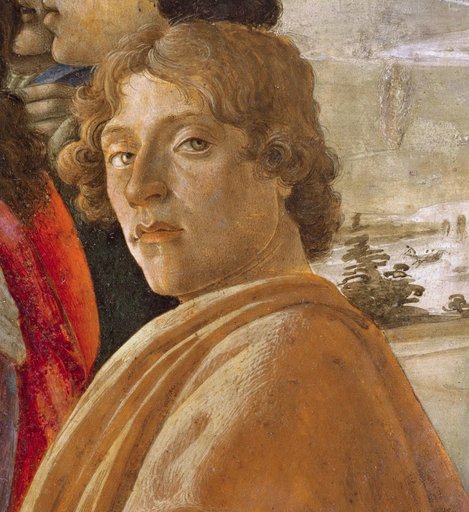
Alessandro di Mariano di Vanni Filipepi, better known as Sandro Botticelli or simply Botticelli, was an Italian painter of the Early Renaissance.