Artwork
The Seine with Clothing on the Bank (Study for "Bathers at Asnières")
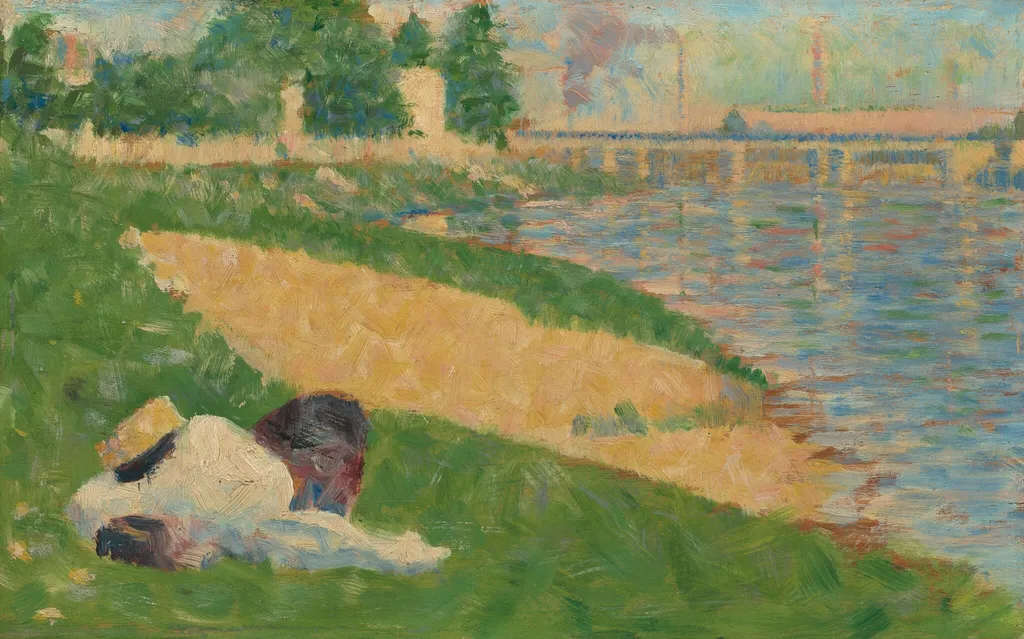
The Seine with Clothing on the Bank (Study for "Bathers at Asnières") is an oil painting by the Impressionist artist Georges Seurat. It dates from 1884 and is held in the collection of the National Gallery of Art.
About this work
Subject & Meaning
The composition isolates a cluster of garments, shirts, trousers, and undergarments, rendered in muted tones that contrast with the river’s reflective surface.
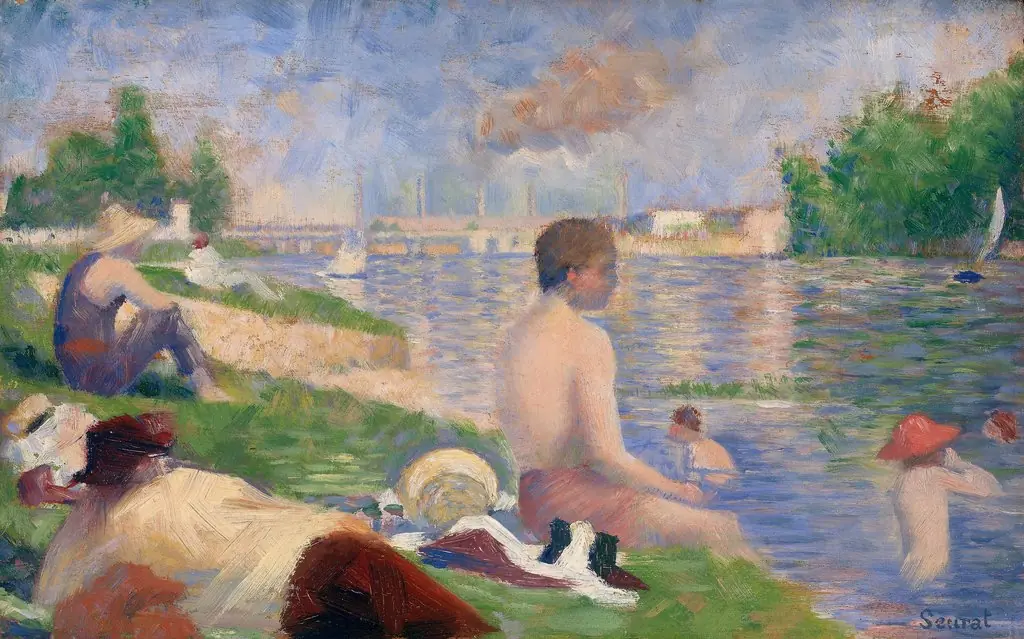
This small oil study depicts discarded clothing arranged along the bank of the Seine, positioned as if momentarily abandoned by unseen bathers. The composition isolates a cluster of garments, shirts, trousers, and undergarments, rendered in muted tones that contrast with the river’s reflective surface. The scene functions as a preparatory vignette for Seurat’s larger composition Bathers at Asnières (1883–1884), where the same riverbank setting appears populated by figures in the distance.
Rather than depicting human presence directly, the study emphasizes absence and anticipation, framing the river as a site of leisure and transition between private and public realms.
Technique & Style
The work is executed in oil on a wooden panel, with Seurat’s handling emphasizing precise, small strokes and a muted palette that modulates between ochres, greens, and blues.
The composition is restrained, framing the riverbank and discarded garments as a still-life tableau that prefigures the broader compositional logic of Bathers at Asnières. Light is rendered through discrete, optical mixtures rather than blended transitions, consistent with Seurat’s developing pointillist method.
The panel’s support and the fine, controlled application indicate a preparatory study rather than a freely brushed sketch, aligning with its status as a working drawing toward the larger canvas.
History & Provenance
Georges Seurat executed this oil study on wood panel in 1883 as preparatory work for his larger composition, Bathers at Asnières. The painting entered the commercial market through Bernheim-Jeune in Paris before moving to Alex Reid & Lefevre in London. By 1930, the work was held jointly by De Hauke & Co. in New York and the London dealer Percy Moore Turner.
Following the dissolution of De Hauke, Jacques Seligmann & Co. absorbed its stock and sold their share of the painting to Turner in 1935.
The work was subsequently acquired by William A. Cargill of Scotland. After Cargill's death, his estate sold the piece at Sotheby's in London on June 11, 1963. The buyer, acting for Hector Brame of Paris, purchased it on behalf of the American collector Paul Mellon.
Mellon bequeathed the painting to the National Gallery of Art in Washington, D.C., in 1999, though his wife, Rachel Lambert Mellon, retained a life interest until her death in 2014.
The Seine with Clothing on the Bank is held by the National Gallery of Art in Washington, D.C., where it entered the collection as a bequest from Paul Mellon in 1999. Prior to this donation, the work was part of the estate of William A. Cargill, sold at Sotheby's in London on June 11, 1963, and subsequently purchased for Mellon by Hector Brame. The painting's provenance also traces through major dealers including Bernheim-Jeune, Alex Reid & Lefevre, De Hauke & Co., and Jacques Seligmann & Co. during the early 20th century.
The source material details the ownership history and transfer to the museum but does not list specific exhibition records for the work.
Legacy
The study contributed to the development of Seurat's iconic Bathers at Asnières, influencing how he rendered light and spatial interaction in the larger composition. Its compositional innovations informed later Neo-Impressionist approaches to figure placement and atmospheric effects, with scholars noting its role in shaping Seurat's final treatment of the subject. The work remained in private hands until its acquisition by the National Gallery of Art in 1999, where it is now part of the permanent collection and studied as a key preparatory piece for the artist's later masterpiece.
Overview
Georges Seurat’s 1884 oil on wood, titled The Seine with Clothing on the Bank, functions as a preparatory study for his larger composition Bathers at Asnières. The work captures a quiet stretch of the Seine’s shore, rendered in the artist’s characteristic fragmented brushwork and bright palette.
Context
At the time Seurat was engaging with contemporary debates about light, color, and modern life. The Seine’s banks were a popular subject for artists exploring the interplay of natural scenery and the encroaching industrial city, situating this study within both Impressionist and Realist traditions.
Own this work as a print
Artist & collection
Artist
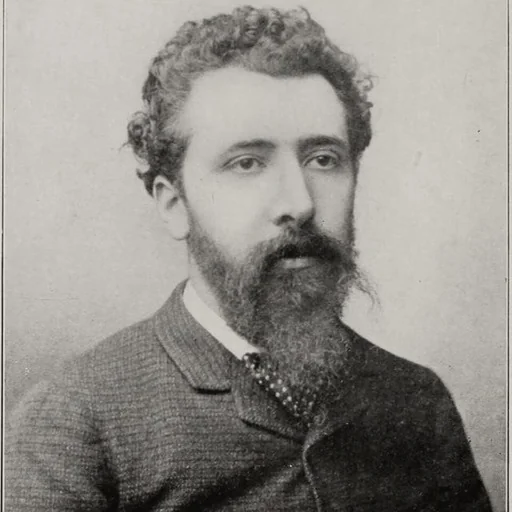
Georges Pierre Seurat (UK: SUR-ah, -ə, US: suu-RAH; French:; 2 December 1859 – 29 March 1891) was a French post-Impressionist artist.


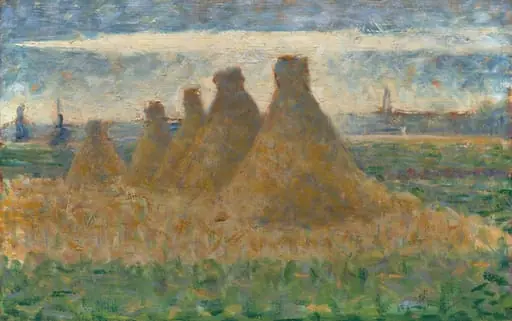
- Final Study for "Bathers at Asnières"
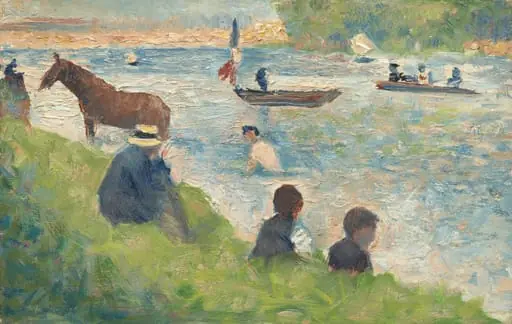 Horse and Boats (Study for "Bathers at Asnières")
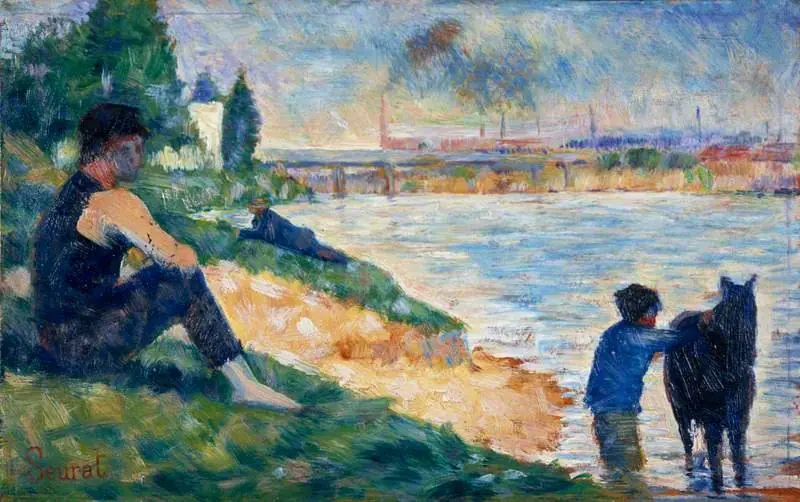 Bathers at Asnières (Study III)
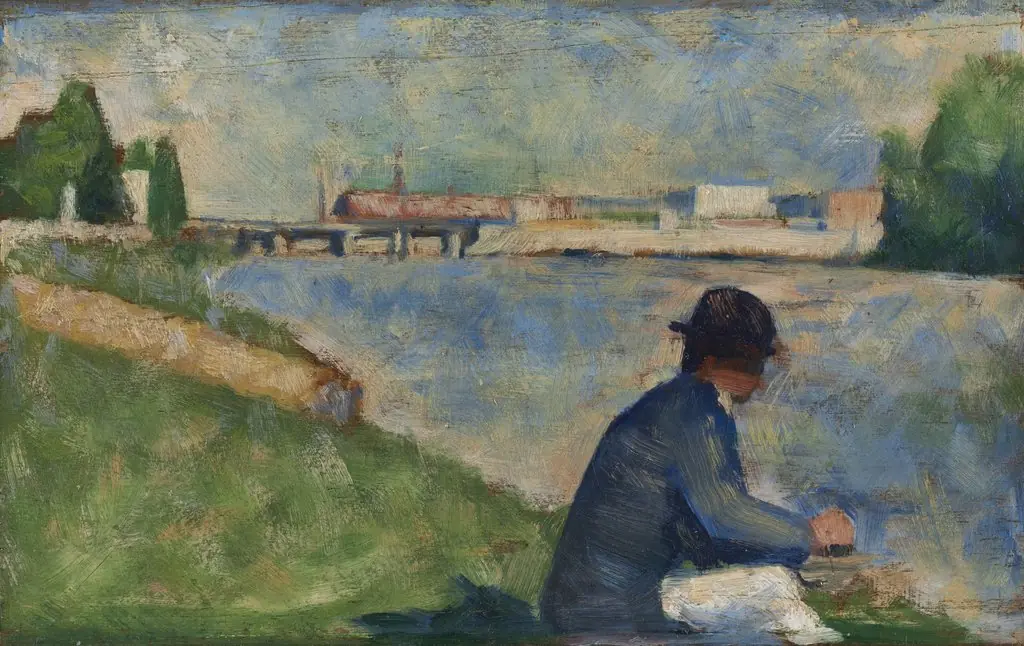 Study for "Bathers at Asnières"
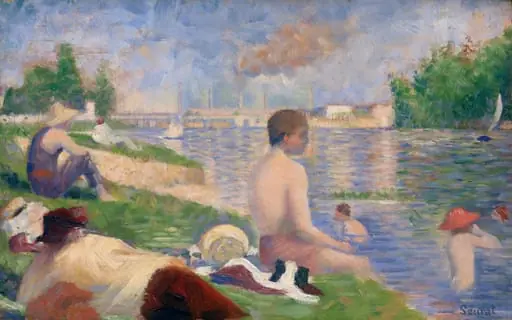 Final Study for "Bathers at Asnières"
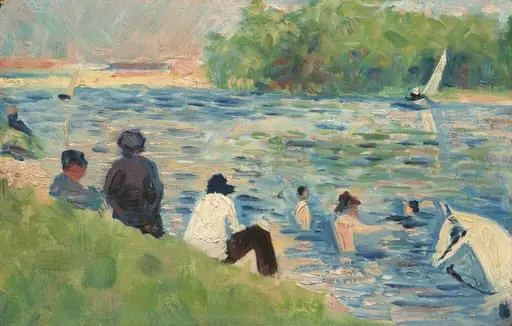 Bathers (Study for "Bathers at Asnières")
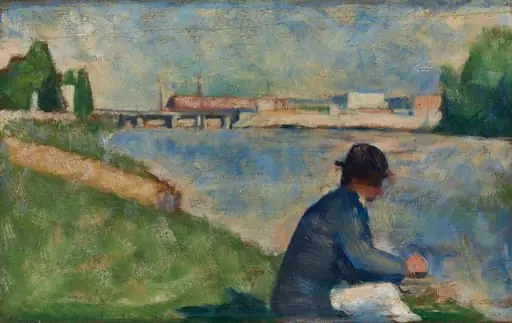 Study for "Bathers at Asnières"
 The Bank of the Seine
 View of the Seine
 Banks of the Seine at Médan