Artwork
Alfonso d'Avalos Addressing his Troops
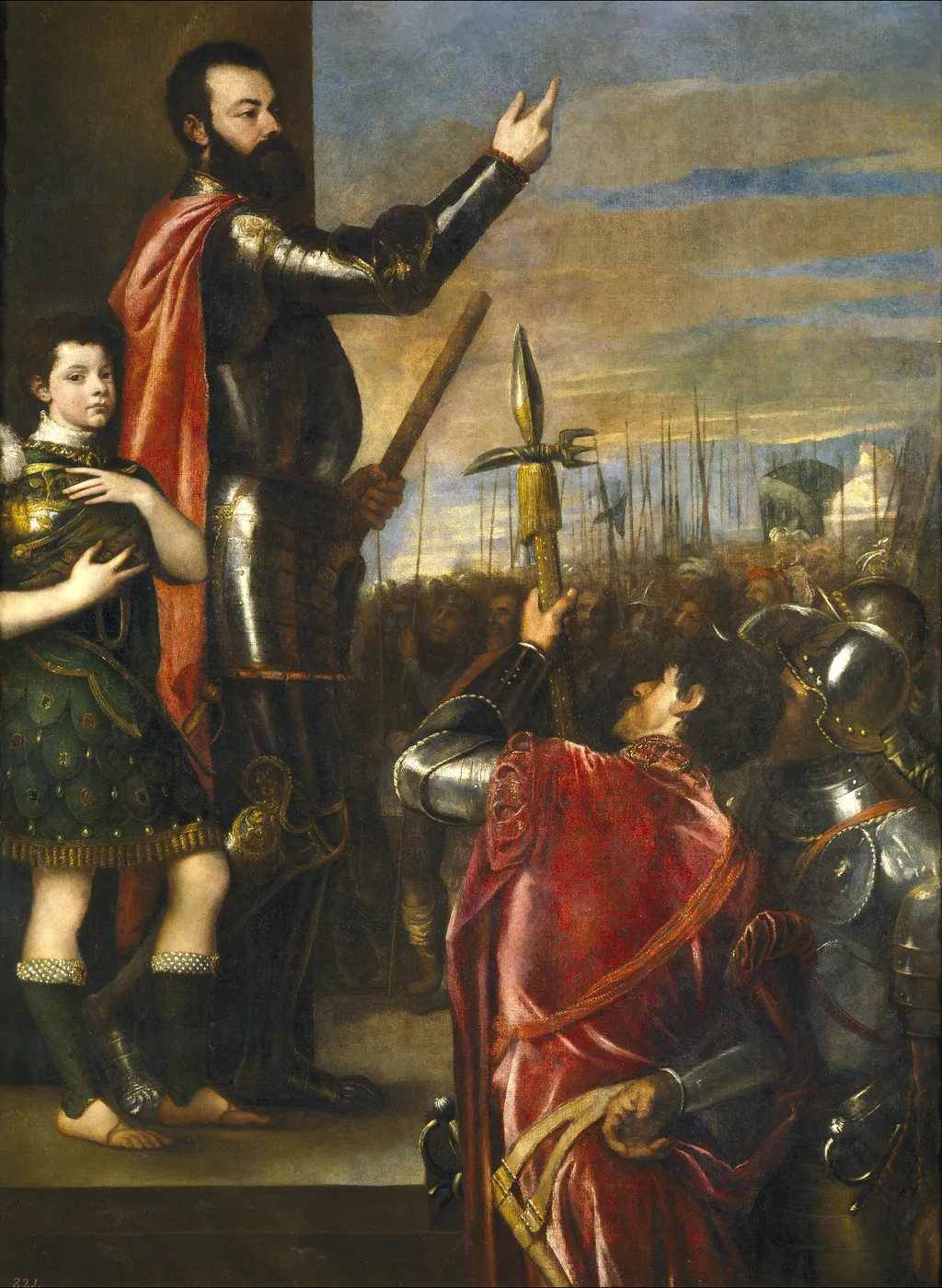
Alfonso d'Avalos Addressing his Troops is an oil painting by the Mannerist artist Titian. It dates from 1540 and is held in the collection of the Museo del Prado.
About this work
Subject & Meaning
The painting depicts the historical adlocutio of Alfonso d'Avalos, Marquess of Vasto, addressing his mutinous troops in Milan in 1537.
The painting depicts the historical adlocutio of Alfonso d'Avalos, Marquess of Vasto, addressing his mutinous troops in Milan in 1537. Faced with soldiers demanding unpaid wages, the general quelled the rebellion through eloquent oratory, offering his young son as a hostage to guarantee future payment. This narrative serves as a dual portrait and history painting, symbolizing the commander's diplomatic skill, loyalty to Emperor Charles V, and willingness to sacrifice his own child to restore order.
Visually, the work employs classical iconography derived from the Arch of Constantine and numismatic reliefs, positioning d'Avalos on an elevated dais with his right arm raised in a gesture of authoritative speech. His son stands beside him holding a helmet, acting as the physical pledge of the general's promise. The composition transforms a specific military incident into a moral exemplar of leadership and the power of words over violence.
Technique & Style
Executed in oil on canvas around 1540, the work measures 223 × 165 cm. Titian employs a deliberately compressed, stage-like space in which the armored commander stands on a dais and raises his right arm in a classical adlocutio gesture, while his young son holds his helmet at the center. The palette is dominated by muted earth tones and dark armor, punctuated by a crimson cape and the red of a soldier’s cloak, producing a ‘sombre and violently composed’ effect. The halberdier at lower left recalls Dürer’s engravings, and the armor of d’Avalos follows a design associated with Girolamo Martinengo.
The composition synthesizes antique reliefs such as those on the Arch of Constantine with numismatic models, emphasizing rhetorical elevation over naturalistic recession.
History & Provenance
Alfonso d'Avalos commissioned Titian to paint the work in 1539 during a visit to Venice, depicting a 1537 incident where the Marquis quelled a troop mutiny by offering his son as a hostage. Although undated, the painting is generally attributed to 1540 or 1541. Following its initial public exhibition in Milan in 1541, the work entered the collection of the Gonzaga family, Dukes of Mantua.
It was later acquired by King Charles I of England. After the King's execution, the painting was sold at auction and purchased by Philip IV of Spain. The work remained in the Spanish royal collection until 1828, when King Fernando VII transferred it to the Museo del Prado in Madrid.
The painting is held in the Museo del Prado, Madrid, with inventory number P00424. It was first shown publicly in Milan in 1541 during the visit of Emperor Charles V. Afterward it entered the Gonzaga collection in Mantua, then passed to King Charles I of England; following his execution its contents were sold and it was acquired by Philip IV of Spain. In 1828 Fernando VII transferred it to the Museo del Prado, where it has remained.
Context
Art historical scholarship identifies Alfonso d'Avalos Addressing his Troops as a mature work of Titian's Venetian School, created around 1540–1541. Critics regard the painting as a synthesis of portrait and history painting, where the artist employs a dramatic, Manierist style characterized by a 'brutal' and declamatory tone. The composition is noted for its deliberate reference to classical antiquity, specifically the Arch of Constantine and Roman numismatic reliefs, to elevate the Marquis's oratory.
Scholars interpret the work as a political instrument commissioned by d'Avalos to justify his clemency during a 1537 mutiny and reaffirm his loyalty to Emperor Charles V. The painting's provenance links it to major European collections, including the Gonzaga family and the English royal collection, before entering the Museo del Prado. Its placement in art history marks a departure from naturalistic depth toward a synthesized, dramatic narrative language influenced by contemporaries like Giulio Romano.
Overview
Titian's oil painting, Alfonso d'Avalos Addressing his Troops, created around 1540, depicts the Neapolitan nobleman and military leader. Now housed in the Museo del Prado, this work serves as both a formal portrait of the Marquis del Vasto and a historical narrative, commemorating a specific incident from his career. It captures a moment of leadership and persuasion, showcasing d'Avalos's authority and influence over his soldiers.
Own this work as a print
Artist & collection
Artist
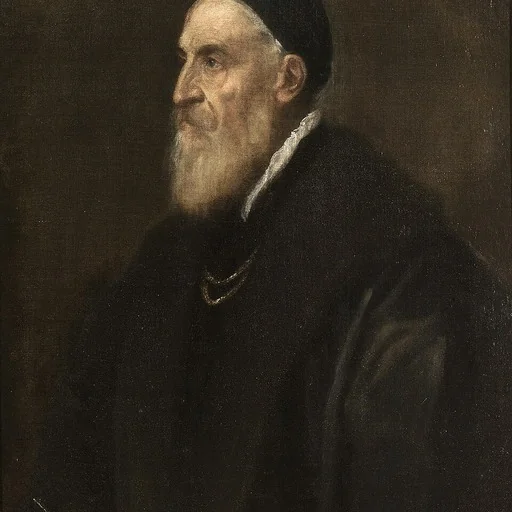
Tiziano Vecellio (Italian:; c. 1488/1490 – 27 August 1576), Latinized as Titianus, hence known in English as Titian ( TISH-ən), was an Italian Renaissance painter. The most important artist of Renaissance Venetian…

 Saint Demetrius
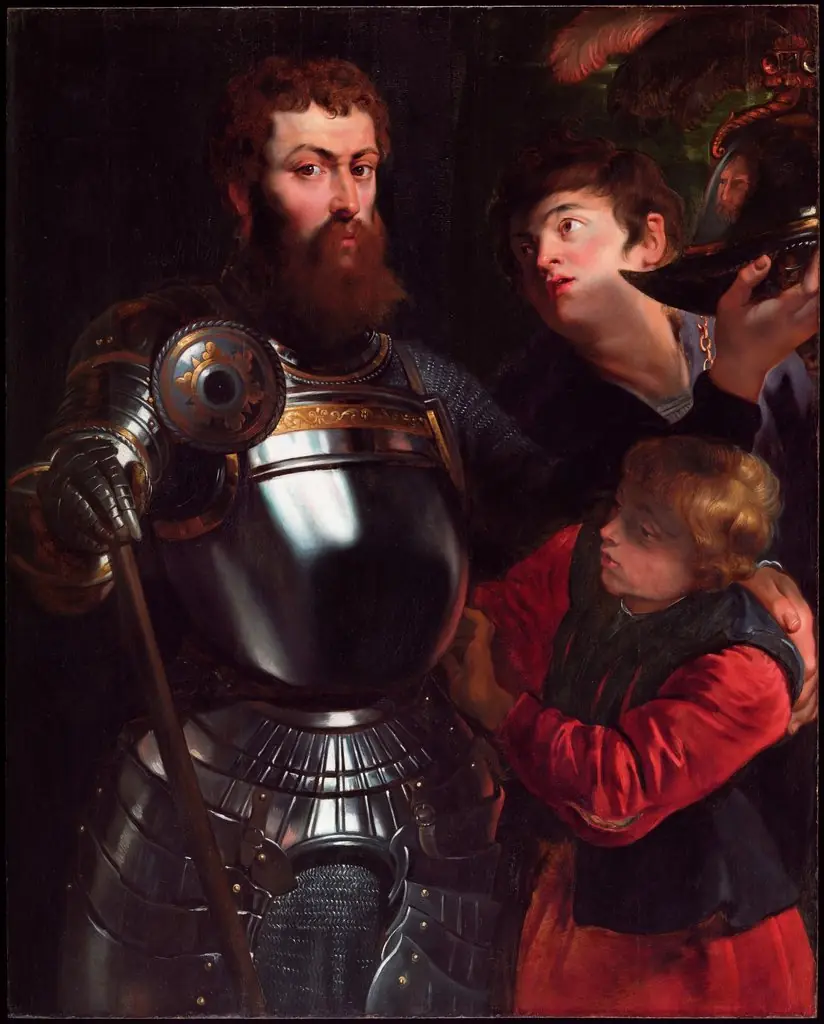 Warrior with Two Pages
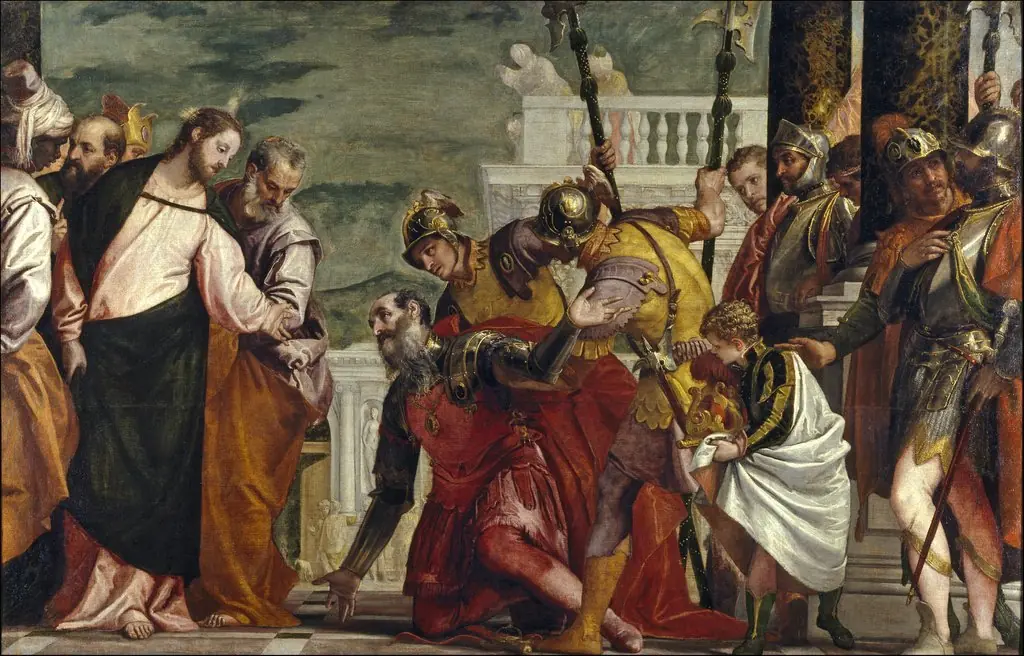 Christ and the Centurion
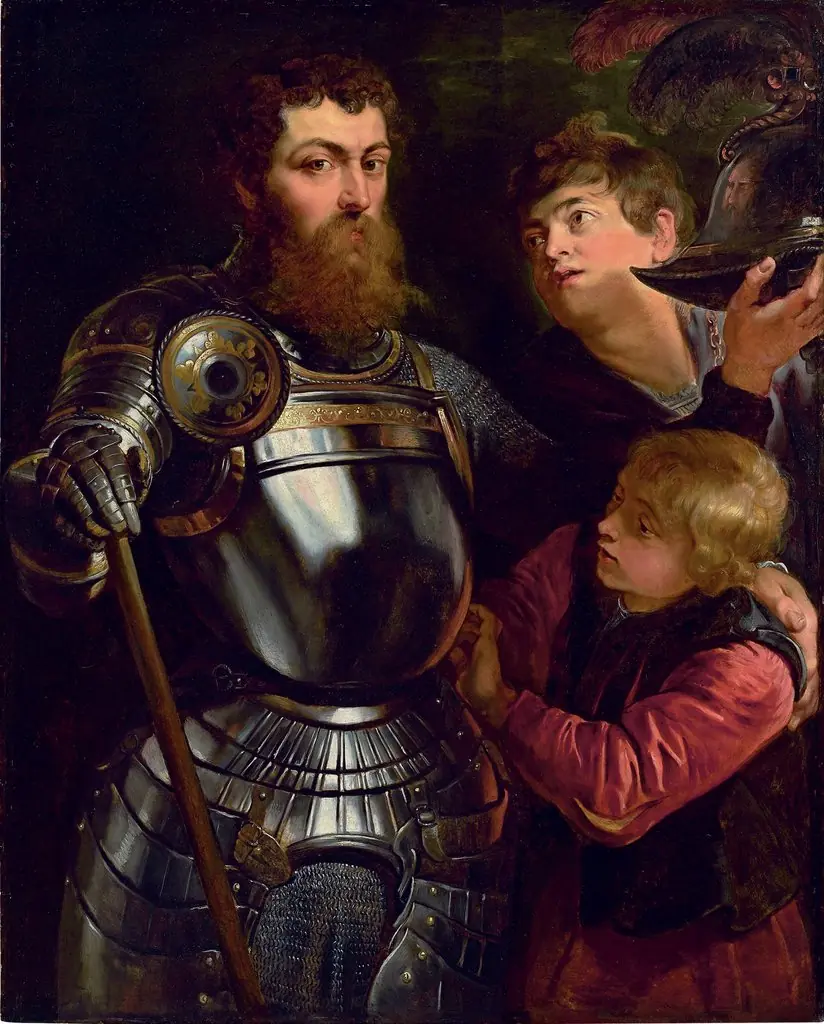 Portrait of a Commander
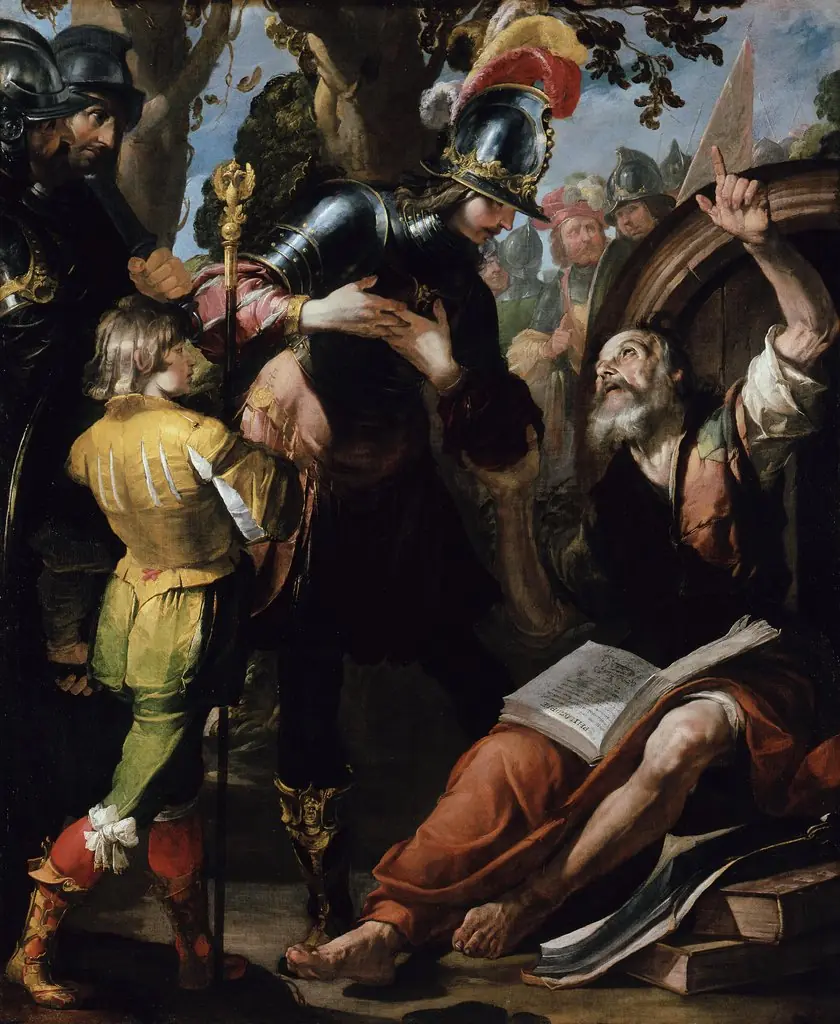 Alexander and Diogenes
 Saul und David mit dem Haupt des Goliath
 Conversion of Saul
 Saint Benedict receiving Totila, King of the Ostrogoths
 The Liberation of Brisach
 The Apostle Saint James or Saint James the Moor Slayer
 Indische Könige huldigen Alexander dem Großen
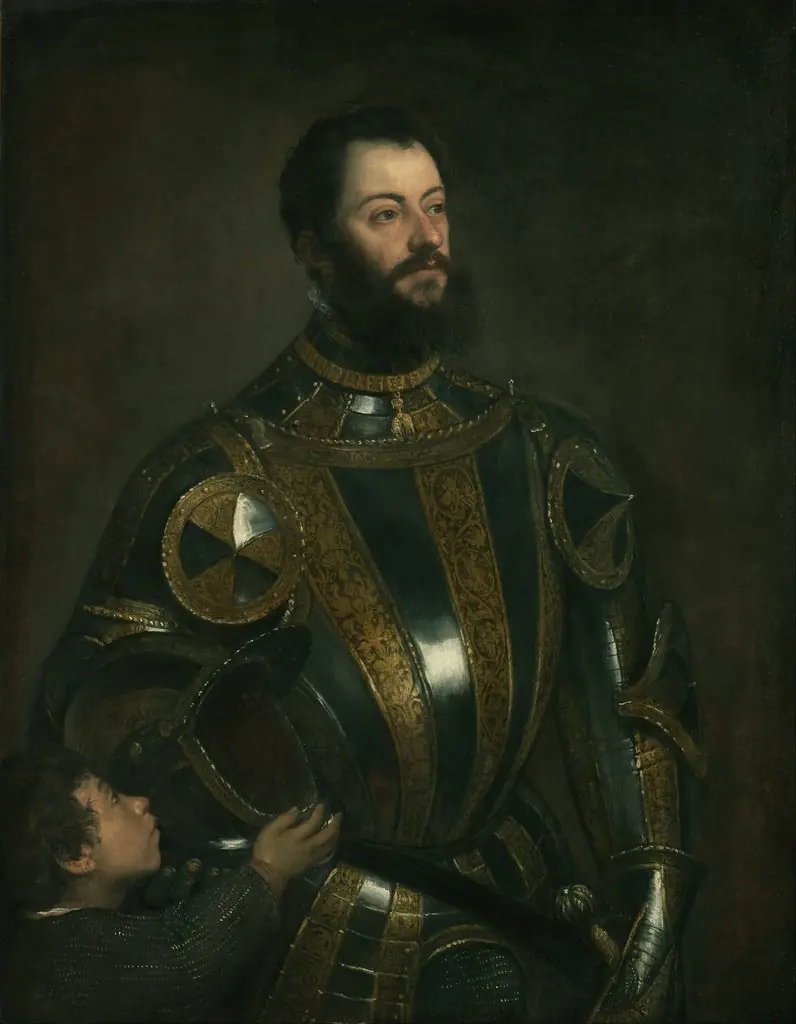
- Portrait of Alfonso d'Avalos, Marchese del Vasto, in Armor with a Page