Artwork
Venus Anadyomene
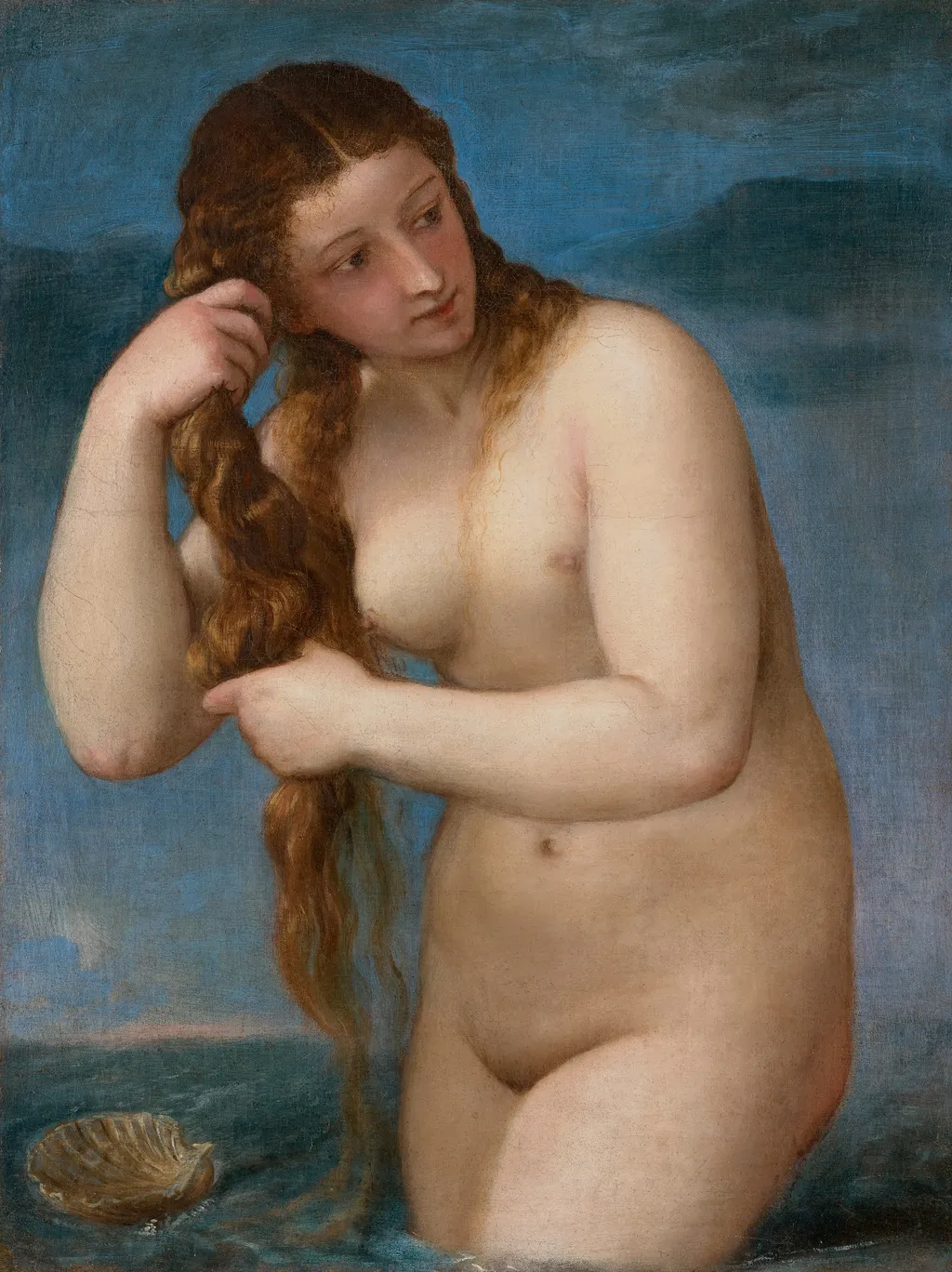
Venus Anadyomene is an oil painting by the High Renaissance artist Titian. It dates from 1520 and is held in the collection of the National Galleries Scotland.
About this work
The shell is smaller than in other birth of Venus scenes, like Botticelli’s, and serves only to identify the subject.
Venus Anadyomene is an oil painting by Titian, dated around 1520. It shows the goddess Venus rising from the sea and wringing her hair, with a small shell at the bottom left.
The shell is smaller than in other birth of Venus scenes, like Botticelli’s, and serves only to identify the subject. The composition follows a description by the Greek poet Hesiod, who said Venus was born fully grown from a shell.
You might also explore works at the Scottish National Gallery.
Subject & Meaning
The painting depicts Venus rising from the sea and wringing her wet hair, a subject drawn from the Greek poet Hesiod's account of the goddess being born fully grown from the sea. A scallop shell floats at the lower left, identifying the scene as Venus's birth from the waters of Cyprus; the shell is rendered smaller than in comparable depictions such as Botticelli's Birth of Venus, functioning as an attribute rather than as a vessel carrying the goddess.
Titian's wringing-hair motif deliberately imitates the lost masterwork of the same title by the ancient Greek painter Apelles, described in Pliny's Natural History. By including this detail, Titian signalled his ambition to rival antique art, in which Venus was likewise shown washing her hair. The figure's voluptuous proportions and sideways glance also reflect classical sculptural prototypes such as the Crouching Venus and the Cnidian Venus.
The painting is framed as an ideal female nude portrait cropped tightly by the canvas edges, with the goddess standing upright and twisting slightly forward as she emerges from the water, her legs still submerged to mid-thigh.
History & Provenance
Titian painted Venus Anadyomene around 1520, an oil on canvas (75.8 × 57.6 cm) that illustrates the goddess rising from the sea and wringing her hair.
It passed from Christina of Sweden and the Orleans Collection to John Egerton, 6th Duke of Sutherland, was lent to the National Gallery of Scotland in 1945, and in 2003 was acquired from Francis Egerton, 7th Duke of Sutherland for more than £11 million with assistance from the Heritage Lottery Fund (£7.6m), the Art Fund, the Wolfson Foundation, and the Scottish Executive (£2.5m).
The painting is held by National Galleries Scotland and displayed at the Scottish National Gallery in Edinburgh. Its accession number is NG 2751. Following acquisition, it served as the centrepiece of a 2004 exhibition and appeared in the National Art Collections Fund's anniversary exhibition "Saved!".
Context
Painted by Titian circa 1520, the oil on canvas (75.8 × 57.6 cm) exemplifies the mythological nude that defines his Venetian output. The composition shows the goddess emerging from the sea, wringing her hair while a shell lies at the lower left, a detail that scholars link to classical precedents such as the Crouching Venus and Apelles's lost work. Titian's rendering reflects his engagement with antiquity, as noted by Pliny, and draws on the physical type of ideal women he portrayed in other paintings.
The work was acquired by the National Galleries of Scotland in 2003 after a public fundraising effort that raised more than £11 million, supported by the Heritage Lottery Fund, the Art Fund, and the Scottish Executive.
Legacy
Titian's Venus Anadyomene secured its legacy as a deliberate Renaissance rival to Apelles' lost masterwork, a connection explicitly cited by Pliny the Elder. By depicting the goddess wringing her hair, Titian engaged in a humanist challenge to revive the art of antiquity, while his composition also drew upon classical sculpture types like the Crouching Venus. The painting's modern reputation was cemented in 2003 when it became a national treasure for Scotland, acquired for over £11 million through a major public fundraising campaign involving the National Art Collections Fund and the Heritage Lottery Fund.
This high-profile purchase, which facilitated the work's transition from the private Sutherland collection to public ownership, was followed by its role as the centrepiece of the 2004 exhibition and the National Art Collections Fund's anniversary show "Saved!", reaffirming its status as a pivotal masterpiece of the Venetian school.
Overview
Titian's "Venus Anadyomene," an oil painting from approximately 1520, portrays the goddess Venus emerging from the ocean. The artwork captures her in the act of wringing water from her hair, a gesture that emphasizes her recent birth from the sea. A small shell positioned in the lower left corner subtly identifies the mythological subject, referencing classical accounts of her origin.

Own this work as a print
Artist & collection

Artist
Tiziano Vecellio (Italian:; c. 1488/1490 – 27 August 1576), Latinized as Titianus, hence known in English as Titian ( TISH-ən), was an Italian Renaissance painter. The most important artist of Renaissance Venetian…