Artwork
Venus of Urbino
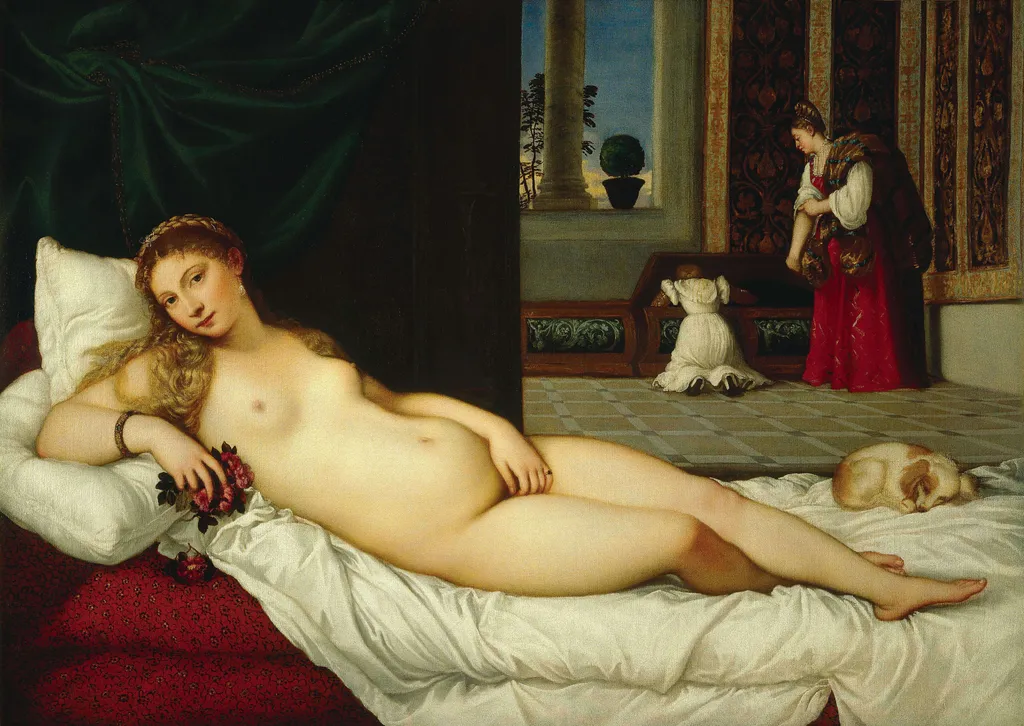
Venus of Urbino is an oil painting by the High Renaissance artist Titian. It dates from 1538 and is held in the collection of the Uffizi Gallery.
About this work
Titian began Venus of Urbino around 1532 to 1534 and finished it in 1538, keeping it for years before the sale. A nude woman reclines on a bed in a richly furnished room, a small dog asleep at her feet, a common Renaissance symbol. It now hangs in the Uffizi Gallery in Florence.
Subject & Meaning
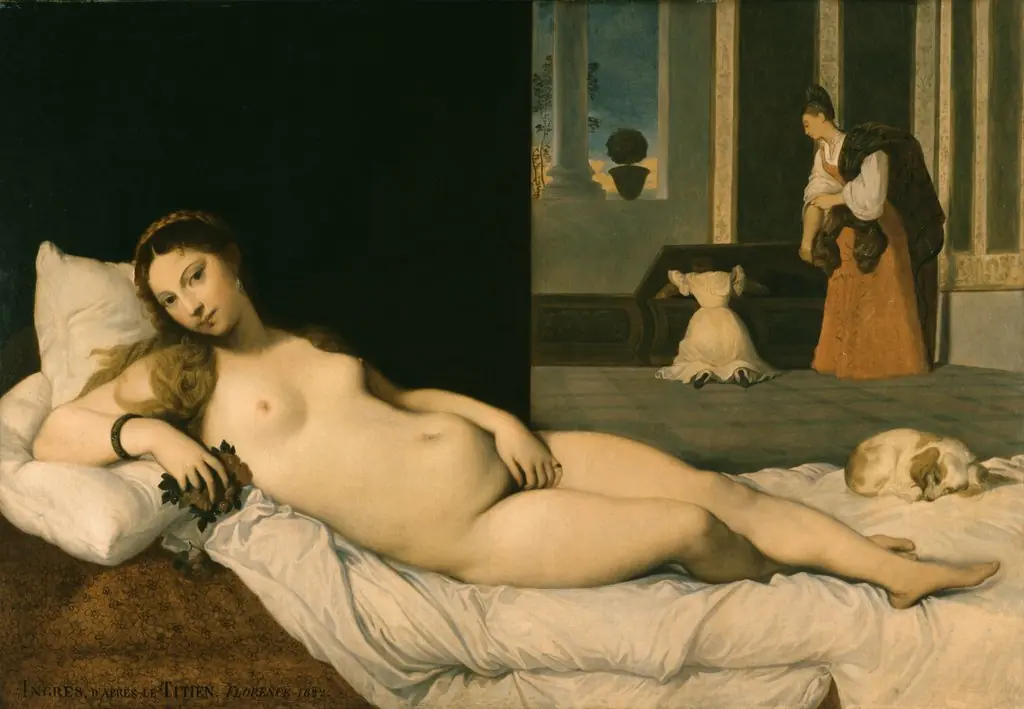
The painting shows a nude young woman reclining on a bed, her gaze directed at the viewer, hand over her genitals and a bouquet of roses in the other hand; a dog lies at the foot of the bed and two servants rummage through a cassone in the background. These elements combine eroticism with domestic symbolism: the roses, the exposed genitalia, and the maidservants reference marital fertility and the preparation of a bride, while the dog has been read as a sign of marital fidelity and the della Rovere household. Interpretations diverge between a portrayal of a courtesan, an allegory of marital love, or a symbolic rite linked to Renaissance ideas that female pleasure aids conception.
The work thus merges mythic Venus imagery with contemporary marital contexts, using iconography to convey both sensuality and the social purpose of the marriage contract.
Technique & Style
Two distinct perspectival zones are constructed rather than a single unified space: the foreground bed and the deeper chamber with maids at a cassone.
The Venus of Urbino is an oil painting on canvas, executed by Titian in 1538 and measuring 119 by 165.5 cm, a portable format suited to a noble patron. The canvas support allowed Titian to demonstrate his celebrated handling of varied surfaces: the warm, pearlescent flesh rendered in sfumato so that the body dissolves atmospherically into its surroundings, the loose golden "Titian" hair falling in waves, the sleeping dog's fur, the satin linens, the embroidered cushion covers, the wall tapestry, and the jewelry catching light. A cool emerald-green curtain divides the background, its folds echoing the curves of the figure, while summer light enters through a rear window to animate the textiles.
Two distinct perspectival zones are constructed rather than a single unified space: the foreground bed and the deeper chamber with maids at a cassone. The composition pivots on the figure's direct gaze and the placement of her left hand at the optical center, with the pavement's vanishing point aligned with her left eye and hand.
History & Provenance
The Venus of Urbino was painted by Titian in 1538 and delivered that year to Guidobaldo II della Rovere, Duke of Urbino. He referred to the work simply as "the nude woman" when negotiating its purchase in 1538, anxious it might be sold elsewhere. Earlier hypotheses that Guidobaldo commissioned it to mark his 1534 marriage to Giulia Varano are not documented.
The painting's title derives from Giorgio Vasari, who saw it in the ducal guardaroba at Urbino in 1548 and called the reclining figure a "Venus."
The work remained largely in Pesaro, at the Villa Imperiale after the della Rovere court relocated there in 1624. It passed to the Medici in 1633 through Vittoria della Rovere's marriage to Ferdinando II de' Medici, and was transferred to the Uffizi in Florence in 1736, where it has since remained. The work has traveled for major exhibitions in the 21st century, including venues in Madrid, Brussels, Tokyo, Venice, and Urbino.
Context
The Venus of Urbino (1538) occupies a pivotal position in the development of the reclining female nude, a genre Titian helped establish within Venetian Renaissance art. Scholarship has polarized around its interpretation: some, like Rona Goffen, argue for marital symbolism, citing the cassone (marriage chest), the dog (fidelity), and Venus's gesture (linked to Renaissance beliefs about female arousal and conception), while others, including Charles Hope, dismiss allegorical readings, viewing it as a straightforward celebration of beauty and sensuality devoid of classical or moralizing content. Edgar Wind's admission of its "undisguised hedonism" underscores the work's rupture with Neoplatonic ideals, reflecting Titian's broader rejection of didacticism in favor of naturalistic eroticism.
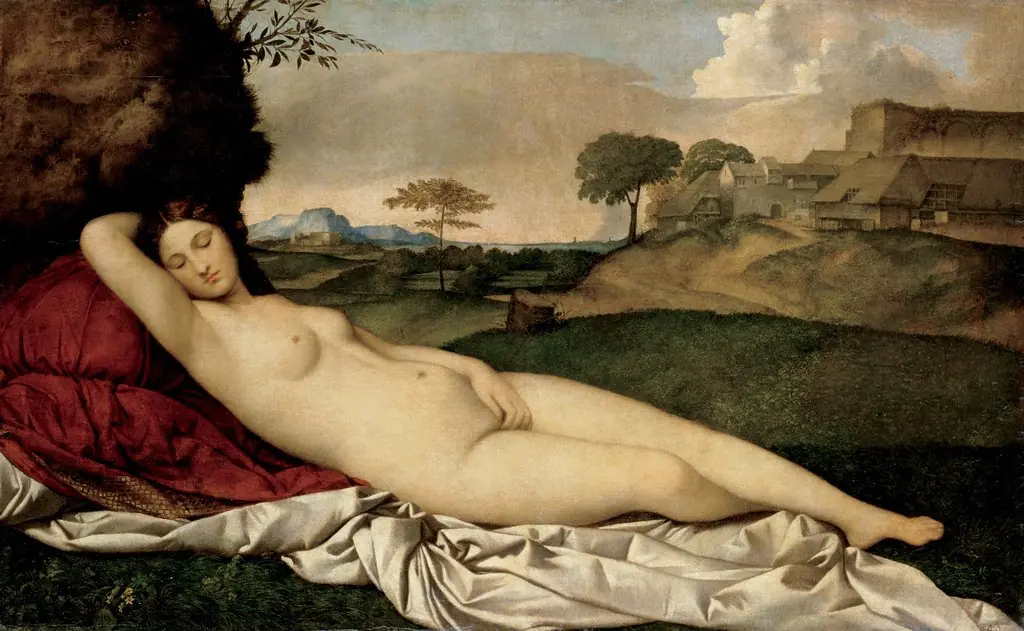
The painting's direct gaze and domestic setting further distinguished it from Giorgione's Sleeping Venus (c. 1510), marking a shift toward psychological engagement and contemporary realism. Its influence resonates in later works, notably Manet's Olympia (1863), which recontextualized its provocative immediacy for modern audiences.
Legacy
Titian's composition established a defining tradition for the reclining female nude in Venetian art, directly influencing Édouard Manet's controversial 1863 work Olympia. The painting's legacy extends to modern times, with Lucian Freud referencing both Titian's original and Manet's adaptation in his 1993 piece Evening in the Studio. A copy by Franz von Lenbach, created in 1866, is held in the Alte Pinakothek in Munich.
Art historically, the work is recognized for breaking the mythic isolation of earlier depictions like Giorgione's Sleeping Venus by placing the figure in a domestic interior with direct eye contact. This shift toward explicit sensuality and naturalism sparked enduring scholarly debate regarding whether the image represents a marital allegory or a courtesan, a discourse that continues to shape interpretations of the genre.
Overview
Titian's Venus of Urbino, an oil painting, depicts a reclining nude woman within an opulent Renaissance interior. Created by the Italian master around the mid-1530s, this work is traditionally understood as portraying the goddess Venus. It showcases Titian's skill in rendering the human form and rich textures, and is now a significant piece in the collection of the Galleria degli Uffizi in Florence.
Own this work as a print
Artist & collection

Artist
Tiziano Vecellio (Italian:; c. 1488/1490 – 27 August 1576), Latinized as Titianus, hence known in English as Titian ( TISH-ən), was an Italian Renaissance painter. The most important artist of Renaissance Venetian…