Artwork
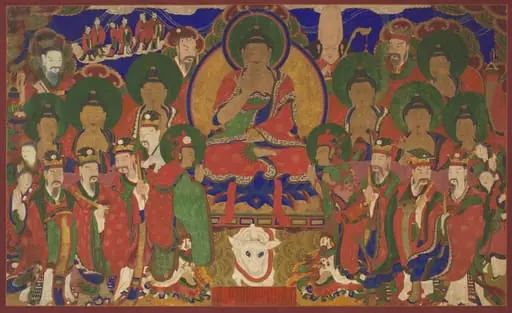
Assembly of Buddhist Deities
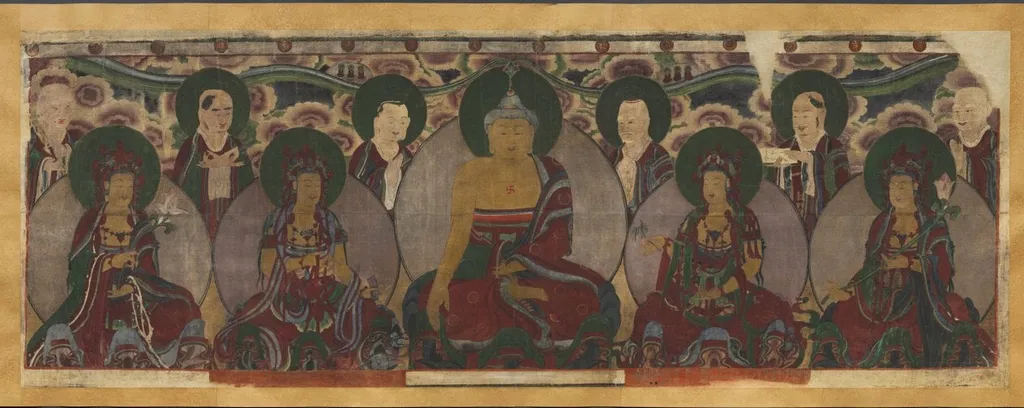
Assembly of Buddhist Deities is an unspecified painting by the Korean Minhwa artist Unknown. It dates from 1846 and is held in the collection of the Cleveland Museum of Art.
- Accession no.
- 1918.541
- Credit line
- Director's Contingent Fund
About this work
The colors are still bright, but the bottom edge is worn, monks probably touched it every day for prayers.
You see a tall scroll crowded with golden figures: one Buddha in the center, arms out, fingers touching the earth, surrounded by smaller holy beings in red, blue, and green robes.
The painting was made in 1846 for a Korean monastery. The colors are still bright, but the bottom edge is worn, monks probably touched it every day for prayers. Even the partly erased writing tells us where it hung.
To see more paintings like this, look up korea, joseon dynasty (1392–1910).
Overview
This vertical scroll painting, created in 1846 during Korea’s Joseon dynasty, depicts a gathering of Buddhist figures centered on Sākyamuni Buddha. Executed in mineral pigments on silk, it was designed for devotional use within a monastic residence. Though the lower inscription is partially worn, its remaining traces confirm its original location and date, reflecting its role in daily monastic practice.
Subject & Meaning
Sākyamuni Buddha, seated centrally, gestures toward the earth, invoking the moment of his enlightenment under the Bodhi tree. Surrounding him are bodhisattvas and arhats, each rendered with distinct robes in red, blue, and green, symbolizing their spiritual roles. The composition conveys a sacred assembly, reinforcing the presence of enlightened beings as witnesses and guides for practitioners in the monastic space.
Technique & Style
The painting employs fine brushwork and layered mineral pigments to achieve vivid, enduring coloration. Figures are outlined with precision and filled with flat, symbolic hues typical of Joseon Buddhist art. Gold leaf accents highlight halos and garments, enhancing spiritual radiance.
The vertical format and dense arrangement reflect traditional East Asian devotional painting conventions, prioritizing symbolic clarity over spatial depth.
History & Provenance
Commissioned for a Korean monastery in 1846, the scroll was likely displayed in the monks’ living quarters, where it served as a focus for daily ritual and meditation. Wear along the lower edge suggests frequent handling during devotional acts. The partially legible inscription confirms its origin and function, offering rare direct evidence of its use within a specific monastic community.
Context
Produced during the late Joseon period, when Buddhism existed alongside Confucian state orthodoxy, this work reflects the quiet persistence of monastic traditions. Despite state suppression, Buddhist communities maintained devotional practices through such paintings, which bridged textual study and visual contemplation. Its creation underscores the resilience of Buddhist art in private, ritual contexts.
Legacy
This painting exemplifies the continuity of Korean Buddhist iconography into the 19th century. Its survival, with colors intact despite physical wear, offers insight into how devotional objects were integrated into daily monastic life. It remains a tangible link to the spiritual routines of Joseon-era monks, preserving a visual language that endured beyond political and doctrinal shifts.
Artist & collection









- Assembly of Buddhist Deities
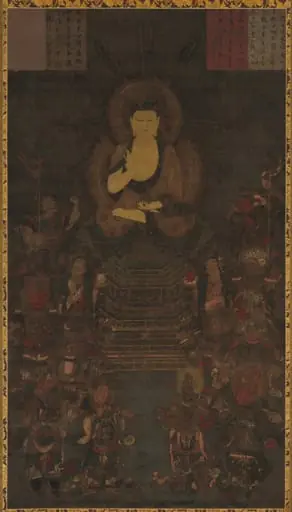 Medicine Master Buddha and the Twelve Divine Generals
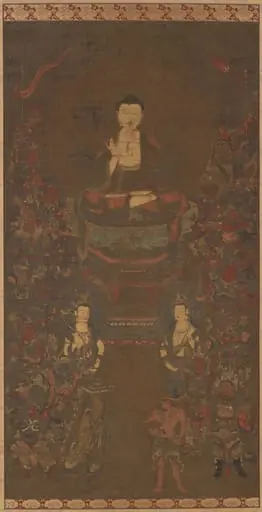 Shakyamuni with the Sixteen Benevolent Deities
 The Assembly of Tejaprabha Buddha
 Tantric Buddha Vairochana as Vajrasattva
 Shakyamuni with two attendants
 Seated Manjusri
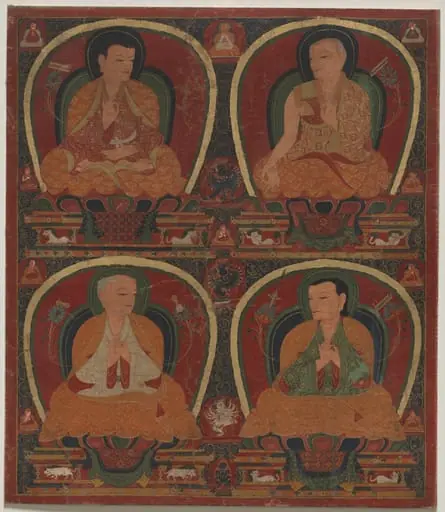 Four seated Masters
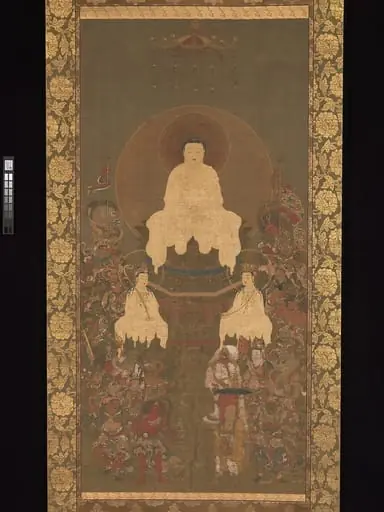 釈迦三尊十六善神像|Shaka (Shakyamuni), the Historical Buddha, with Two Attendant Bodhisattvas and Sixteen Benevolent Deities
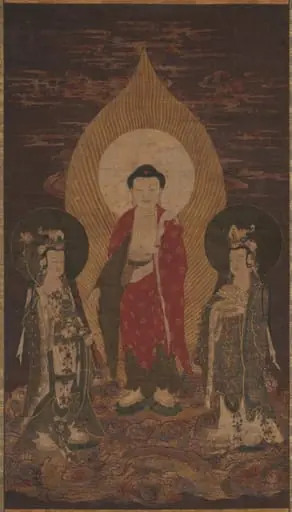 Amitābha Triad
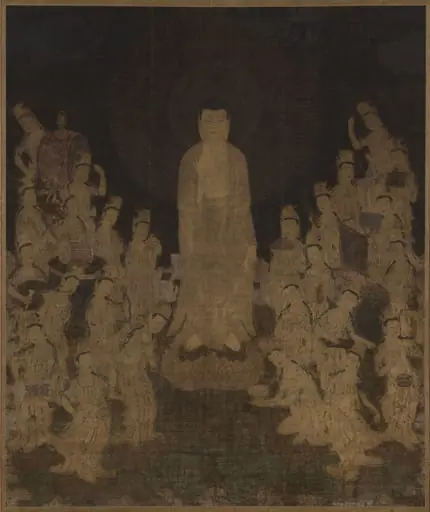 Welcoming Descent of Amida with Twenty-Five Bodhisattvas