Artwork
The guard spares the life of the slave when he learns that he is the son of the princess of the Rum, from a Tuti-nama (Tales of a Parrot): Fiftieth Night
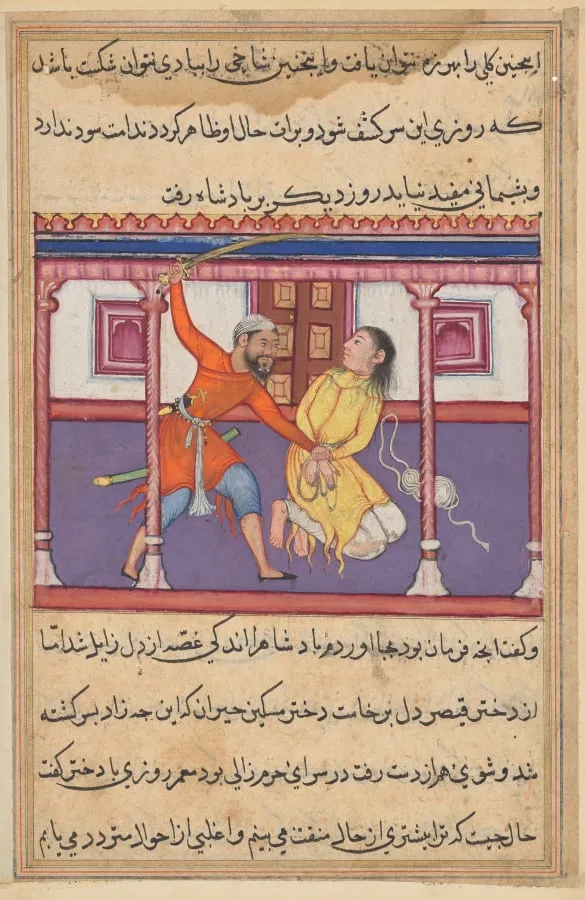
The guard spares the life of the slave when he learns that he is the son of the princess of the Rum, from a Tuti-nama (Tales of a Parrot): Fiftieth Night is an unspecified painting by the Mughal Painting artist Unknown. It dates from 1560 and is held in the collection of the Cleveland Museum of Art. This painting illustrates a moment from the fiftieth night of the Tuti-nama, a collection of frame tales centered on a talking parrot.
- Accession no.
- 1962.279.321.b
- Credit line
- Gift of Mrs. A. Dean Perry
About this work
The king thinks the man is the princess’s lover and orders him killed, but at the last moment, the truth comes out.
You see a man kneeling, hands tied, while a guard holds a sword above his head. His turban is unraveled on the ground, and his long hair is messy. A crowd watches in a palace courtyard.
This painting tells a story from a book called the Tuti-nama, or Tales of a Parrot. The king thinks the man is the princess’s lover and orders him killed, but at the last moment, the truth comes out. The guard lowers his sword.
To see more art like this, look up Mughal India, court of Akbar (reigned 1556–1605).
Overview
This painting illustrates a moment from the fiftieth night of the Tuti-nama, a collection of frame tales centered on a talking parrot. It depicts a pivotal scene in which a condemned young man’s identity is revealed just before execution, halting the blade of the royal guard. The setting is a Mughal palace courtyard, where onlookers witness the dramatic turn of events.
The work originates from the imperial atelier of Emperor Akbar, reflecting the court’s interest in illustrated narrative literature.
Subject & Meaning
The scene captures the moment of revelation: a man, bound and disheveled, discloses he is the secret son of a princess, not her lover as the king believed. His untied turban and tangled hair signify his fall from dignity, while the guard’s suspended sword marks the threshold between death and redemption. The narrative underscores themes of mistaken identity, familial secrecy, and divine intervention through human revelation.
Technique & Style
Executed in opaque watercolor and gold on paper, the painting employs fine brushwork and rich, layered pigments typical of Mughal miniature traditions. Figures are rendered with delicate detail, their gestures clearly conveying emotion and narrative tension. The courtyard is suggested through architectural elements rather than full perspective, emphasizing the human drama over spatial realism. Gold accents highlight key figures and textiles, reinforcing the scene’s royal context.
History & Provenance
Created during the reign of Akbar (1556–1605), the painting belonged to a complete manuscript of the Tuti-nama commissioned by the emperor. These illustrated volumes were produced by teams of artists in the imperial workshop, blending Persian literary traditions with Indian visual styles. The manuscript was likely kept in the royal library and may have been dispersed after Akbar’s death, with individual folios entering private and institutional collections over time.
Context
The Tuti-nama was translated from Arabic into Persian under Akbar’s patronage and adapted into a series of moral tales framed by the parrot’s nightly stories. Illustrated manuscripts like this one served both as entertainment and as tools of courtly culture, reinforcing ideals of justice, wisdom, and royal authority. The inclusion of such narratives in imperial commissions reflects Akbar’s broader interest in synthesizing diverse literary and religious traditions.
Legacy
This painting exemplifies the height of Mughal manuscript illustration, influencing later regional styles across India. Its narrative precision and emotional restraint became benchmarks for court artists. Surviving folios from the Akbari Tuti-nama are now held in major museums and libraries, where they continue to inform scholarship on Indo-Persian art, storytelling, and the role of visual culture in early modern governance.
Artist & collection









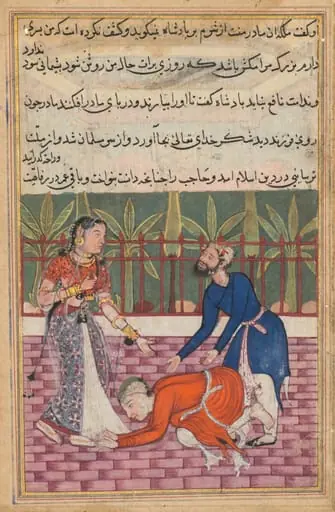
- The guard restores the son who falls at his mother’s feet, from a Tuti-nama (Tales of a Parrot): Fiftieth Night
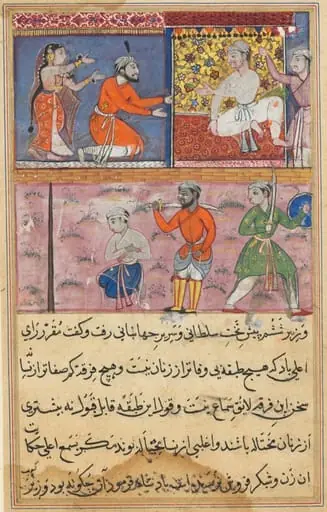 The prince sent back to the place of execution for the sixth time, from a Tuti-nama (Tales of a Parrot): Eighth Night
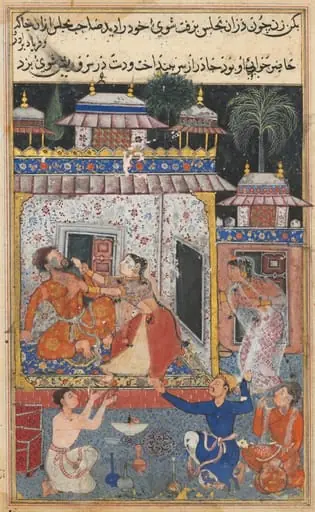 The deceitful wife assaults her erring husband, from a Tuti-nama (Tales of a Parrot): Eighth Night
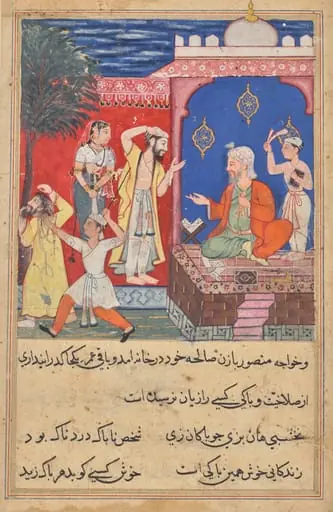 The false Mansur punished before the judge and expelled from the city, from a Tuti-nama (Tales of a Parrot): Seventeenth Night
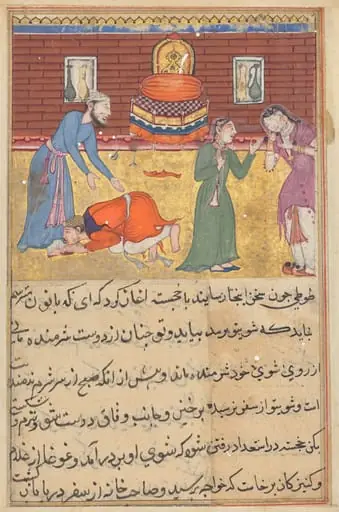 The pious man’s son, now a king, reveals himself to his father; his nurse upbraids his unfaithful mother, from a Tuti-nama (Tales of a Parrot): Fifty-second Night
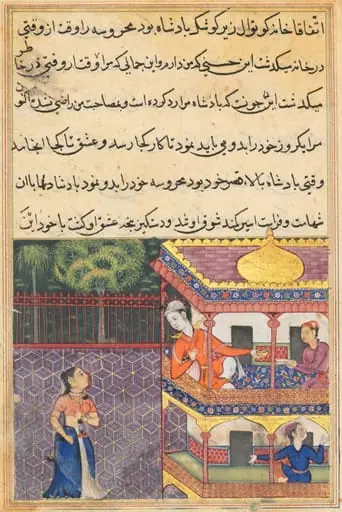 The king of Zabul sees Mahrusa from his palace balcony, from a Tuti-nama (Tales of a Parrot): Thirty-sixth Night
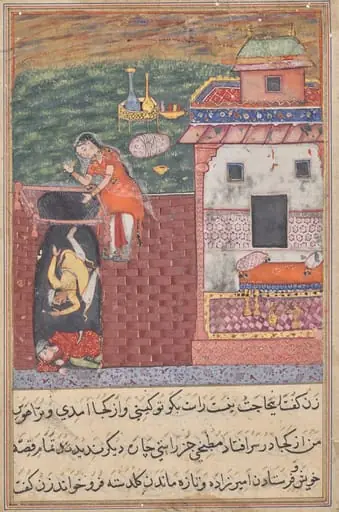 The two cooks, who attempt to seduce the warrior’s loyal wife, are trapped by her in a cellar, from a Tuti-nama (Tales of a Parrot): Fourth Night
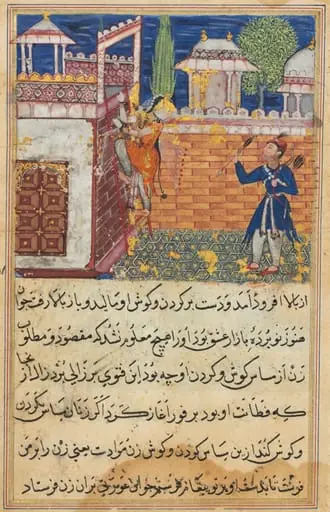 The deceitful wife returns to her terrace after caressing her lover, from a Tuti-nama (Tales of a Parrot): Eighth Night
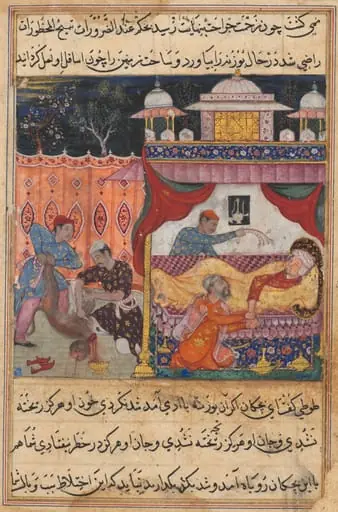 The monkey slain, his blood to be used as medicine for the ailing prince he has bitten, from a Tuti-nama (Tales of a Parrot): Fifth Night