Artwork
Untitled
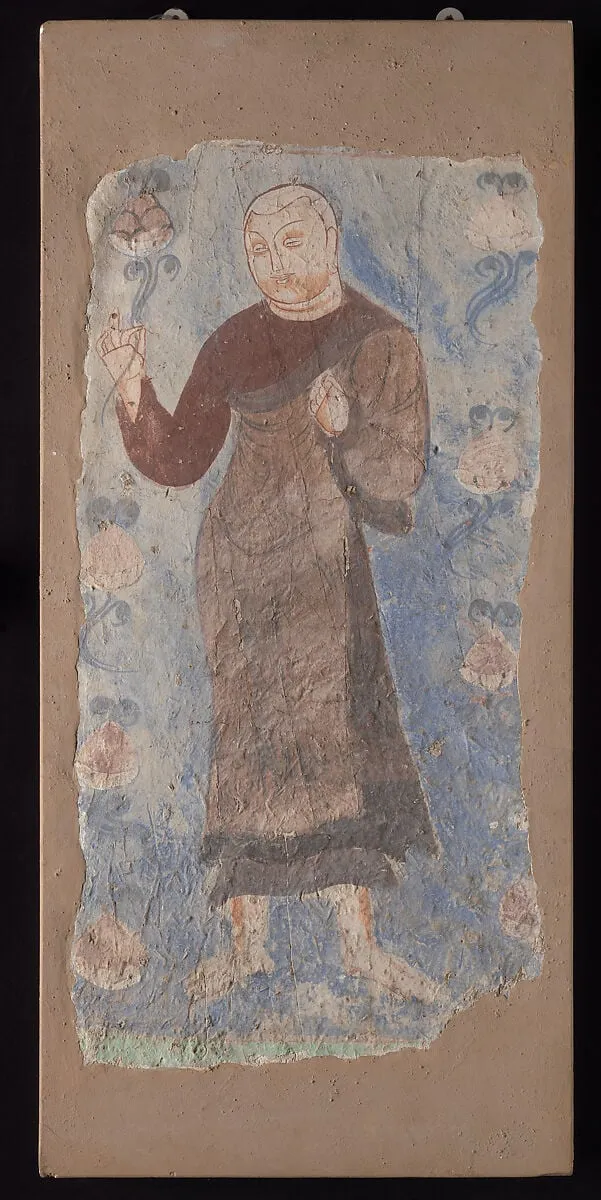
Untitled is an unspecified painting. It dates from 600 and is held in the collection of the Metropolitan Museum of Art.
- Accession no.
- 42.49
- Credit line
- Fletcher Fund, 1942
About this work
Subject & Meaning
The lotus, a recurring motif in Buddhist visual language, conveys spiritual purity and the emergence of enlightenment from the murky waters of samsara.
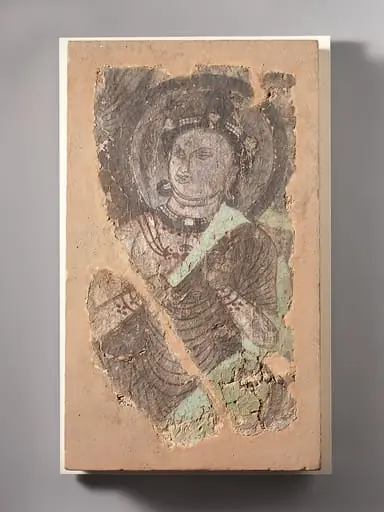
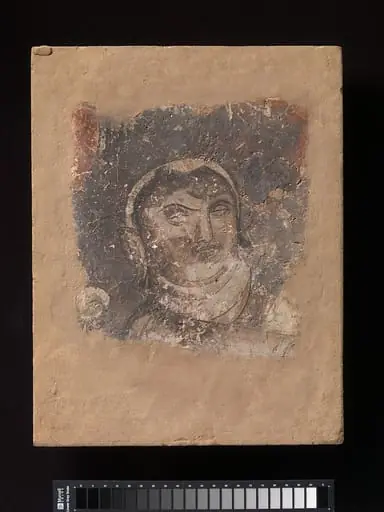
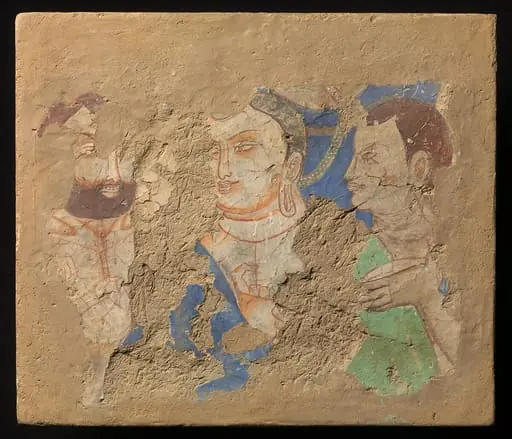
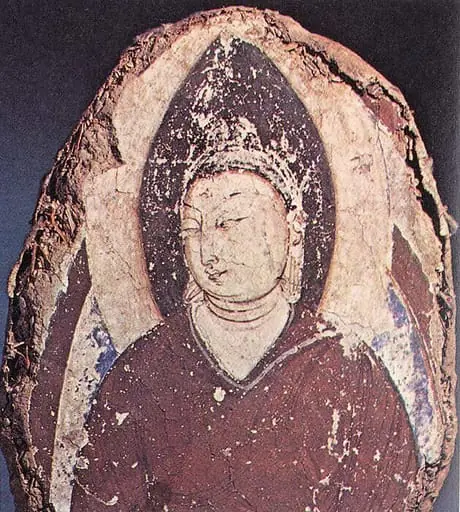
The painting shows a solitary monk standing beside a blooming lotus on a mud-plaster surface. The lotus, a recurring motif in Buddhist visual language, conveys spiritual purity and the emergence of enlightenment from the murky waters of samsara. The monk, identified only by his contemplative posture, represents the ascetic seeker who guides the viewer toward transcendence.
The accompanying figure, rendered as a man, likely functions as a donor or patron, linking the sacred scene to earthly patronage. Together these elements encode a Buddhist narrative of devotion, the pursuit of wisdom, and the protective role of religious figures within the cosmological order.
History & Provenance
The painting is believed to have been created in China during the 6th–7th century. It is executed in pigments on mud plaster and depicts a lotus, a man, and a monk, subjects associated with Buddhist iconography. The work was produced by an anonymous painter, a common practice for religious artworks of the period.
It is held in the collection of the Metropolitan Museum of Art in New York. No documentation regarding its original commission survives, and the early ownership history prior to the museum's acquisition is undocumented. The work measures 81.3 × 37.5 cm.
Context
The painting, dated to the early medieval period (ca. 6th–7th century), is executed in pigments on mud plaster and belongs to the religious genre of Chinese Buddhist art. Its iconography, a lotus, a male figure, and a monk, reflects typical devotional motifs of the era. Scholars studying early Chinese Buddhist visual culture cite such anonymous works as exemplars of the syncretic artistic vocabulary that spread from China to other Asian regions, situating the piece within the broader narrative of Buddhist artistic exchange.
Legacy
The painting, dated to the 6th–7th century, is a religious work on mud plaster depicting a lotus, a man, and a monk. Its iconography aligns with early Buddhist visual motifs and has been examined in scholarly studies of early Chinese religious art. The work is part of the Metropolitan Museum of Art collection, a placement that signals its recognized cultural importance and contributes to its reputation in the history of Asian art.
As an anonymous piece, it continues to inform studies of early medieval Chinese painting and the development of Buddhist visual language.
Overview
This untitled wall painting, created with pigments on mud plaster, depicts three figures in red robes. They stand beside a body of water filled with lotus blossoms. The artwork's remarkable preservation allows its original colors to remain vibrant even after fourteen centuries.
As a painting, it offers insight into ancient artistic practices and religious imagery from its region of origin.
Technique & Style
The enduring vibrancy of this painting's colors is attributed to its distinctive creation method. Unlike many ancient Chinese wall paintings that utilized wet lime plaster, this work was executed on dry mud plaster. This less common technique proved more effective in preserving the pigments over time.
The artist's stylistic choice to depict the lotuses as an abstract pattern further contributes to the artwork's unique visual character.
Artist & collection

- Untitled
 Untitled
 唐/五代 菩薩圖|Banner with Bodhisattva, possibly Mahamayuri
 Buddha in the Preaching Attitude
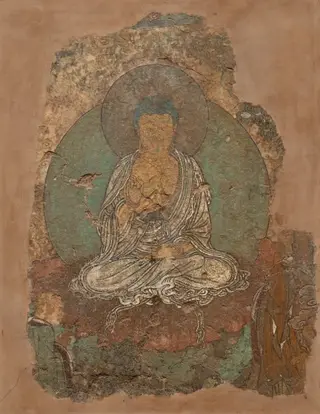 Buddha in the Preaching Attitude
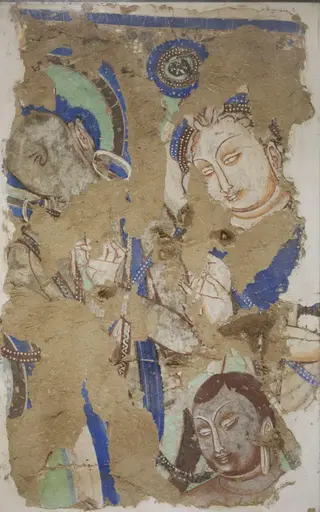 Three Heads (fragment of a wall painting)
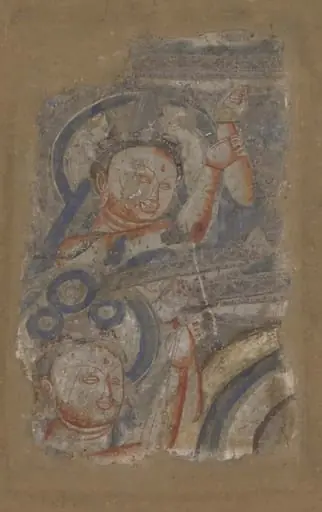 Untitled
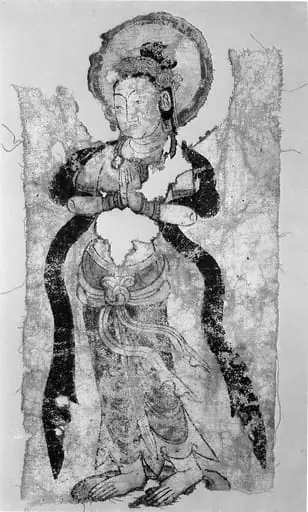 Untitled
 Untitled
 Untitled
 Sudhana and a pair of antelopes, folio 37 (recto) from a Gandavyuha-sutra (Scripture of the Supreme Array)
 Untitled