Artwork
Madonna of the Caves
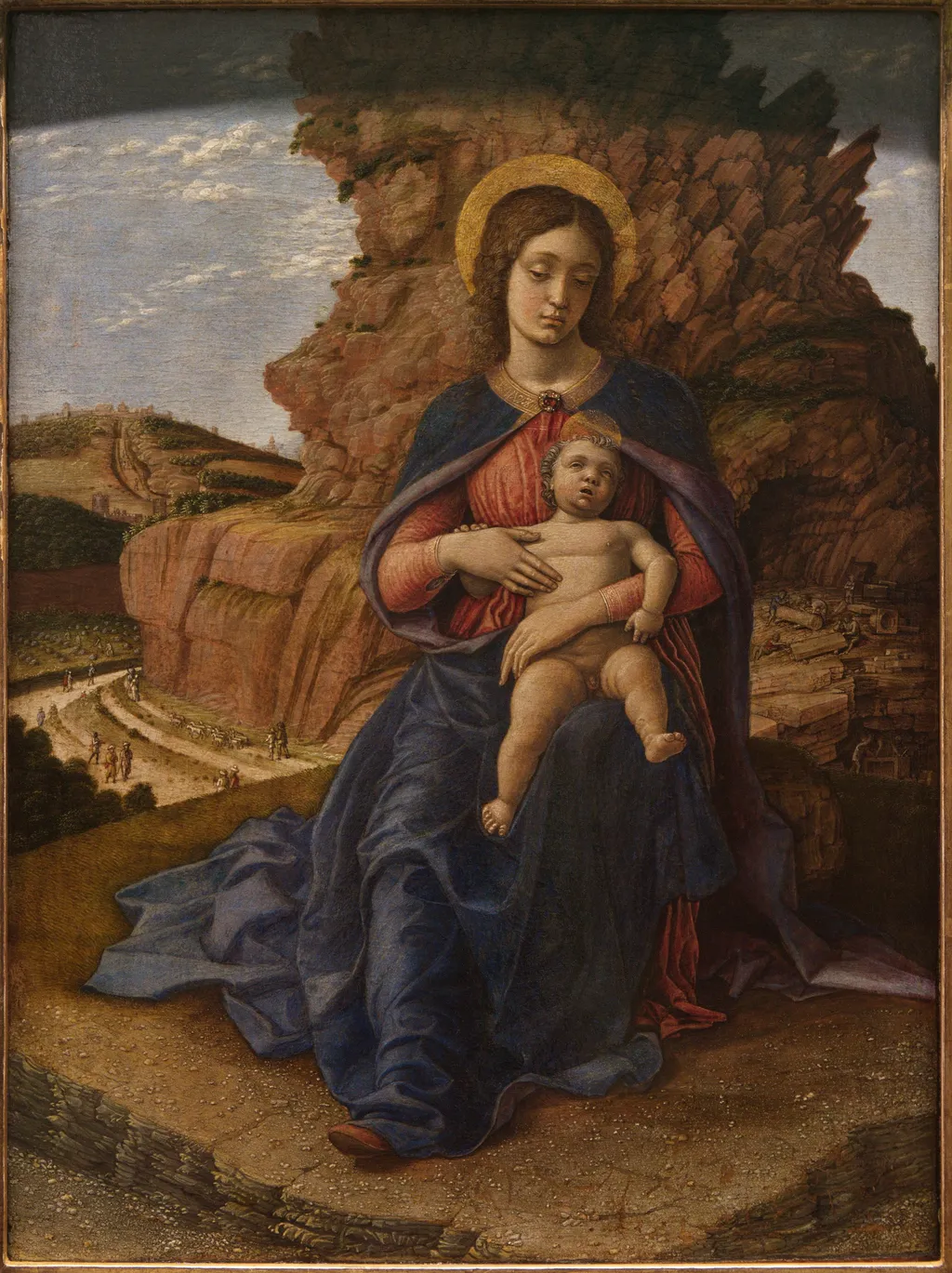
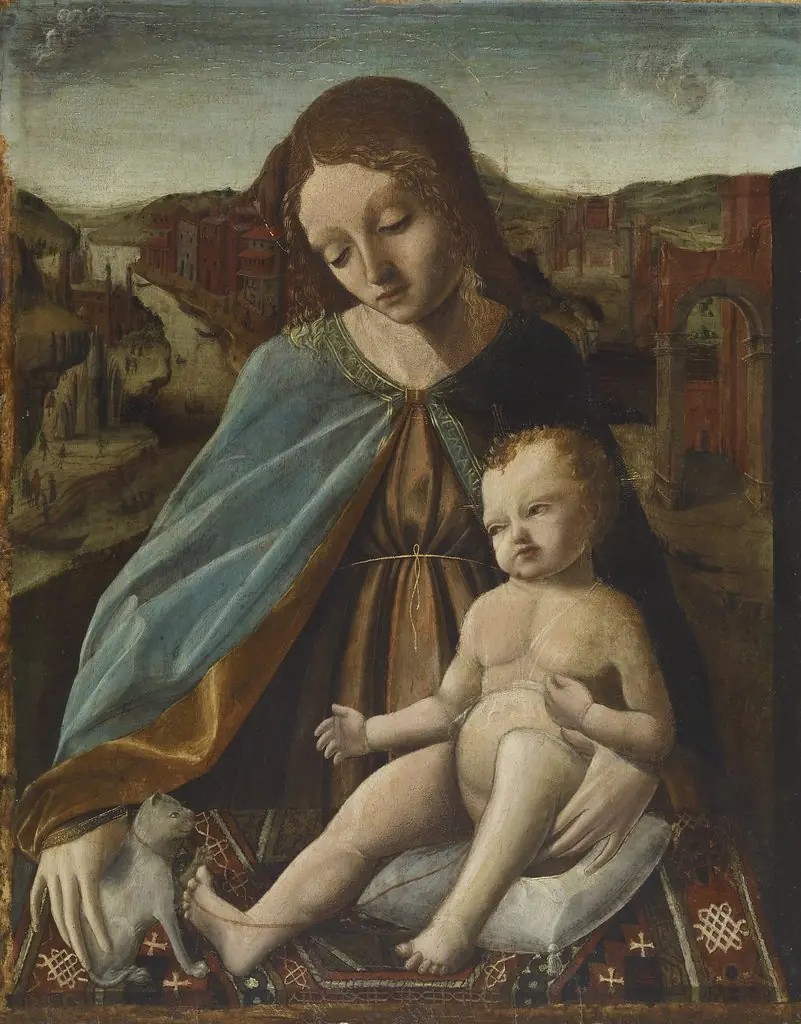
Madonna of the Caves is a tempera painting by the Early Renaissance artist Andrea Mantegna. It dates from 1495 and is held in the collection of the Uffizi Gallery.
About this work
Overview
The painting takes its name from the stone quarry depicted in the right background, where laborers carve architectural elements and a sarcophagus.
Madonna of the Caves is a tempera on panel painting by the Italian Renaissance artist Andrea Mantegna, dated to between 1488 and 1490. Measuring 32 by 29.6 centimeters, this small-scale religious work depicts the Virgin and Child seated before a rugged rocky outcrop. The painting takes its name from the stone quarry depicted in the right background, where laborers carve architectural elements and a sarcophagus. It is currently housed in the Uffizi Gallery in Florence.
Subject & Meaning
The composition centers on the Virgin Mary, dressed in a red robe symbolizing divine love and a deep blue mantle with gold borders, holding the sleeping Christ Child on her lap. Both figures feature circular golden halos. The Virgin gazes downward with a sorrowful expression, reflecting her awareness of Christ's fate. The right background features a stone quarry with workers carving a slab, a column shaft, a capital, and a sarcophagus, alluding to the Flagellation and the Entombment. The rock on which Mary sits may represent the summit of Calvary. In the left background, pastoral scenes unfold with a shepherd, a flock, farmers harvesting hay, a castle, and a road leading to a walled city. The transition from deep shadow on the right to light on the left has been interpreted as an allegory of redemption through Christ and the Church, with Mary as the mother of both.
Technique & Style
Executed in tempera on a wooden panel, the painting demonstrates Mantegna's precise handling and detailed brushwork, which Vasari noted required a fine brush. The surface exhibits fine craquelure throughout. Flesh tones are smoothly blended, while the drapery and rocks receive a more textured, layered application of paint. Light falls from the upper left, illuminating the faces of the figures and the distant landscape while casting the right side in deep shadow. The vertical emphasis of the massive, sharply carved reddish-brown rock formation dominates the composition, framing the Virgin. The geological formations are rendered with Mantegna's characteristic intensity, described by scholars as resembling a blaze of schistose stone illuminated by the vibrations of sunset. The small format and meticulous detail have led some historians to cite the work as evidence of Flemish influence on the artist.
History & Provenance
The dating of the work to 1488 through 1490 relies on Giorgio Vasari's description of the collections of Francesco I de' Medici, who owned the painting. Vasari attributed the work to Mantegna's stay in Rome, where the artist was working on frescoes for the Belvedere Villa of Pope Innocent III in the Vatican. Some scholars have linked the panel to a work commissioned by Lorenzo de' Medici, mentioned in correspondence from 1484. The painting entered the Uffizi Gallery in Florence, where it has been documented in the collection since at least 1704.
Context
The painting was created during or shortly after Mantegna's Roman period, reflecting his deepening engagement with antiquity, visible in the quarry workers carving classical architectural elements. Scholars have debated the specific landscape depicted, with Fiocco proposing the mountains around Carrara and Kristeller identifying it as Monte Bolca near Ronca, between Vicenza and Verona. More abstract interpretations include Andreas Hauser's reading of the basaltic rocks as a volcanic Christ symbolizing the source of spiritual life. Dating Mantegna's works remains challenging because he repeatedly reused themes like rocky backgrounds throughout his career, making chronological certainty difficult for undated panels.
Own this work as a print
Artist & collection
Artist
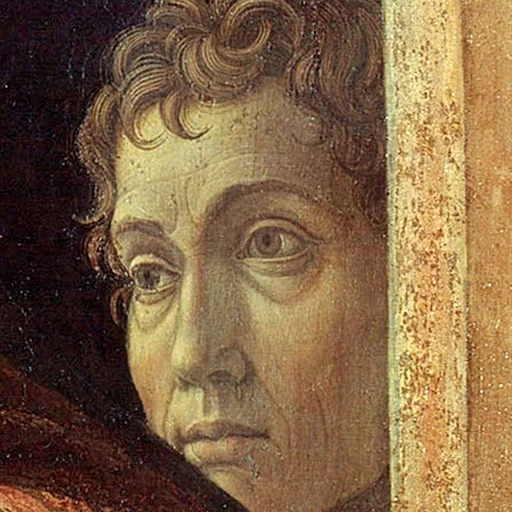
Andrea Mantegna (UK: US:; Italian:; c. 1431 – September 13, 1506) was an Italian Renaissance painter, a student of Roman archaeology, and the son-in-law of Jacopo Bellini. Like other artists of the time, Mantegna…