Artwork
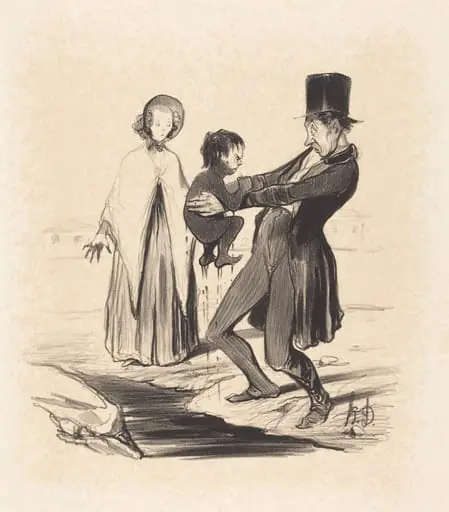
Une Terrible rencontre
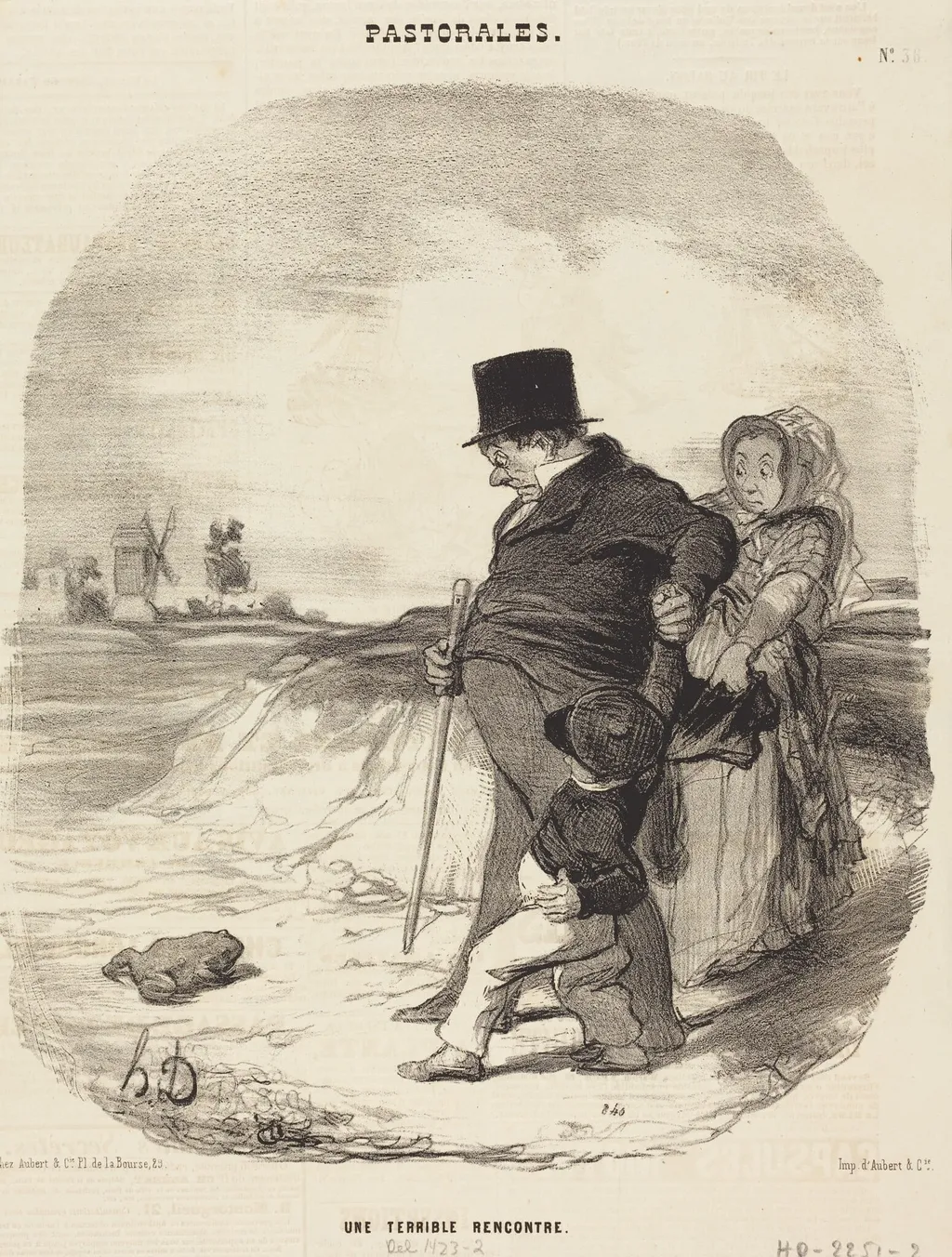
Une Terrible rencontre is an ink print by the Romanticist artist Honoré Daumier. It dates from 1845 and is held in the collection of the National Gallery of Art.
About this work
Overview
Its informal medium and urgent style reflect Daumier’s commitment to social commentary through accessible, widely distributed imagery.
Created in 1845, Une Terrible rencontre is a lithograph on newsprint by Honoré Daumier, part of a broader series of satirical prints published in French periodicals like La Caricature and Le Charivari. Executed with rapid, expressive lines, the work captures a moment of tension between two figures near a riverbank. Its informal medium and urgent style reflect Daumier’s commitment to social commentary through accessible, widely distributed imagery.
Subject & Meaning
The scene portrays an elderly man in formal attire, leaning on a cane and clutching a bag, locked in a strained interaction with a younger, wrapped figure. The title suggests an unsettling encounter, possibly symbolic of generational conflict, economic dependency, or the burden of inherited privilege. Daumier avoids explicit narrative, instead inviting viewers to interpret the emotional weight of the moment through posture and gesture.
Technique & Style
Daumier employed lithography to achieve a spontaneous, sketch-like quality, using coarse, uneven lines that mimic the immediacy of drawing. The rough texture of newsprint enhances the work’s rawness, contrasting with the polished finishes of academic art. His exaggerated forms and minimal background detail focus attention on the psychological tension between the figures, a hallmark of his caricatural approach.
History & Provenance
The print originated in the vibrant press culture of 1840s France, where Daumier regularly contributed to satirical journals critical of the July Monarchy. Though the original publication context is lost, the work survives as part of collections preserving Daumier’s journalistic prints. Its survival on fragile newsprint underscores its ephemeral origins and the risk involved in producing politically charged imagery under censorship.
Context
Produced during a period of political unrest following the 1830 Revolution, Daumier’s prints responded to rising class tensions and public disillusionment with elite power. Une Terrible rencontre reflects broader anxieties about social hierarchy and moral decay, using intimate scenes to critique institutions without direct caricature of specific figures. The riverbank setting may allude to the fluid, unstable nature of French society at the time.
Legacy
Daumier’s lithographs, including this one, helped redefine printmaking as a vehicle for social critique rather than mere illustration. His influence extended to later generations of realist and expressionist artists who valued emotional honesty over idealization. Though initially dismissed as journalistic, these works are now recognized for their psychological depth and formal innovation in depicting everyday conflict.
Own this work as a print
Artist & collection
Artist
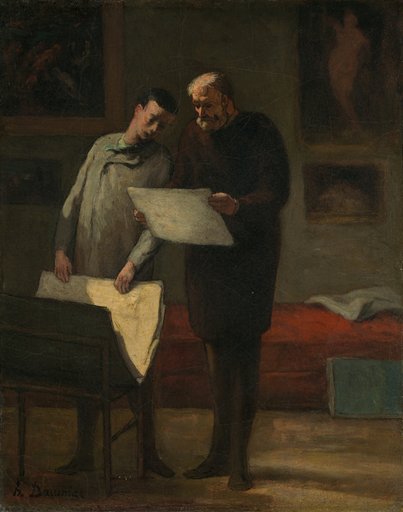
Honoré-Victorin Daumier (French: ; 26 February 1808 – 10 or 11 February 1879) was a French painter, sculptor, and printmaker, whose many works offer commentary on the social and political life in France, from the…









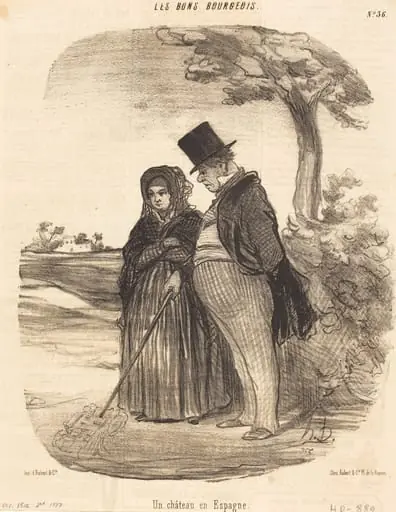 Un Chateau en Espagne
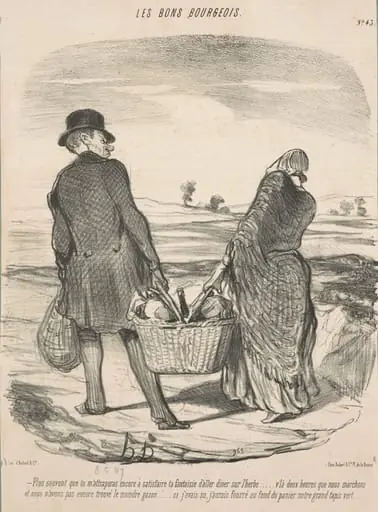 Plus souvent que tu m'attraperas encore à satisfaire ta fantaisie d'aller dîner sur l'herbe . . . V'là deux heures que nous marchons et nous n'avons pas encore trouvé le moindre qazon . . . Si j'avais su, j'aurais fourré au fond du panier notre grand tapis vert.
 Le Puits de Grenelle
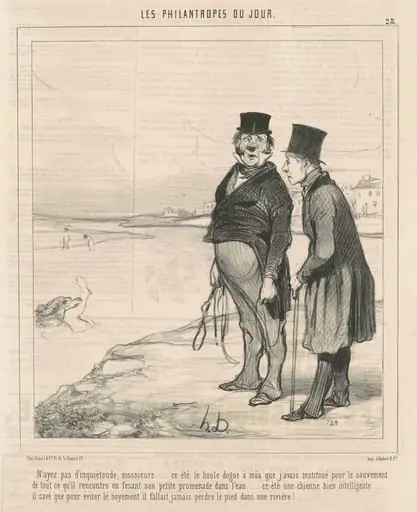 N'ayez pas d'inquiètoude ...
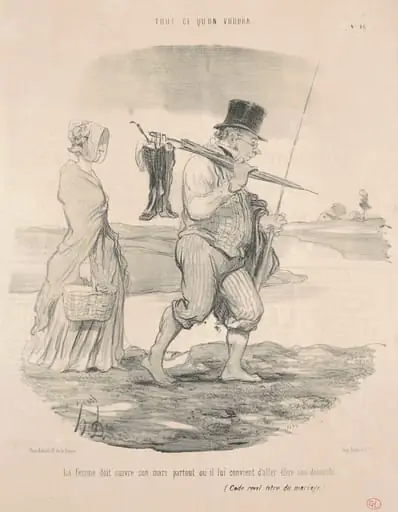 La femme doit suivre son mari ...
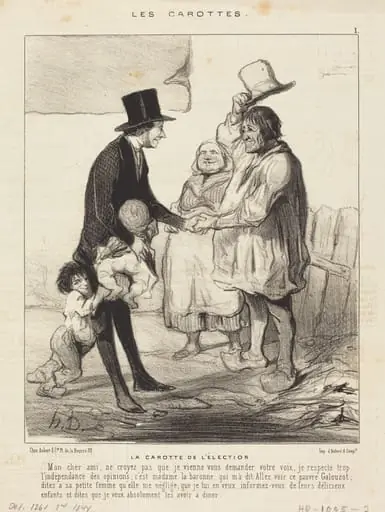 La Carotte de l'élection
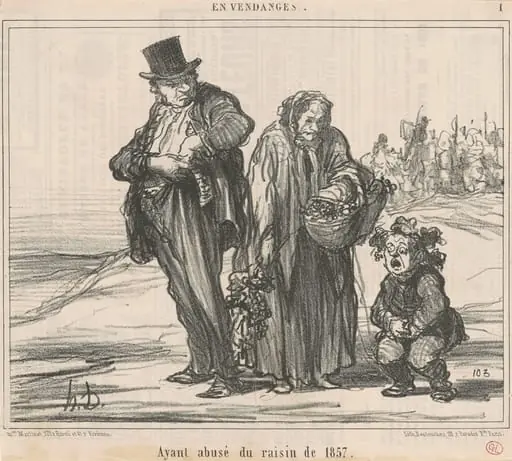 Ayant abusé du raisin de 1857
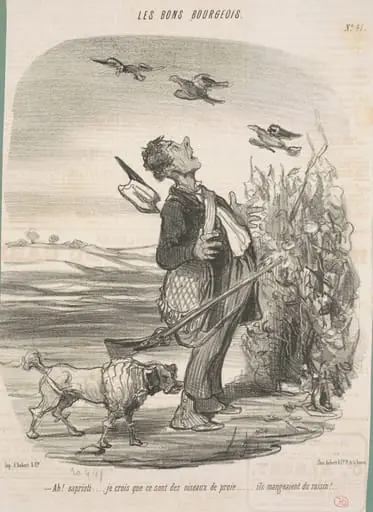 Ah! ... Je crois que ce sont des oiseaux de proie ...