Artwork
Woman Viewed from Behind (Visit to a Museum)
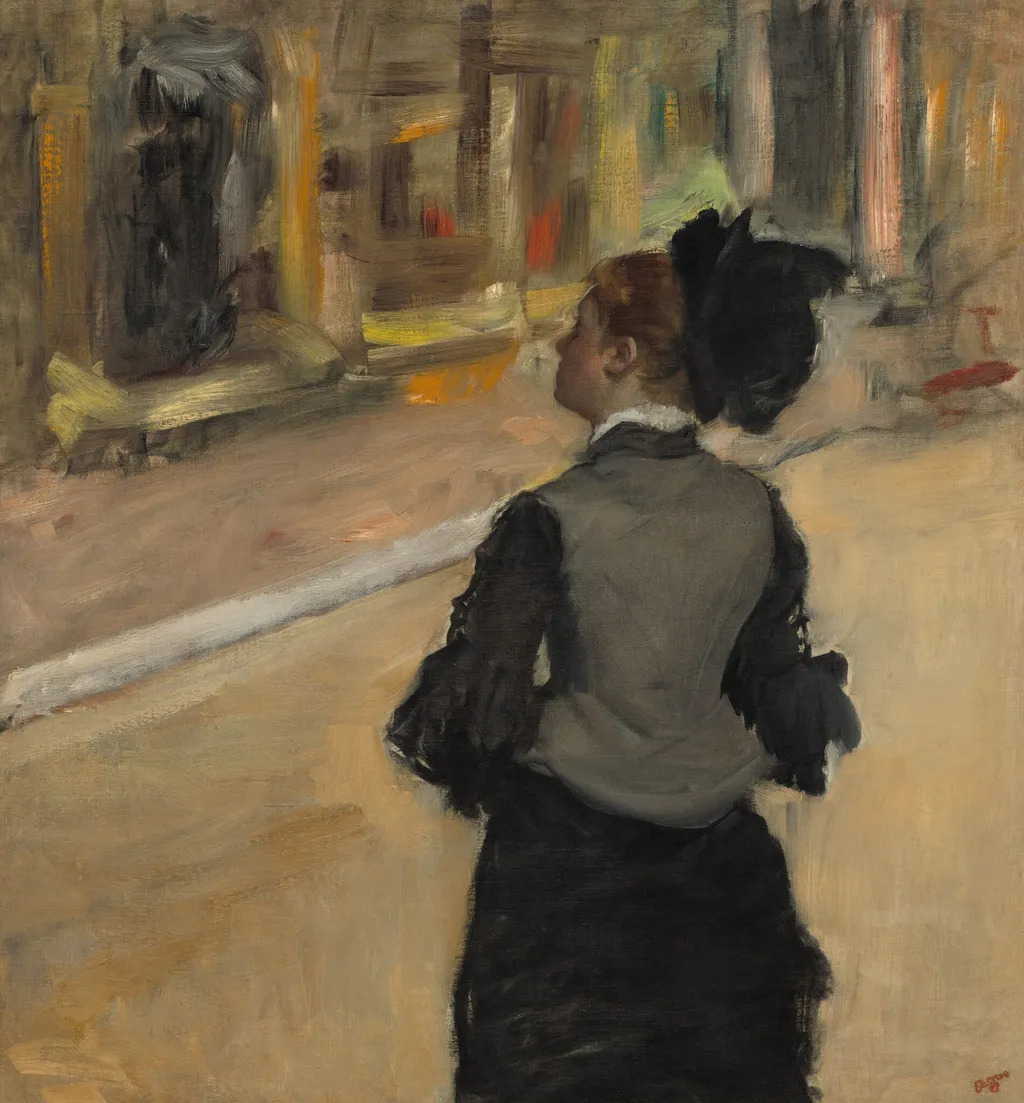
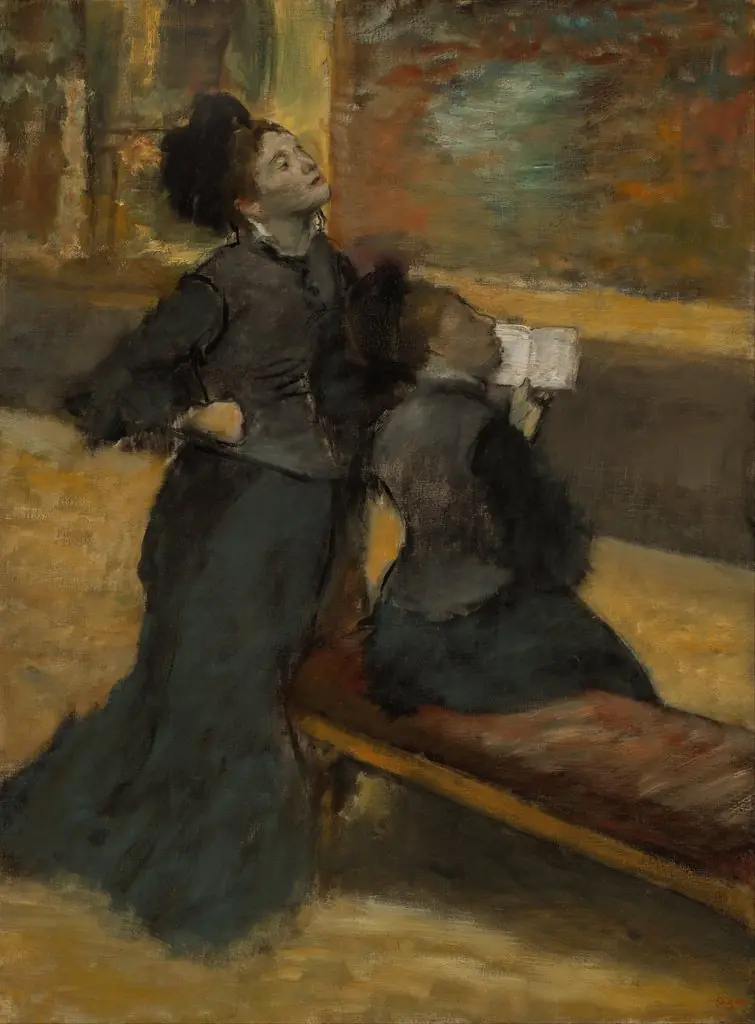
Woman Viewed from Behind (Visit to a Museum) is an oil painting by the Impressionist artist Edgar Degas. It dates from 1882 and is held in the collection of the National Gallery of Art.
- Inscription
- Inscribed:lower right: Degas
About this work
Overview
6 centimeters (32 by 29 3/4 inches), the work is held in the collection of the National Gallery of Art in Washington, D.
Woman Viewed from Behind (Visit to a Museum) is an oil on canvas painting by the French artist Edgar Degas, dated circa 1879-1885, with the National Gallery of Art giving a more precise range of 1879-1885 and other sources noting 1882. Measuring 81.3 by 75.6 centimeters (32 by 29 3/4 inches), the work is held in the collection of the National Gallery of Art in Washington, D.C., where it is displayed in the West Building Main Floor, Gallery M89. The painting is significant as a key example of Degas's sustained exploration of women in museum and gallery settings during the 1880s, and for its sophisticated meditation on the act of looking that prefigures central concerns of modern art.
Subject & Meaning
The painting depicts a woman seen from behind and slightly to the left, standing in what appears to be the Louvre Museum in Paris. She wears a dark skirt, a gray fitted jacket with black sleeves, and a large black bow or hat atop her auburn hair, with her hands tucked behind her back. Before her, strips of yellow and orange suggest the frames of paintings she is inspecting, though the artworks themselves are rendered as a blur of colors. The National Gallery of Art identifies the figure as likely Mary Cassatt, the American painter and Degas's close friend and fellow artist, an identification supported by other sources that note Cassatt served as Degas's model for several works in this series. The composition raises fundamental questions about spectatorship: what the woman sees, whether she knows she is being observed, and whether the viewer privileged with this rear view can truly access her experience. This thematic focus on the psychology and politics of looking aligns the work with Degas's broader interest in contemporary social life and the complex dynamics of public and private seeing.
Technique & Style
Executed in oil on canvas, the painting displays the loose, visible brushwork and soft, atmospheric handling characteristic of Degas's mature style. The palette is restrained, consisting of muted earth tones, grays, blacks, and touches of ochre and green, with diffused light that avoids harsh shadows and contributes to a hazy, contemplative mood. Edges are deliberately softened, and the overall effect is notably unfinished, a quality that has drawn scholarly attention to Degas's working methods and his deliberate manipulation of finish. The background dissolves into indistinct forms, with a dark vertical element to the left that suggests a statue or large figure, while the foreground figure remains the clear compositional focus. This technique of blurring the ostensible subject of attention, the artworks on the wall, while sharpening the figure who looks, inverts conventional expectations and demonstrates Degas's innovative approach to genre painting. A small red monogram, reading Degas, appears in the lower right corner.
History & Provenance
The painting remained in Degas's possession until his death in 1917. It was sold at the Degas studio sale at the Galerie Georges Petit, Paris, on 11 December 1918, as lot number 20. By 1935 it had entered the collection of Mme. Friedmann in Paris, and by inheritance passed to Mme. René Dujarric de la Rivière of Boulogne, France, by 1960, as indicated by a label on the reverse recording her loan of the work to the 1960 Durand-Ruel exhibition. The painting was subsequently handled by Wildenstein and Co., New York, who sold it in 1973 to Mr. Paul Mellon of Upperville, Virginia. Mellon gifted the work to the National Gallery of Art in 1985, where it entered the collection as accession number 1985.64.11. The painting has been exhibited extensively, including at the Gazette des Beaux-Arts, Paris, in 1955; Durand-Ruel, Paris, in 1960; the Virginia Museum of Fine Arts in 1978 and 1979; the National Gallery of Art in 1986; the Grand Palais, Paris, the National Gallery of Canada, Ottawa, and The Metropolitan Museum of Art, New York, in 1988-1989; the Kunsthaus Zürich in 1994-1995; the J. Paul Getty Museum in 1998; and in several subsequent exhibitions through 2017.
Context
The painting belongs to a series of works Degas produced in the 1880s depicting women in museum and gallery settings, a subject contemporaneous with his close friendship with Mary Cassatt. Degas had invited Cassatt to join the Impressionist group in 1877, and around 1879-1880 the two artists socialized together, worked together, and collected each other's art. While not romantically involved, their professional relationship was exceptionally close and mutually influential. The choice of the Louvre as setting carries personal resonance for Degas, who had registered as a copyist there in 1853 and who revered the Old Masters he encountered in its galleries. The work also reflects his broader trajectory from aspiring history painter, trained in rigorous academic methods and deeply influenced by Jean-Auguste-Dominique Ingres, to a painter of modern life who applied classical discipline to contemporary subjects. Critical and scholarly attention to the painting has focused on its unresolved finish and its interrogation of visual experience, with recent conservation and art historical study examining Degas's deliberate manipulation of surface and completion as a meaningful aspect of his practice.
Legacy
Woman Viewed from Behind (Visit to a Museum) has maintained its significance as a touchstone for understanding Degas's engagement with themes of spectatorship and the social rituals of art viewing. Its inclusion in major retrospectives and scholarly exhibitions, including the 1988-1989 Degas exhibition that traveled to Paris, Ottawa, and New York, and the 2014 Degas/Cassatt exhibition at the National Gallery of Art, attests to its centrality in the artist's oeuvre. The painting's exploration of the figure seen from behind, with the attendant questions of access, knowledge, and gendered looking it raises, has made it a productive object for art historical analysis concerned with the construction of the gaze in nineteenth-century French painting. Its place in the collection of the National Gallery of Art, following Paul Mellon's distinguished patronage, ensures continued public access and scholarly attention. The work's influence extends to broader discussions of museum experience and the representation of cultural institutions in art, themes that remain vital in contemporary visual culture.
Own this work as a print
Artist & collection
Artist
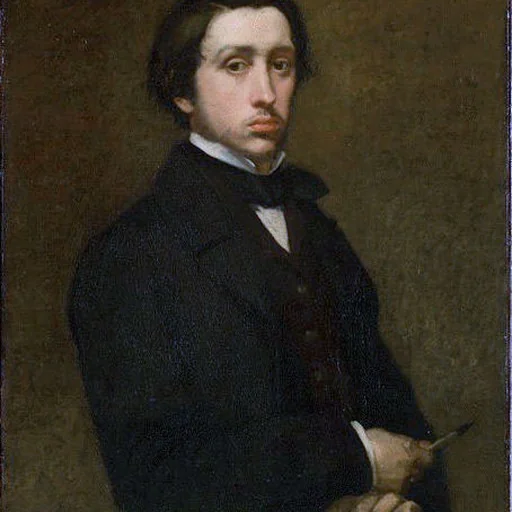
Born Hilaire-Germain-Edgar De Gas on 19 July 1834 in Paris, Edgar Degas came from an affluent banking family with aristocratic roots and spent his childhood among the cultivated circles of the French capital.