Artwork
Portrait of Francisco Lezcano
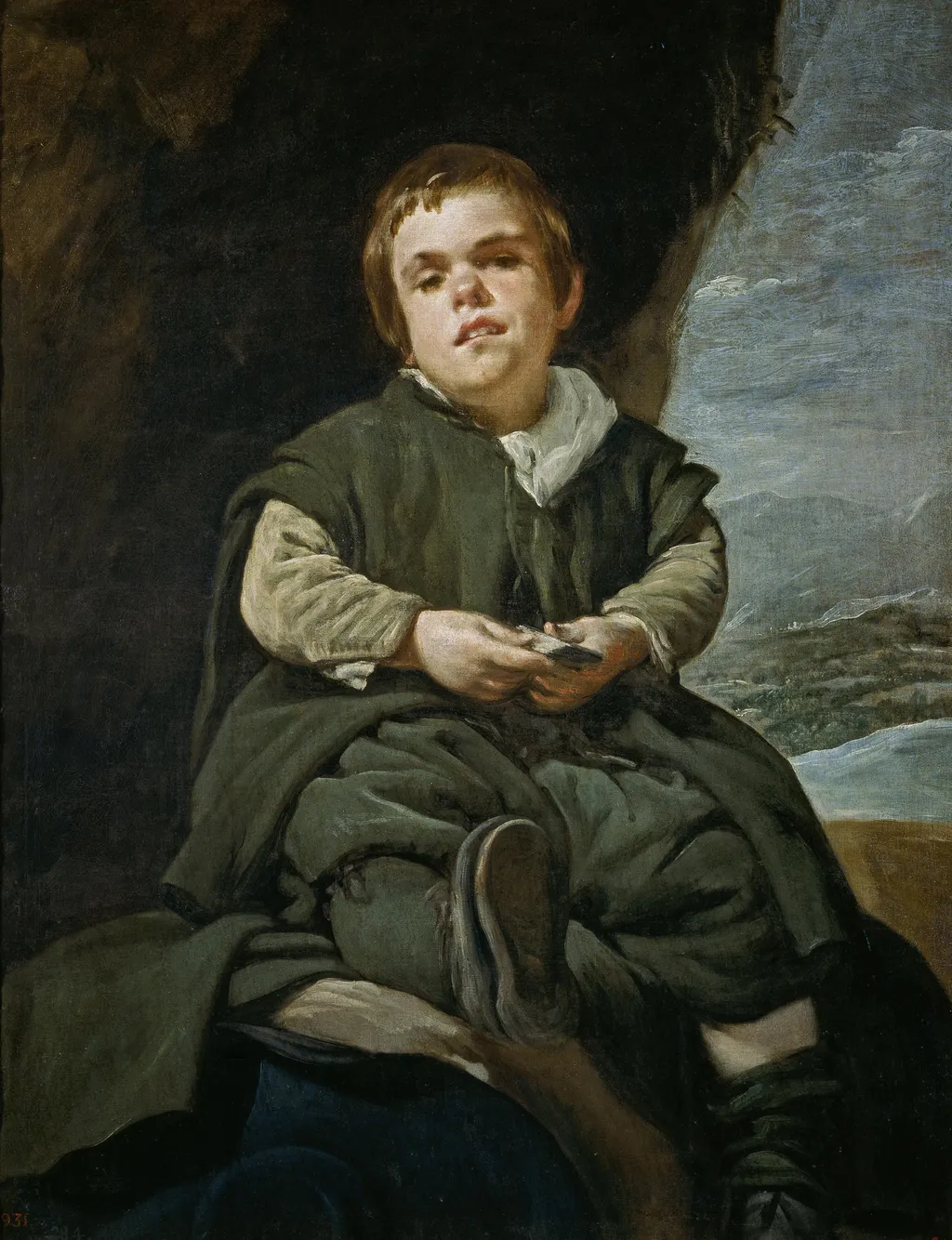
Portrait of Francisco Lezcano is an oil painting by the Early Baroque Italian artist Diego Velázquez. It dates from 1634 and is held in the collection of the Museo del Prado.
About this work
Subject & Meaning
The cards function as a symbol of idleness, though other commentators have suggested the object could be a piece of bread or a tile fragment.
The painting portrays Francisco Lezcano, a dwarf and jester (also called Lezcanillo or el Vizcaíno) who served at the court of Philip IV of Spain and died in 1649. He is shown seated on a rock in hunting attire, with the Sierra de Guadarrama visible behind him, holding playing cards in his hands. The cards function as a symbol of idleness, though other commentators have suggested the object could be a piece of bread or a tile fragment. Velázquez deliberately contrasts Lezcano's vacant, unfocused gaze and idle play with that of his companion piece El Primo, who is depicted reading a thick folio, thereby emphasizing the jester's languor. The hunting costume and low viewpoint were likely tied to the work's original destination as an over-door decoration at the Torre de la Parada, a royal hunting lodge.
Identification of the sitter with Lezcano is not certain: the name "Niño de Vallecas" applied in late-eighteenth-century inventories does not correspond to the Basque Lezcano or to any other known court jester, and the attribution was only adopted in the Prado's 1942 catalogue.
Technique & Style
The painting is an oil on canvas with dimensions 107 × 83 cm. Velázquez employed a rapid, direct execution, building the head and hands with softly blended, deliberately blurred passages achieved by repeatedly reworking wet paint, leaving fingers indicated only by directional vermilion mercury strokes. The composition shows the sitter seated on a rock in an outdoor setting, holding playing cards, set against a schematic landscape of the Sierra de Guadarrama rendered with loose, diluted pigments applied over a greyish ground. The costume, a green hunting tabard over a rumpled shirt, is handled with textured, almost careless brushwork, contrasting with the attenuated contrapposto of the right leg extended toward the viewer.
History & Provenance
Diego Velázquez painted Portrait of Francisco Lezcano in 1634, as recorded in the work’s cataloguing and described across museum and scholarly sources. The painting was created for display at the Torre de la Parada, a hunting lodge near Madrid, and was later moved to the Palacio del Pardo in 1714 before entering the Royal Palace in Madrid by 1772. It entered the Museo del Prado in 1819 and was first listed in the museum’s inaugural catalogue. Ownership passed through the Spanish court, notably belonging to Ferdinand VII of Spain, and it remained in the Prado’s collection thereafter. The work is an oil on canvas measuring 107 by 83 cm and depicts a jester holding playing cards, possibly symbolizing idleness. Its provenance includes being paired with a portrait of Don Diego de Acedo and later being referred to as Niño de Vallecas in 1794 inventories. The attribution to Francisco Lezcano, a court dwarf documented in service to Prince Baltasar Carlos from 1634 until his death in 1649, was solidified in the Prado’s 1942 catalogue, though earlier records expressed uncertainty about the sitter’s identity.
Portrait of Francisco Lezcano is held in the Museo del Prado in Madrid, where it has been since 1819. The inventory or accession number is not specified in the sources, but the work was first listed in the museum’s 1819 catalogue as “Una muchacha boba” and later renamed Niño de Vallecas. Its exhibition history includes a move on 28 July 1714 to the Palacio del Pardo, a display in 1772 at the home of Infante Javier in the new Palacio Real, and inclusion in the “Pieza de Trucos” inventory of 1794. The painting entered the Prado collection in 1819 and has remained in the museum’s permanent display since then.
Context
The portrait has long been discussed within Velázquez’s courtly series of jesters, where it is paired with Don Diego de Acedo in both the Torre de la Parada and later Bourbon collections. Early scholarship often cited the sitter as “Niño de Vallecas,” a nickname tied to court inventories beginning in 1794, but this identification was challenged in 1885 by Gregorio Cruzada Villaamil. The association with Francisco Lezcano, a Basque dwarf admitted to the service of Prince Baltasar Carlos in 1634, gained traction after 1942 and is now widely accepted, despite lingering uncertainty about the exact date of execution. Technical and stylistic analyses situate the work among Velázquez’s hunting-lodge commissions for Philip IV, aligning its muted Guadarrama landscape and green hunting attire with the Torre de la Parada ensemble. Jonathan Brown proposed a date of 1636-1638, while José López-Rey and others have considered a later 1644 context linked to the prince’s Aragonese journey. The painting’s rapid, blurred handling, especially in the hands and face, reflects an evolving technique that culminates in later court jester portraits such as Calabacillas.
Legacy
The Portrait of Francisco Lezcano has been recognized as a significant example of Velázquez’s court jesters series since at least the early 18th century, when it was installed at the Palacio del Pardo. Its later reputation was shaped by 18th‑century inventories that labeled the work “Niño de Vallecas,” a title that persisted until scholarly reassessment in the late 19th century. The identification with Francisco Lezcano was only formally proposed in the 1942 Prado catalogue and has since become the generally accepted attribution. The painting’s pairing with Don Diego de Acedo in multiple royal collections reinforced its status as a key ensemble within Velázquez’s late portraiture, influencing later studies of the artist’s technical evolution and court imagery.
Own this work as a print
Artist & collection
Artist
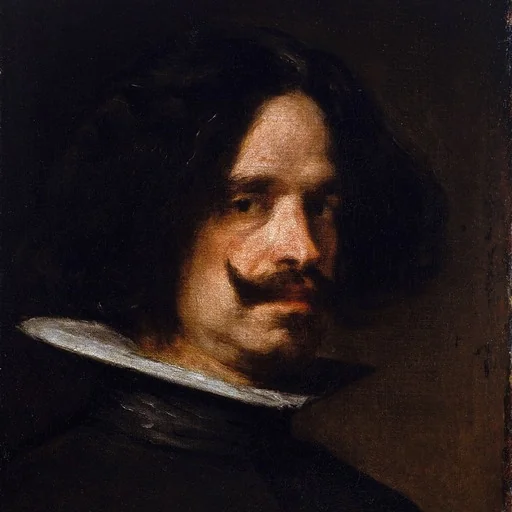
Diego Rodríguez de Silva y Velázquez was a Spanish Baroque painter, the leading artist in the court of King Philip IV of Spain and Portugal, and of the Spanish Golden Age.