Artwork
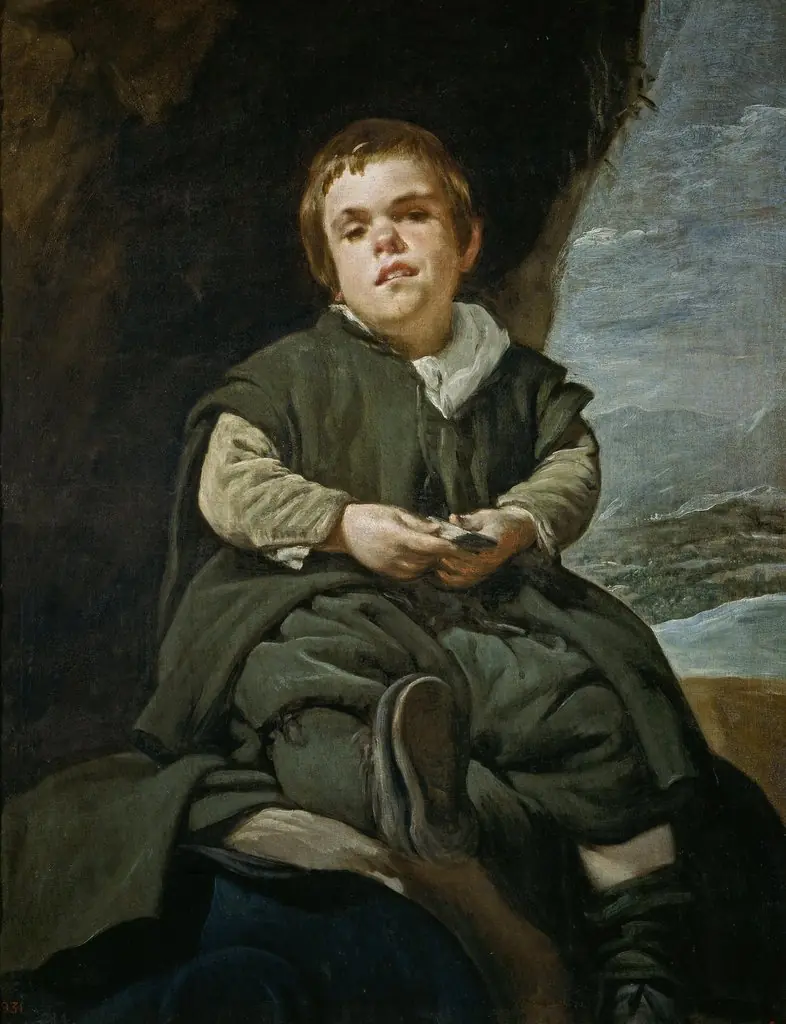
Portrait of Sebastián de Morra
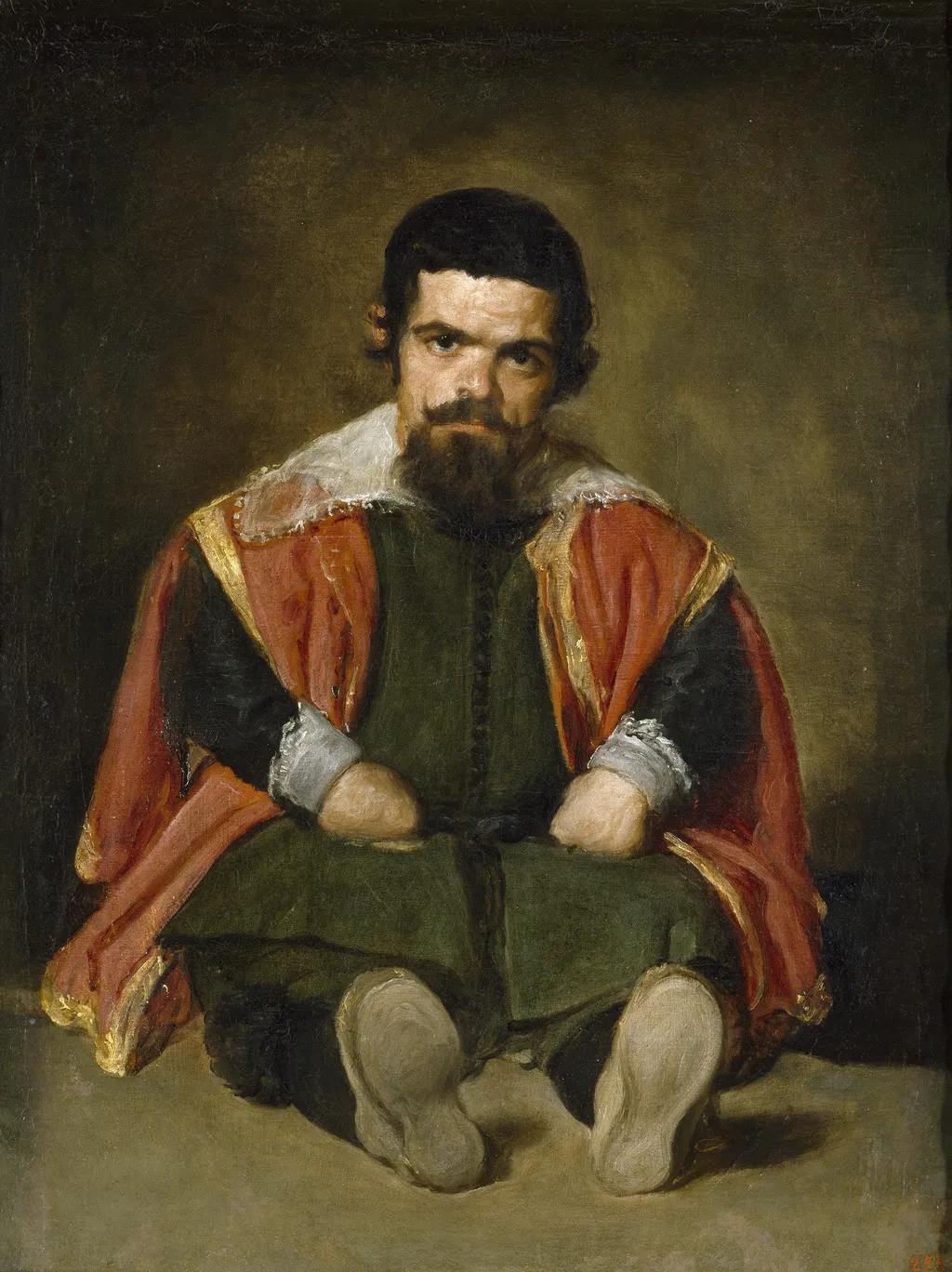
Portrait of Sebastián de Morra is an oil painting by the Early Baroque Italian artist Diego Velázquez. It dates from 1644 and is held in the collection of the Museo del Prado.
About this work
Subject & Meaning
Velázquez portrayed De Morra seated on the ground against a plain dark background, with no objects, companions, or attributes in sight.
The painting depicts Sebastián de Morra, a court dwarf and jester who served Philip IV of Spain. Acquired by the king in 1643 from his brother Cardinal Infante Fernando, De Morra was assigned to Prince Baltasar Carlos as an entertainer until the prince's death in 1646; he himself died in 1649 after six years at court. He was also known by the nickname El Primo.
Velázquez portrayed De Morra seated on the ground against a plain dark background, with no objects, companions, or attributes in sight. The figure stares directly at the viewer, motionless, with clenched fists on his hips and legs fully extended. This frontal, isolated pose, combined with the absence of the symbolic objects typically given to court dwarfs, has led one critic to read the portrait as a denunciation of the court's treatment of De Morra and other dwarfs. The contrast between the festive green-and-red livery and the somber expression underscores the tension between his role as entertainer and his evident discontent. The painting belongs to a broader tradition of court dwarfs known as sabandijas, who were historically portrayed as obedient property of their masters; Velázquez's warmer, naturalistic approach marked a departure from earlier depictions of dwarfs as symbolic or dehumanized figures.
Technique & Style
Velázquez painted the portrait directly, without preparatory drawing or significant compositional changes. The oil-on-canvas work measures 106.5 × 82.5 cm, though it was originally closer to square and later cut down after a fire. Technical studies show the canvas was once fitted to an oval stretcher, with missing corner pieces and irregular cuts likely resulting from the 1734 fire at the Real Alcázar.
The support is unusual for this period: the canvas includes added strips reused from an earlier painting showing a Sierra de Guadarrama landscape, making the preparation experimental. The brown-gray background was worked with highly diluted pigments, creating a luminous halo around the figure. Both face and hands were painted quickly and summarily, producing a deliberately blurred effect. The green costume was darkened with black for the sleeves and buttonholes, while decorative gold borders were applied with precise brushwork over earlier color layers. The subject is shown frontally, motionless against a plain dark background, with light entering from the left to cast the right side of his face in shadow.
History & Provenance
Painted circa 1644, this portrait depicts Sebastián de Morra, a court dwarf who arrived in Madrid in 1643 to serve Prince Baltasar Carlos until the prince's death in 1646. Technical analysis of the canvas weave links the work to Velázquez's presence in Fraga during 1644, suggesting it was created alongside a portrait of Philip IV.
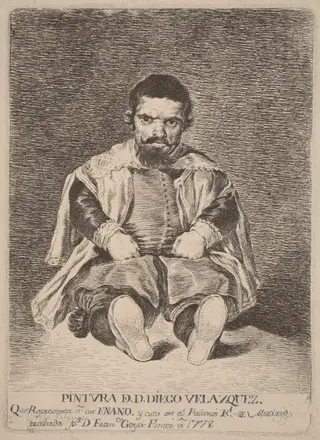
The painting first appeared in the 1666 inventory of the Royal Alcázar, valued at one hundred ducats. It survived the 1734 fire that destroyed the palace, though it was cut down from a larger format and later extended with added strips of canvas. By 1772, the work hung in the Royal Palace, where Francisco Goya copied it in 1778.
The piece entered the Museo del Prado upon its opening in 1819. While initially cataloged simply as a seated dwarf, Pedro de Madrazo tentatively identified the subject as Sebastián de Morra in an 1872 catalogue, an attribution generally accepted despite some scholarly debate regarding the identity of the sitter versus another dwarf known as El Primo.
The painting is currently held by the Museo del Prado in Madrid, where it has been located since the museum's opening in 1819. Historical records first cite the work in the 1666 inventory of the Alcázar de Madrid, listing it in the staircase of the Galería del Cierzo. Following the catastrophic fire of 1734 that destroyed the Alcázar, the canvas survived but was later documented in a 1747 memorial as having been transferred to the Palace of the Buen Retiro. By 1772, the portrait resided in the Royal Palace of Madrid, where Francisco Goya created an etching of it in 1778. In 1834, the Prado catalogued the piece simply as a dwarf seated on the floor before Pedro de Madrazo formally identified the sitter as Sebastián de Morra in his 1872 catalogue. The work was also included in the Rembrandt-Velázquez exhibition.
Context
Velázquez's portrait of Sebastián de Morra occupies a significant place in art history as part of his celebrated series of court dwarf and jester portraits, which scholars distinguish from his classical works. Art historian Enriqueta Harris argued these dwarf portraits did not belong alongside his classical paintings, though critic Catherine Closet-Crane contended they were intended to be seen with other Velázquez portraits, even suggesting parallels with Rubens's philosopher portraits. The painting exemplifies Velázquez's shift toward naturalism after becoming court painter, departing from the cold, dehumanizing treatment of dwarfs by earlier Spanish court artists. One critic has interpreted de Morra's direct, motionless gaze, devoid of hand gestures, as a subtle denunciation of court exploitation. Technical scholarship has revealed experimental aspects: the canvas was reused from an earlier landscape painting, and Velázquez worked without preparatory drawings. The Thread Count Automation Project demonstrated that this portrait and Philip IV's were painted from the same cloth in Fraga during 1644. The canvas was later altered, with evidence of oval framing and fire damage from the 1734 Alcázar fire.
Own this work as a print
Artist & collection
Artist
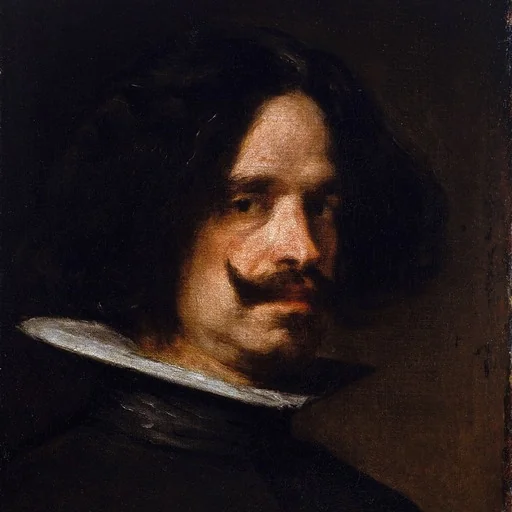
Diego Rodríguez de Silva y Velázquez was a Spanish Baroque painter, the leading artist in the court of King Philip IV of Spain and Portugal, and of the Spanish Golden Age.