Artwork
View of the Garden of the Villa Medici
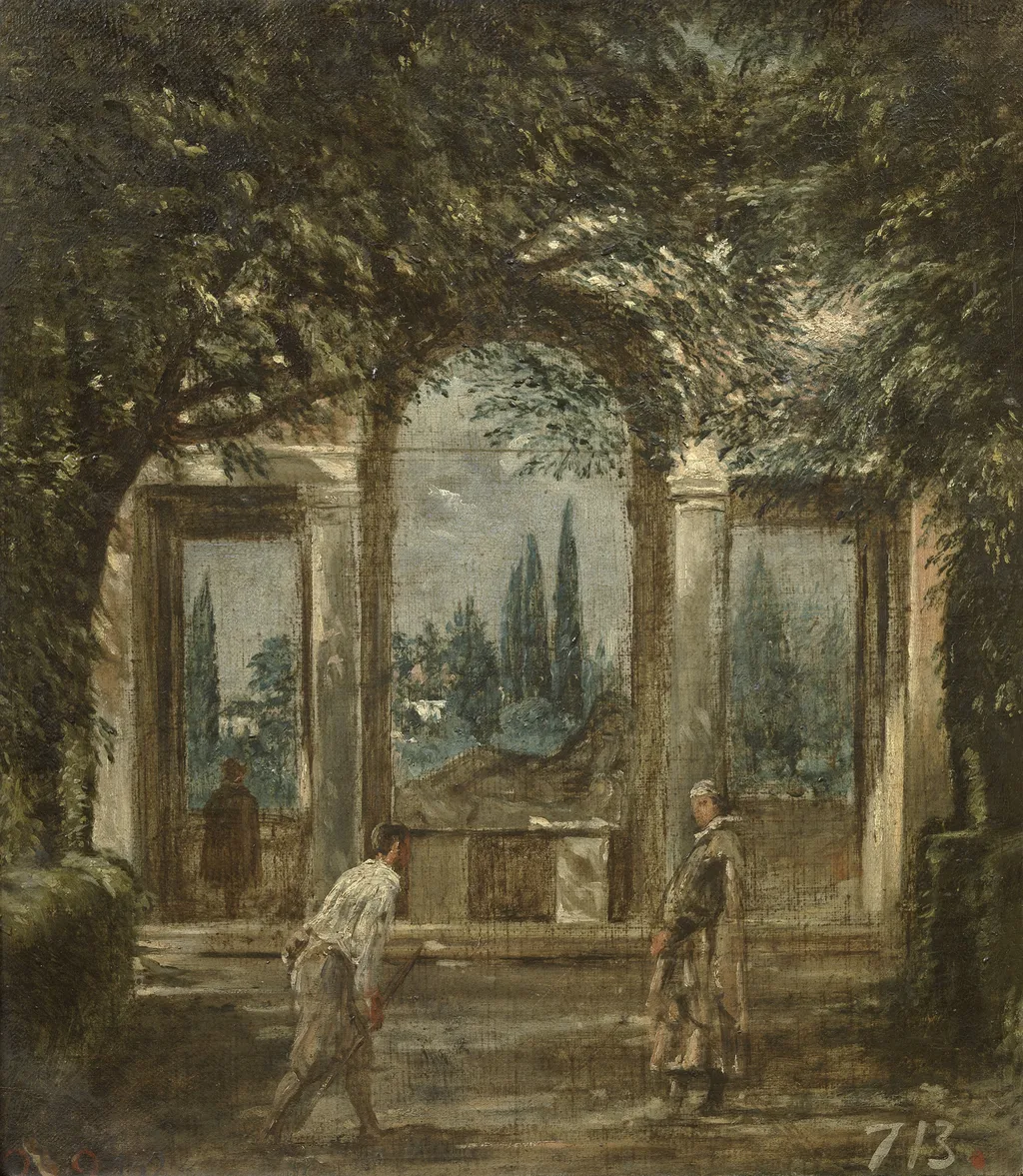
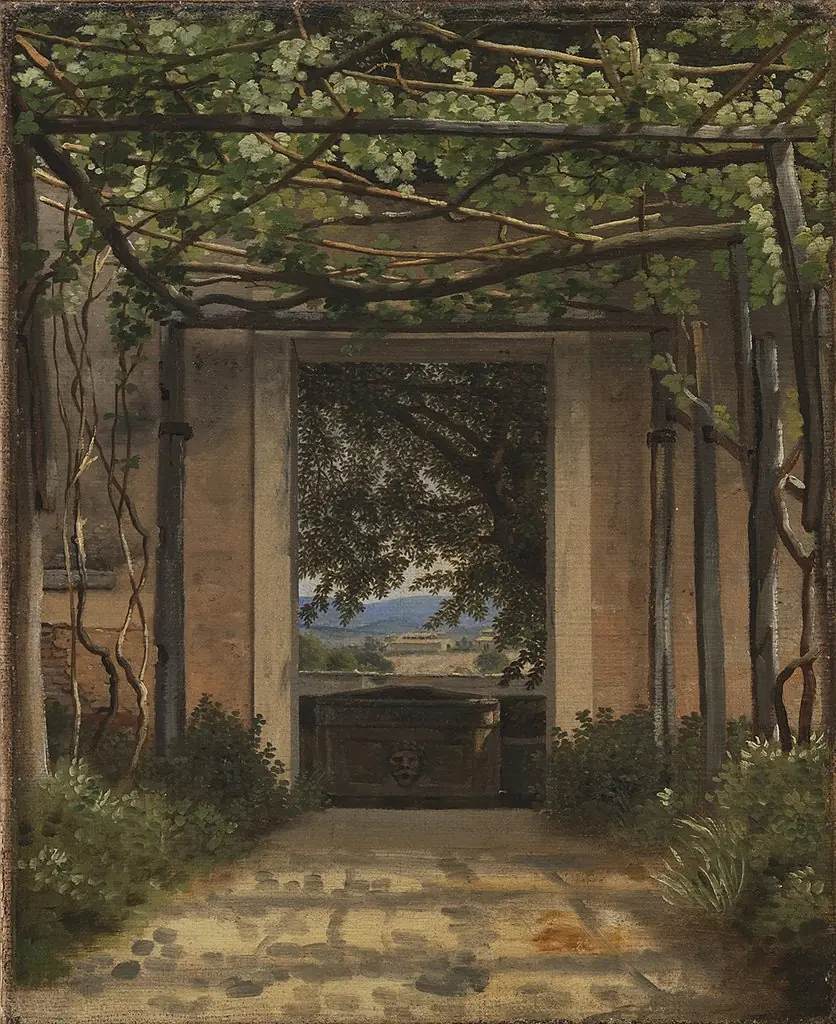
View of the Garden of the Villa Medici is an oil painting by the Early Baroque Italian artist Diego Velázquez. It dates from 1630 and is held in the collection of the Museo del Prado.
About this work
Subject & Meaning
The painting depicts a portion of the Villa Medici’s garden in Rome, centered on a serliana that frames a copy of the Hellenistic sculpture Ariadne Asleep.
The painting depicts a portion of the Villa Medici’s garden in Rome, centered on a serliana that frames a copy of the Hellenistic sculpture Ariadne Asleep. The loggia opens onto a sunlit landscape punctuated by cypresses, rendered in a midday glare that dissolves figures into vaporous silhouettes. Velázquez’s approach emphasizes immediacy: thin, rapid oil strokes executed outdoors convey the fleeting effects of light, a practice rare among contemporaries but prefiguring plein-air studies. The scene’s classical motif, Ariadne’s recumbent form, links it to Roman sculptural culture that Velázquez documented during his Italian sojourns.
Technique & Style
Executed in oil on canvas, the work measures 44 by 38 cm. Technical analysis by the Museo del Prado confirms the painting's ground preparation is identical to that of *The Sibyl*, supporting a creation date around 1630 rather than the artist's later Italian trip. Velázquez employed a radical approach for the era by painting directly outdoors, or *en plein air*, utilizing light, rapid brushstrokes to capture the scene's immediacy. This technique results in a luminous atmosphere where intense midday sunlight filters through dense foliage, rendering the figures as vapor-like silhouettes. The forms are so lightly sketched that the background remains visible through them, a handling style that distinguishes these small landscapes from the classical, figure-heavy compositions typical of his contemporaries.
History & Provenance
View of the Garden of the Villa Medici is an oil on canvas painting by Diego Velázquez created in 1630. It depicts the Garden of the Villa Medici in Rome, featuring the Pavilion of Ariadne and a representation of the sleeping Ariadne sculpture. The work was painted during Velázquez's first stay at the Villa Medici in the summer of 1630, when he was lodged there after arriving in Rome under the patronage of Cardinal Francesco Barberini. Contemporary biographers Francisco Pacheco and Antonio Palomino recorded that Velázquez produced several small landscape studies at this time, using oil paint directly from nature (plein air), a technique unusual for the period. Early scholars such as Carl Justi and Aureliano Beruete attributed the paintings to this initial Italian period, but 20th-century scholars including Von Loga and later Jonathan Brown questioned the dating, proposing a later execution between 1649 and 1651 based on perceived technical advancement. This hypothesis gained wide acceptance, though Enriqueta Harris and others noted that the loggia shown was not obstructed until later works. Enriqueta Harris further argued that Velázquez likely studied the landscapes of Claude Lorrain, whose nature drawings date from 1640 to 1645, influencing his approach. Ultimately, technical analysis by the Museo del Prado confirmed an execution date near 1630, citing similarities in canvas preparation with a known Sibyl painting from that period. The painting may have been one of four small landscapes purchased by King Philip IV through Jerónimo de Villanueva in 1634. It entered the royal collection at the Alcázar of Madrid in 1666, survived the 1734 fire that destroyed the palace, and was later housed in the Buen Retiro palace before being transferred to the Museo del Prado in 1819. The work measures 44 cm in height and 38 cm in width, and is currently held in the Museo del Prado, Madrid. The painting is held in the permanent collection of the Museo del Prado in Madrid. It entered the museum in 1819 as part of the royal collections. Its early provenance traces to the Spanish royal palace: inventoried in 1666 at the Alcázar of Madrid and again in 1734 after the Alcázar fire, when it was transferred to the Buen Retiro Palace. By 1789 it had been catalogued there under the name of Juan Bautista Martínez del Mazo before being reattributed to Velázquez.
Context
The two small Roman garden paintings by Velázquez, including View of the Garden of the Villa Medici, were long debated by early biographers and later scholars. Carl Justi and Aureliano Beruete initially dated them to the artist’s first Italian sojourn (1629-1631), viewing them as on‑site oil sketches. In 1913, Wolfgang von Loga proposed a later execution during Velázquez’s second Italian trip (1649-1651), citing advanced technique; this view gained wide acceptance until Prado technical studies confirmed a preparation identical to the contemporaneous Sibyl and aligned it with the documented first voyage. Modern consensus places the work circa 1630. These landscapes occupy a singular place in Velázquez’s oeuvre and in seventeenth‑century genre hierarchies. While French and Italian contemporaries like Claude Lorrain and Nicolas Poussin framed landscape within classical narratives, Velázquez’s panels isolate architecture and foliage, painted en plein air with rapid, light strokes that foreshadow later plein‑air practices. Their delicate, vaporous figures and sun‑dappled effects, executed directly in oil outdoors, drew later comparisons to Impressionism despite their mid‑seventeenth‑century origin.
Legacy
The painting's innovative technique, characterized by light brushstrokes and direct execution outdoors, established it as a precursor to later artistic movements. This approach of painting en plein air, rare for its time and previously limited to quick sketches by Dutch artists or Claude Lorrain, led critics to draw direct parallels between Velázquez's work and the Impressionists. The canvas was historically significant enough to be inventoried in the Royal Alcázar of Madrid by 1666 and survived the 1734 fire, eventually entering the Museo del Prado in 1819. While its companion piece was at times misattributed to Juan Bautista Martínez del Mazo, this view maintained its attribution to Velázquez throughout its residence in the Buen Retiro Palace, securing its status within the royal collections.
Own this work as a print
Artist & collection

Artist
Diego Rodríguez de Silva y Velázquez was a Spanish Baroque painter, the leading artist in the court of King Philip IV of Spain and Portugal, and of the Spanish Golden Age.