Artwork
Study for "Dance on the Battery in Presence of Peter Stuyvesant"
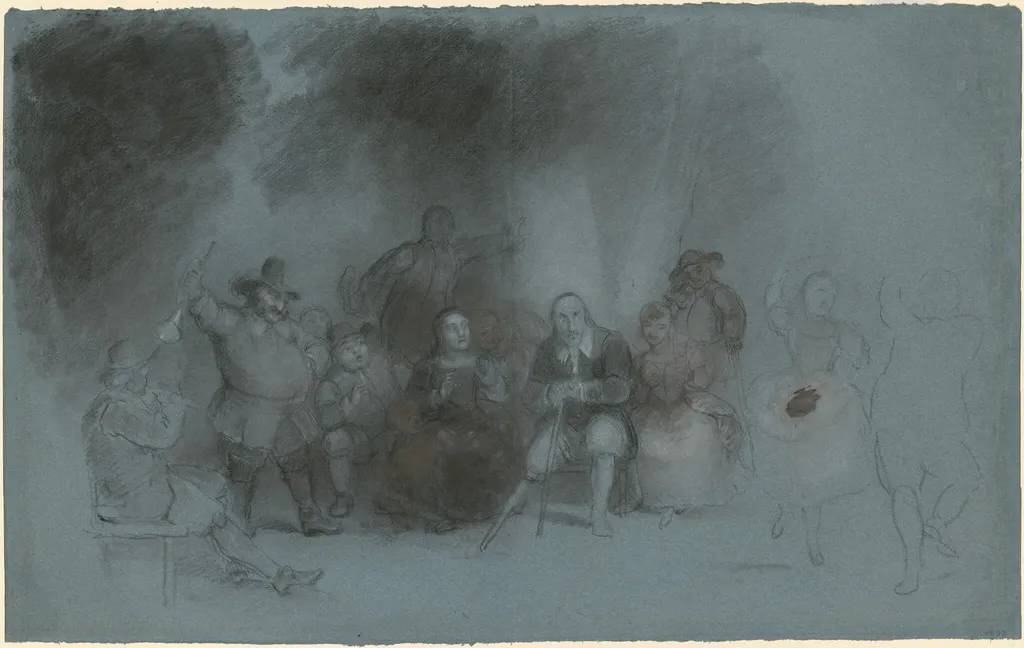
Study for "Dance on the Battery in Presence of Peter Stuyvesant" is a charcoal drawing by the Romanticist artist Asher Brown Durand. It dates from 1838 and is held in the collection of the National Gallery of Art.
About this work
Overview
The sketch serves as a study for a larger composition exploring early New York history and is part of the Corcoran Collection, gifted by Mary Bartlett Cowdrey.
Study for Dance on the Battery in Presence of Peter Stuyvesant is a preparatory drawing by Asher Brown Durand, created circa 1838. Executed in charcoal with brown and white chalk on blue-gray wove paper, the work measures 43.18 by 68.9 centimeters. The sketch serves as a study for a larger composition exploring early New York history and is part of the Corcoran Collection, gifted by Mary Bartlett Cowdrey. It entered the National Gallery of Art in Washington, D.C., in 2015, where it is held under accession number 2015.19.575.
Subject & Meaning
The drawing depicts a communal gathering set in seventeenth-century New Amsterdam, specifically a dance on the Battery in the presence of the colonial director-general Peter Stuyvesant. At the center of the composition, a seated man with a cane, presumably Stuyvesant, and a seated woman form the primary focal pair, flanked by standing and seated figures including children. To the left, a stout standing figure raises a bottle or glass, introducing a festive element. The work also specifically depicts the historical figure Anthony Van Corlaer. Figures on the right remain barely developed, with one showing a dark circular form at the torso, and a standing figure with a raised arm appears in the darkened background above the central group.
Technique & Style
Durand employed a restricted palette of black and white chalk or charcoal with brown wash on a blue-gray ground. The technique varies considerably across the sheet, indicating its preparatory nature. The central figures feature finished modeling and brown wash, while the figures at the edges remain in faint linear contours. Heavy dark shading occupies the upper left and center background, creating a cloudy, atmospheric effect. The uneven completion suggests the artist was working out the composition, focusing his attention on the central group while leaving peripheral elements unresolved. The paper edges appear rough and slightly torn.
History & Provenance
The drawing was created circa 1838. It passed through the collection of Mary Bartlett Cowdrey in New York before entering the Corcoran Gallery of Art in Washington, D.C., in 1948. In 2015, the National Gallery of Art acquired the work. It has been included in several exhibitions, beginning with a Durand retrospective at the Montclair Art Museum in New Jersey in 1971. Subsequent exhibitions include American Pastels from the Corcoran Collection at the Corcoran Gallery of Art in 1978, Early America on Paper at the same institution in 1981, and Asher B. Durand: An Engraver's and a Farmer's Art at the Hudson River Museum in Yonkers, New York, in 1983.
Context
Asher Brown Durand was a prominent figure in nineteenth-century American art, and this drawing relates to his broader engagement with historical and landscape subjects. The work has received scholarly attention, notably from Linda Crocker Simmons, who cataloged it in the 1983 publication American Drawings, Watercolors, Pastels, and Collages in the Collection of the Corcoran Gallery of Art. It was also discussed in the context of Durand's wider career by David B. Lawall in his 1971 exhibition catalog and 1977 monograph, and later by Franklin Kelly and others in the 1996 National Gallery of Art systematic catalogue of American paintings.
Legacy
As a preparatory study, the drawing provides insight into Durand's compositional process and his approach to historical genre scenes. Its inclusion in major exhibitions, such as the 1971 Montclair retrospective and the 1983 Hudson River Museum exhibition, has allowed scholars to trace the development of the larger painting. The transfer of the work from the Corcoran Gallery of Art to the National Gallery of Art in 2015 has secured its preservation and public accessibility, ensuring its continued role in the study of American art on paper.
Own this work as a print
Artist & collection
Artist
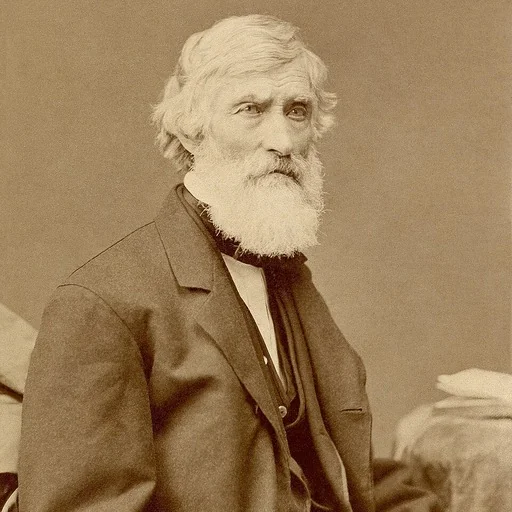
Asher Brown Durand spent his life in the rolling hills of New Jersey, where the forests and farmland shaped his quiet, deliberate way of seeing.

 The Scene with the Tall Baguenodière
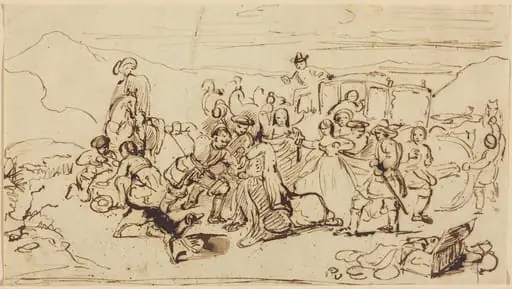 The Murder of Archbishop Sharpe
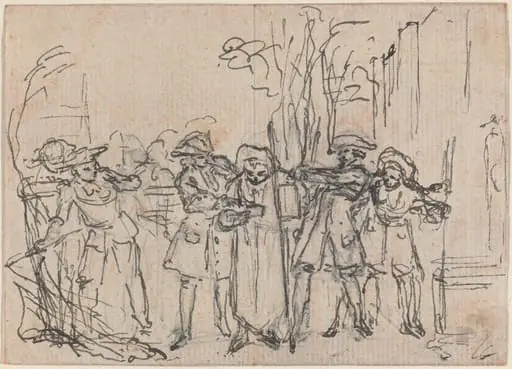 Hob Surprised by Sir Thomas with Mr. Friendly's Letter
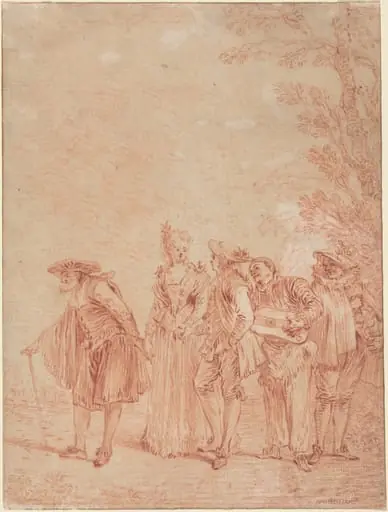 The Wedding Procession
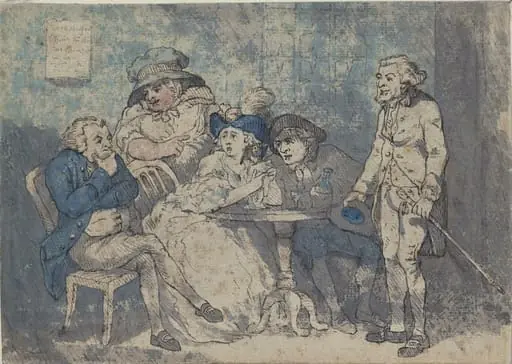 The Guilty Couple
 The Enraged Musician
 Ballet at the Opera
 The Peasant Dance
 Costumed Dancers Performing in a Garden Tavern
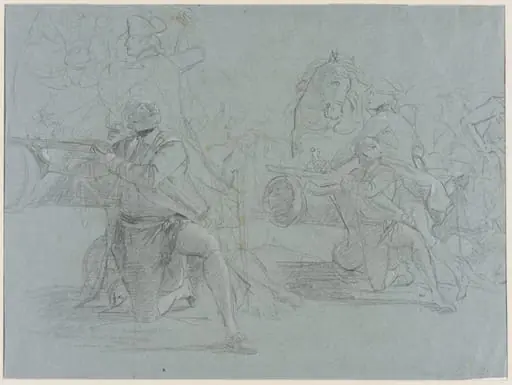 Study for 'The Siege of Gibraltar'
- Study for "The Rustic Dancers"
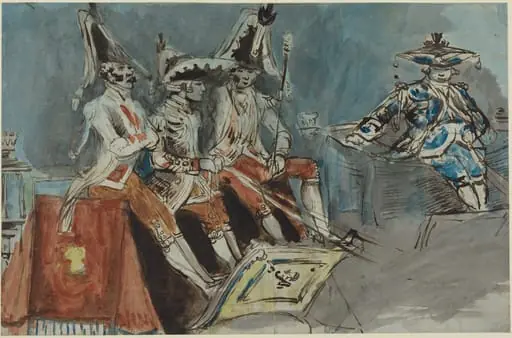 Coachmen