Artwork
The Annunciation
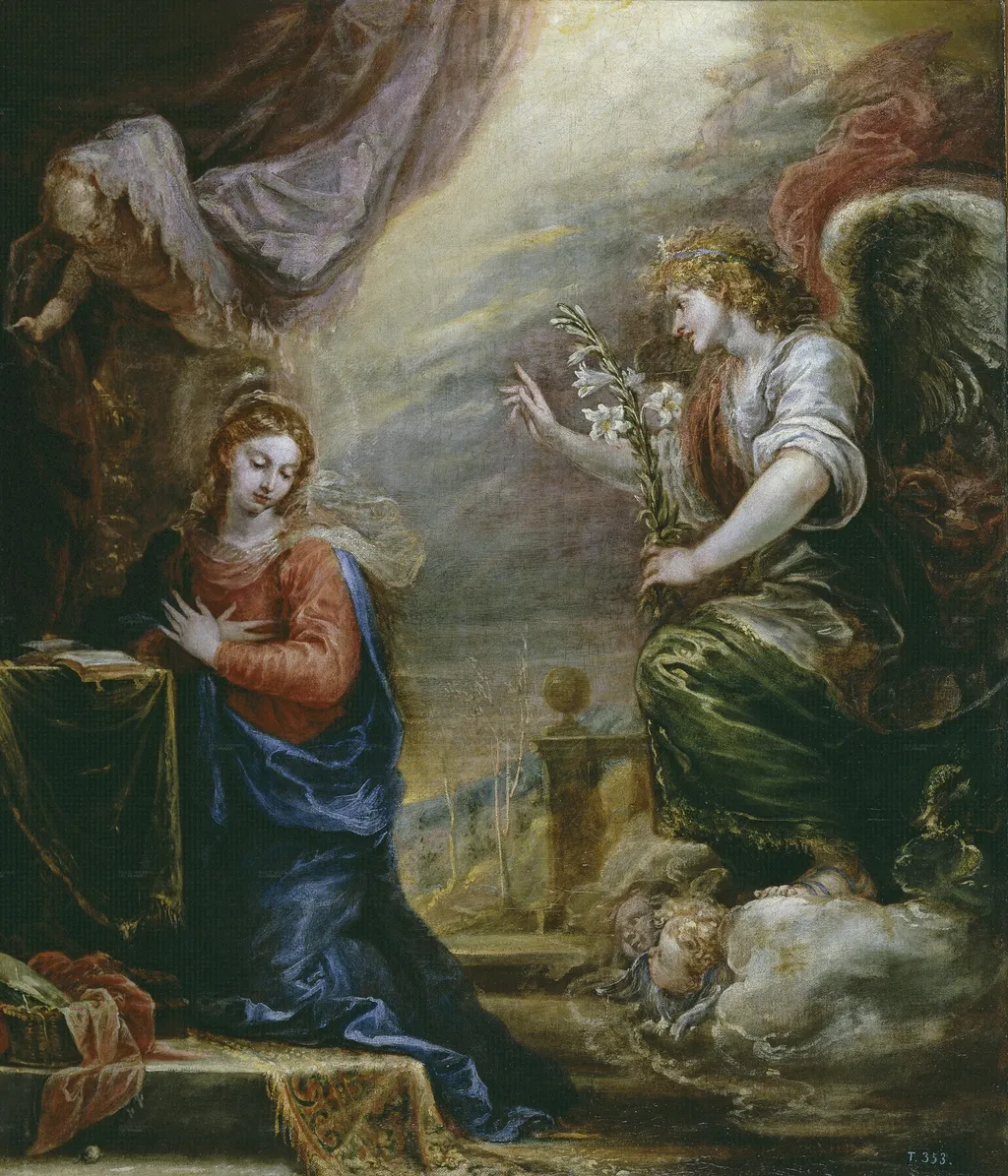
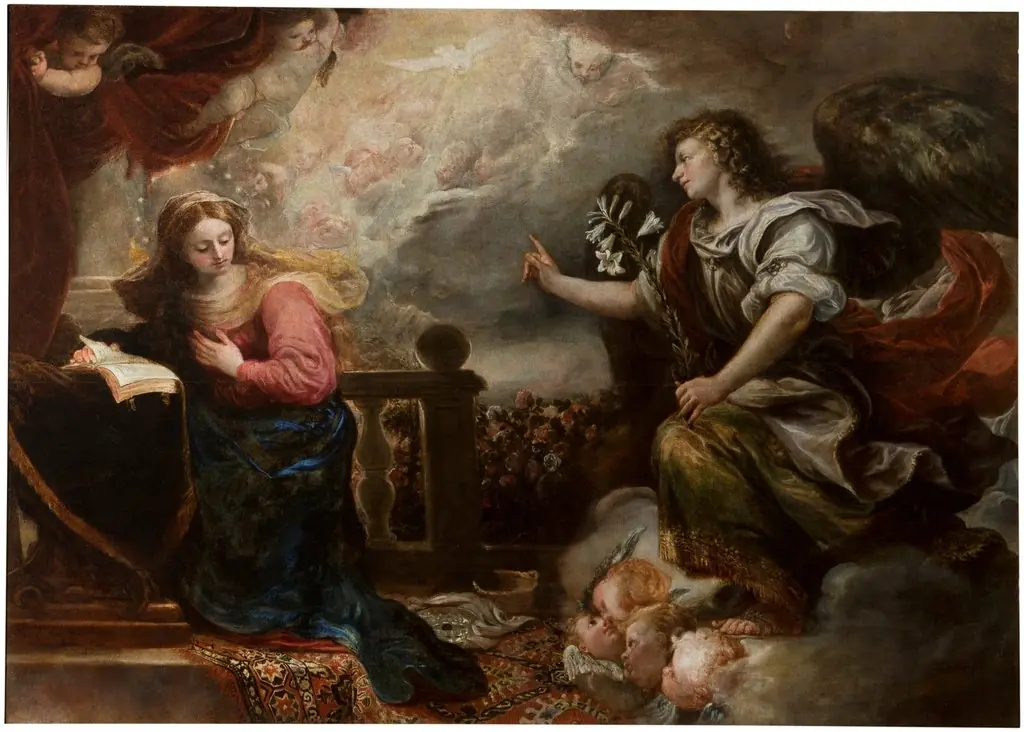
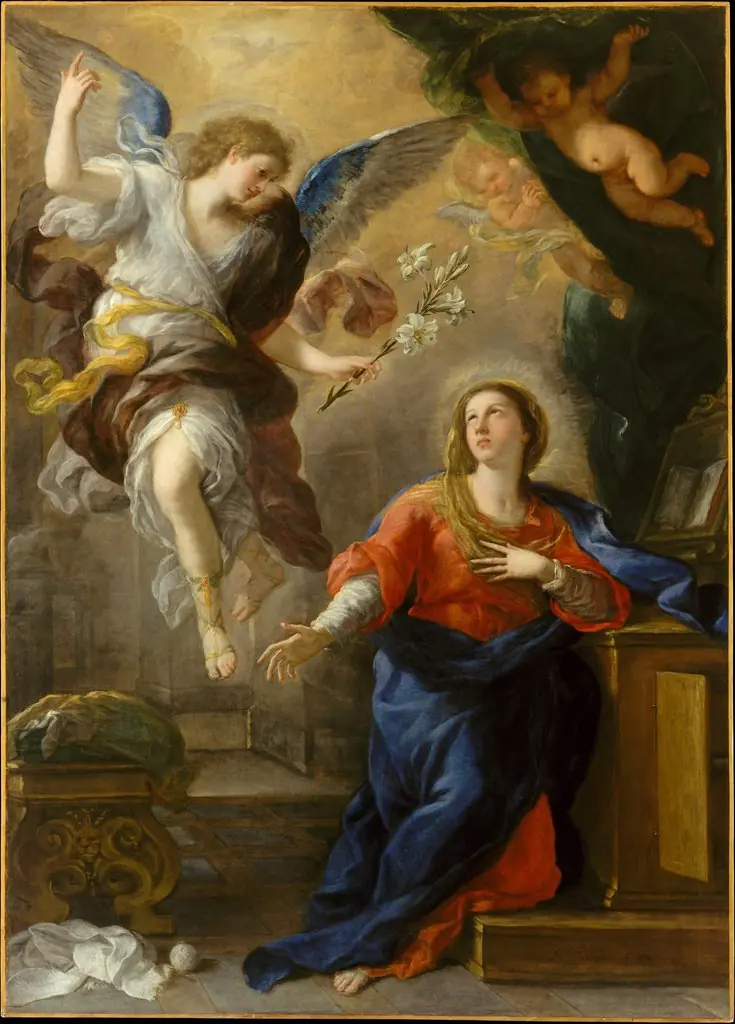
The Annunciation is an oil painting by the Early Baroque Italian artist Francisco Rizi. It dates from 1663 and is held in the collection of the Museo del Prado.
About this work
Subject & Meaning
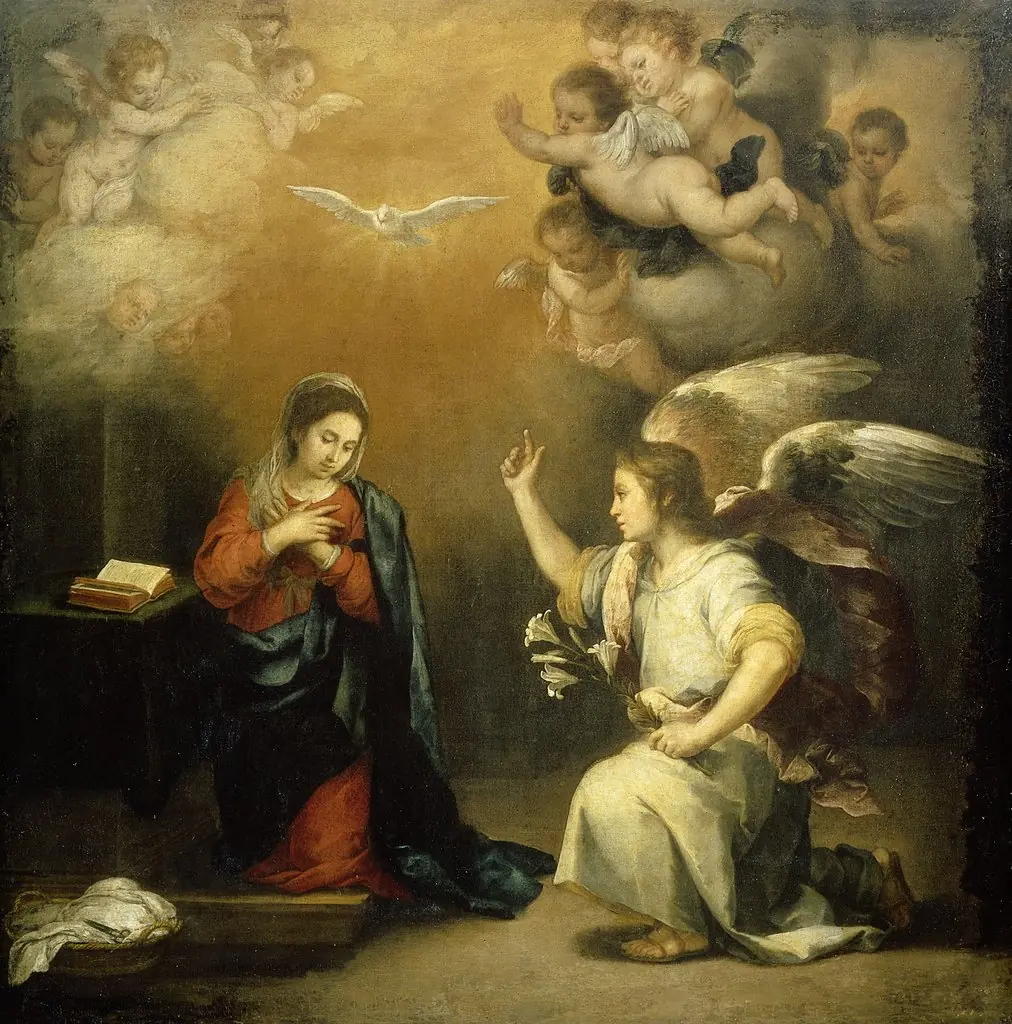
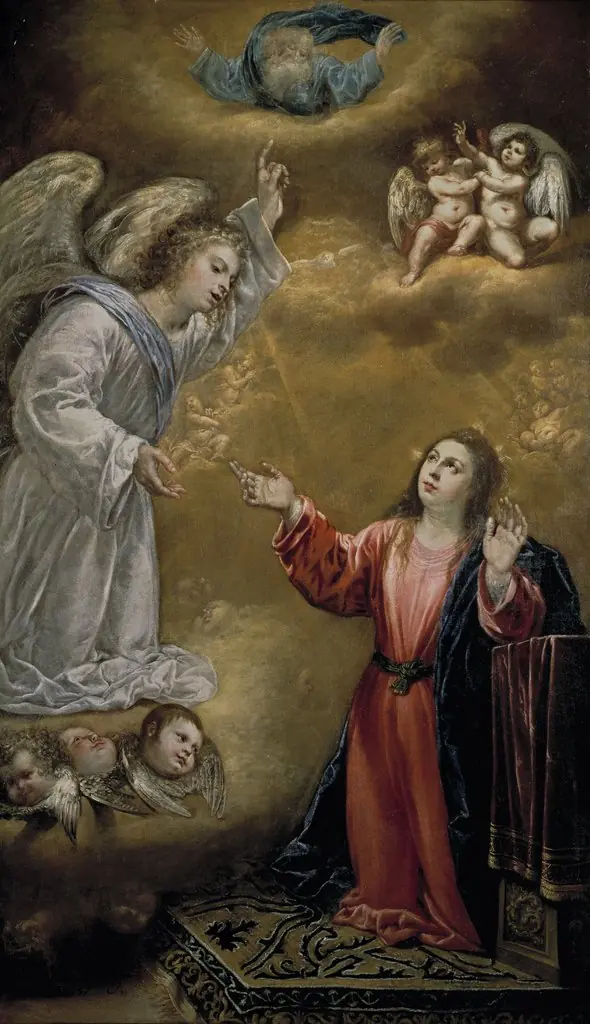
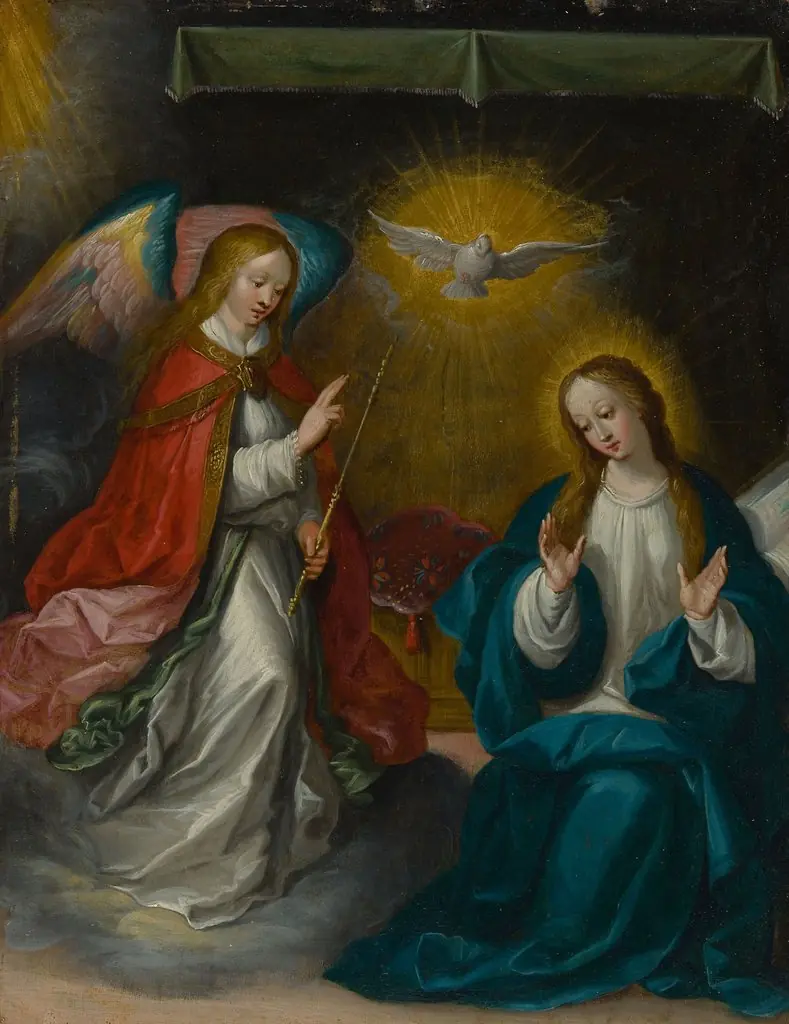
The painting depicts the Annunciation, the biblical moment when the Archangel Gabriel announces to the Virgin Mary that she will conceive the Son of God.
The painting depicts the Annunciation, the biblical moment when the Archangel Gabriel announces to the Virgin Mary that she will conceive the Son of God. Rizi emphasizes the interaction between the angel and Mary rather than a realistic setting, creating an unreal, luminous space where the event unfolds. A putto in the upper left draws back a curtain, inviting the viewer to witness the scene as if arriving at the instant of surprised spontaneity.
Storm clouds add dramatic tension to the Baroque dynamism of the figures, which reflects the influence of Rubens, Tintoretto, and Venetian painting. The composition combines delicacy and movement, with refined, vibrant color and sparkling light, making the action itself the true protagonist.
Technique & Style
The Annunciation by Francisco Rizi is an oil painting on canvas, measuring 112 × 96 cm. Because the canvas was originally set into the attic of an altarpiece, its upper edge still terminates in a flattened arch shape that remains visible on the surface.
The work exemplifies Rizi's mature style, defined by rapid, free brushwork that leaves forms somewhat undefined, a handling likened by the art historian Jonathan Brown to painting as though executing large oil sketches. Loose, discarded strokes and agile marks are paired with a rich, vibrant palette and dynamic compositions built on pronounced diagonals influenced by Rubens, occasionally tempered by symmetry recalling the teachings of his master Vicente Carducho. Rizi's admiration for sixteenth-century Venetian painting, especially Tintoretto, is also evident.
The Annunciation's color is refined and luminous, and its composition prioritizes the encounter between angel and Virgin over a realistic interior. Storm clouds heighten the Baroque dramatic impulse, while the angel in the upper left draws back a curtain to frame the scene.
History & Provenance
The painting was created in 1663 as an oil on canvas work. It was originally located in the attic of the retablo of the Nativity within the chapel of Don Jerónimo de la Torre at the Convento de Nuestra Señora de los Ángeles in Madrid, where it formed part of a larger altarpiece that included a Nativity and other works by Rizi. Following the 19th‑century desamortización de bienes eclesiásticos, the piece entered the Museo de la Trinidad in 1835 and was transferred to the Museo del Prado in 1872.
The work is attributed to Francisco Rizi and is documented in the Museo del Prado collection, where it remains on display.
The painting is held in the Museo del Prado, Madrid, with accession number P004271.
It entered the Prado’s holdings via the Museo de la Trinidad in 1872, having been transferred from the latter institution after its earlier inclusion in 1835. Before that, it was part of the altarpiece in the chapel of Jerónimo de la Torre at the Convento de Nuestra Señora de los Ángeles, Madrid, where it occupied the upper section of the Nativity altarpiece until the early nineteenth century.
Context
Art historians regard this painting as a masterpiece of Francisco Rizi's mature style, with the Museo del Prado describing it as a testament to the artist's magnificent abilities. Scholars note that the work exemplifies Rizi's advanced technique, characterized by rapid, loose brushwork that creates an indefinable quality akin to large oil sketches. This approach, combined with vibrant color and dynamic diagonal compositions, reveals significant influences from Peter Paul Rubens and sixteenth-century Venetian painting, particularly Tintoretto.
While retaining some symmetry reminiscent of his teacher Vicente Carducho, Rizi prioritizes dramatic action over realistic spatial description. The composition uses storm clouds and a curtain pulled back by an angel to create an unreal, marvelous setting that heightens the spontaneity of the scene. Critic Javier Portús argues that the piece demonstrates the exquisite height reached by Baroque painting in Madrid, successfully balancing dignity, delicacy, and monumental scale.
Overview
Francisco Rizi’s 1663 oil on canvas, titled The Annunciation, is part of the collection at Madrid’s Museo del Prado. The work presents the biblical moment when the angel announces to Mary that she will bear the Son of God, rendered in a compact interior that balances darkness with a gentle illumination from the upper left.
Own this work as a print
Artist & collection